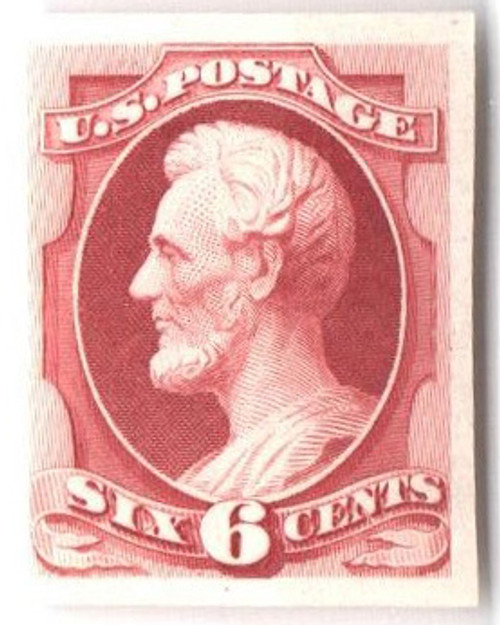
Scarce 12¢ Clay Specimen Stamp Can Be Yours
Specimen stamps are an often-overlooked area of philately. They were produced and distributed primarily to serve as samples for local and foreign postal authorities. Having reference collections allowed clerks to distinguish valid postage from counterfeits, which encouraged the exchange of international mail by discouraging fraud.
Specimen stamps were created by adding overprints to regular stamps to render them invalid for postage. The black overprint measures 12 mm long. These stamps were produced in very limited quantities.
The stamp you'll receive when you order today will be in unused condition with small flaws which are a reminder of this stamp’s history and age.
U.S. #155
The earliest-known use of the 1870-71 90¢ Carmine Perry was September 1, 1872. Approximately 160,150 of the stamps were printed by the National Bank Note Company on a flat plate press and perforated 12.
This stamp is part of the Bank Note Series
March 1, 1870, is the earliest known use of one of the Bank Note stamps, a long-running set of stamps produced by three different bank note companies.
Less than a year earlier, in March 1869, the Post Office introduced the Pictorial Series. For the first time in US postal history, our stamps pictured something other than the portraits of national leaders.
Among the topics on the Pictorials were a train, a post rider, a ship, Christopher Columbus, and an eagle and shield. While these stamps are popular and sought after today, the people of the time thought the stamp designs were frivolous, and the stamps themselves were very unpopular. Within a year, the stamps were removed from sale.
The postmaster general then needed to develop new stamps to replace the Pictorials. Among the public’s many complaints were that the stamps were too small, unattractive, and of inferior quality. Thus, the new issues were not only larger and better quality, but they also carried new designs. Heads, in profile, of famous deceased Americans were chosen as the new subject matter.
Because the pictorials were to be printed for four years but were withdrawn from sale after less than a year, the National Bank Note Company still had three years remaining in their contract. They would be the first of the three Bank Note Companies to produce this new era of stamps. All of the stamps they produced were supposed to have grills, but only about five to ten percent had them.
The first known use of one of these new stamps, US #147, came on March 1, 1870. Several stamps of other denominations throughout March and April soon followed it.
This marked the start of the “Bank Note” Series, so named because it was printed by three prominent Bank Note printing companies – the National, Continental, and American Bank Note Companies, in that order. As the contract for printing passed from company to company, so did the dies and plates. Each company printed the stamps with slight variations and identifying them can be both challenging and complex.
The Bank Note era officially came to an end on June 9, 1894, after the Post Office reached an agreement with the Bureau of Engraving and Printing to start producing new US stamps.
Scarce 12¢ Clay Specimen Stamp Can Be Yours
Specimen stamps are an often-overlooked area of philately. They were produced and distributed primarily to serve as samples for local and foreign postal authorities. Having reference collections allowed clerks to distinguish valid postage from counterfeits, which encouraged the exchange of international mail by discouraging fraud.
Specimen stamps were created by adding overprints to regular stamps to render them invalid for postage. The black overprint measures 12 mm long. These stamps were produced in very limited quantities.
The stamp you'll receive when you order today will be in unused condition with small flaws which are a reminder of this stamp’s history and age.
U.S. #155
The earliest-known use of the 1870-71 90¢ Carmine Perry was September 1, 1872. Approximately 160,150 of the stamps were printed by the National Bank Note Company on a flat plate press and perforated 12.
This stamp is part of the Bank Note Series
March 1, 1870, is the earliest known use of one of the Bank Note stamps, a long-running set of stamps produced by three different bank note companies.
Less than a year earlier, in March 1869, the Post Office introduced the Pictorial Series. For the first time in US postal history, our stamps pictured something other than the portraits of national leaders.
Among the topics on the Pictorials were a train, a post rider, a ship, Christopher Columbus, and an eagle and shield. While these stamps are popular and sought after today, the people of the time thought the stamp designs were frivolous, and the stamps themselves were very unpopular. Within a year, the stamps were removed from sale.
The postmaster general then needed to develop new stamps to replace the Pictorials. Among the public’s many complaints were that the stamps were too small, unattractive, and of inferior quality. Thus, the new issues were not only larger and better quality, but they also carried new designs. Heads, in profile, of famous deceased Americans were chosen as the new subject matter.
Because the pictorials were to be printed for four years but were withdrawn from sale after less than a year, the National Bank Note Company still had three years remaining in their contract. They would be the first of the three Bank Note Companies to produce this new era of stamps. All of the stamps they produced were supposed to have grills, but only about five to ten percent had them.
The first known use of one of these new stamps, US #147, came on March 1, 1870. Several stamps of other denominations throughout March and April soon followed it.
This marked the start of the “Bank Note” Series, so named because it was printed by three prominent Bank Note printing companies – the National, Continental, and American Bank Note Companies, in that order. As the contract for printing passed from company to company, so did the dies and plates. Each company printed the stamps with slight variations and identifying them can be both challenging and complex.
The Bank Note era officially came to an end on June 9, 1894, after the Post Office reached an agreement with the Bureau of Engraving and Printing to start producing new US stamps.