

New
Zoom the image with the mouse
#1-2 offer
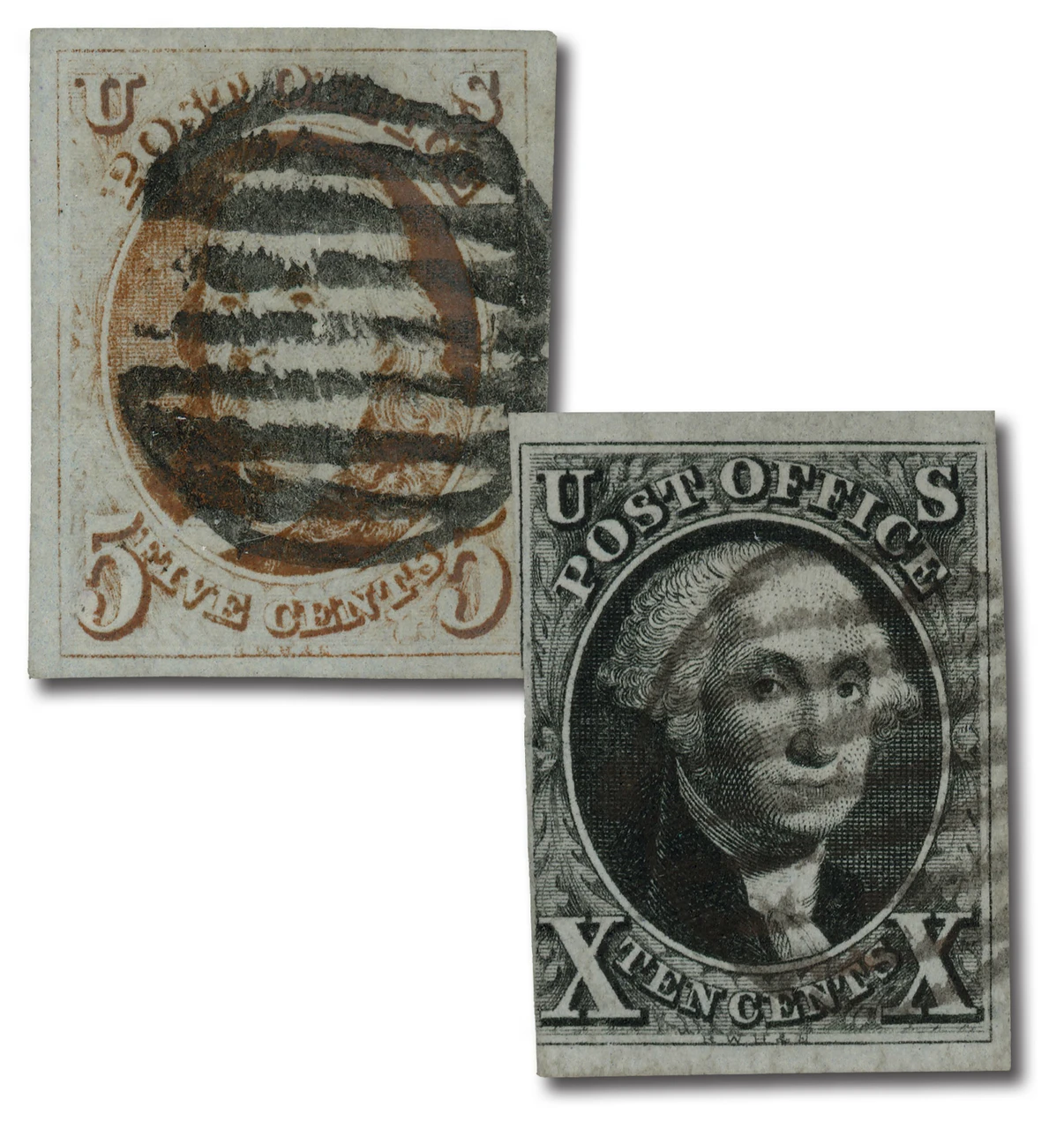
1847 5c Franklin & 10c Washington, First Two Stamps of the United States
$2,650.00 - $5,900.00
Share:
Own Two Key Pieces of Philatelic and American History
America's first postage stamps went on sale July 1, 1847. US #1 paid the half-ounce postage rate for any letter traveling 300 miles or less (5¢). US #2 paid the same rate but for letters traveling over 300 miles (10¢).
These stamps helped revolutionize our mail system, so it's only fitting they picture two of America's greatest Founding Fathers – Benjamin Franklin and George Washington. Franklin, the nation's first Postmaster General, was the natural choice to anchor the new system he helped build. Washington's portrait, based on Gilbert Stuart's unfinished study, would go on to appear on more U.S. stamps than any other president.
Both stamps were hand-printed on a flat-bed "Spider" press, one sheet at a time, using dies originally cut for private banknotes. Because they were issued imperforate and cut apart by hand at the post office, centering varies widely from stamp to stamp — which is exactly why Very Fine examples like this set command a premium. Large, balanced margins on #1 and #2 are increasingly hard to find in any grade.
Nearly 180 years have passed since America’s first stamps left the printing plate. Somewhere along the way, US#1 & #2 traveled the country on real letters — news of a birth, a business deal, a homestead out west. It's worth pausing to imagine what messages they carried, and who was waiting on the other end to read them.
These stamps have survived the ravages of time because someone, somewhere, chose to preserve them rather than let them disappear. Adding this set to your collection continues that legacy — keeping a piece of America's postal history intact.
Did You Know?
In 1796, Martha Washington commissioned Gilbert Stuart to paint matching portraits of her and the president for Mount Vernon. Stuart preferred the president's likeness to his earlier one and left both unfinished, using it as a template for over 75 paid replicas — despite Martha's repeated requests, neither portrait ever reached Mount Vernon. He kept them until his death, after which they were sold to the Boston Athenaeum, giving them their name: the Athenaeum portraits.
Own Two Key Pieces of Philatelic and American History
America's first postage stamps went on sale July 1, 1847. US #1 paid the half-ounce postage rate for any letter traveling 300 miles or less (5¢). US #2 paid the same rate but for letters traveling over 300 miles (10¢).
These stamps helped revolutionize our mail system, so it's only fitting they picture two of America's greatest Founding Fathers – Benjamin Franklin and George Washington. Franklin, the nation's first Postmaster General, was the natural choice to anchor the new system he helped build. Washington's portrait, based on Gilbert Stuart's unfinished study, would go on to appear on more U.S. stamps than any other president.
Both stamps were hand-printed on a flat-bed "Spider" press, one sheet at a time, using dies originally cut for private banknotes. Because they were issued imperforate and cut apart by hand at the post office, centering varies widely from stamp to stamp — which is exactly why Very Fine examples like this set command a premium. Large, balanced margins on #1 and #2 are increasingly hard to find in any grade.
Nearly 180 years have passed since America’s first stamps left the printing plate. Somewhere along the way, US#1 & #2 traveled the country on real letters — news of a birth, a business deal, a homestead out west. It's worth pausing to imagine what messages they carried, and who was waiting on the other end to read them.
These stamps have survived the ravages of time because someone, somewhere, chose to preserve them rather than let them disappear. Adding this set to your collection continues that legacy — keeping a piece of America's postal history intact.
Did You Know?
In 1796, Martha Washington commissioned Gilbert Stuart to paint matching portraits of her and the president for Mount Vernon. Stuart preferred the president's likeness to his earlier one and left both unfinished, using it as a template for over 75 paid replicas — despite Martha's repeated requests, neither portrait ever reached Mount Vernon. He kept them until his death, after which they were sold to the Boston Athenaeum, giving them their name: the Athenaeum portraits.
Related Items


Most Orders Ship
within 1 Business Day
90 Day Return Policy
Satisfaction Guaranteed
Earn Reward Points
for FREE Stamps & More