

Zoom the image with the mouse
#1083
1956 3c Nassau Hall
$0.45
Share:
U.S. #1083
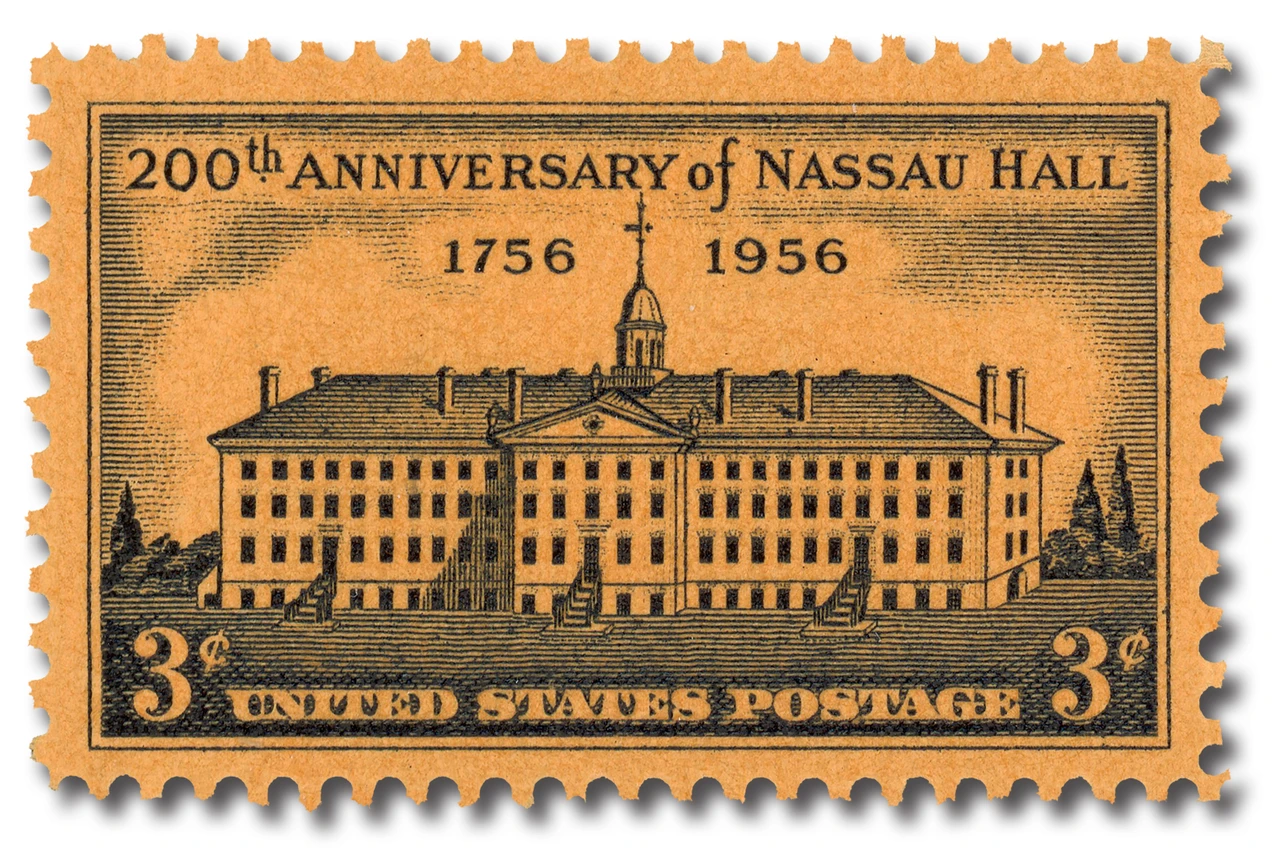
1956 3¢ Nassau Hall, Princeton University
Issue Date: September 22, 1956
City: Princeton, New Jersey
Quantity: 122,100,000
Printed by: Bureau of Engraving and Printing
Printing Method: Rotary Press
Perforations: 11 x 10 ½
Color: Black, orange
Princeton University's Nassau Hall turned 200 years old in 1956, and the Post Office marked the occasion with the first commemorative stamp ever printed on colored paper, using Princeton's own school colors for the design. When workers finished building Nassau Hall in 1756, it was the largest building in colonial New Jersey and the largest academic building anywhere in the American colonies. It served as the school's main building for classes, dining, and dormitory space all at once, since it was essentially the entire campus in its early years.
Nassau Hall played a role in the nation's founding beyond its work as a college building. During the Revolutionary War, both American and British troops occupied it at different points, including a 1777 battle that helped drive British forces from Princeton. Then in 1783, the building briefly became the seat of the United States government. The Continental Congress met there for four months after fleeing a mutiny by unpaid soldiers in Philadelphia, and it was inside Nassau Hall that Congress received word of the peace treaty ending the Revolutionary War.
U.S. #1083
1956 3¢ Nassau Hall, Princeton University
Issue Date: September 22, 1956
City: Princeton, New Jersey
Quantity: 122,100,000
Printed by: Bureau of Engraving and Printing
Printing Method: Rotary Press
Perforations: 11 x 10 ½
Color: Black, orange
Princeton University's Nassau Hall turned 200 years old in 1956, and the Post Office marked the occasion with the first commemorative stamp ever printed on colored paper, using Princeton's own school colors for the design. When workers finished building Nassau Hall in 1756, it was the largest building in colonial New Jersey and the largest academic building anywhere in the American colonies. It served as the school's main building for classes, dining, and dormitory space all at once, since it was essentially the entire campus in its early years.
Nassau Hall played a role in the nation's founding beyond its work as a college building. During the Revolutionary War, both American and British troops occupied it at different points, including a 1777 battle that helped drive British forces from Princeton. Then in 1783, the building briefly became the seat of the United States government. The Continental Congress met there for four months after fleeing a mutiny by unpaid soldiers in Philadelphia, and it was inside Nassau Hall that Congress received word of the peace treaty ending the Revolutionary War.
Related Items


Most Orders Ship
within 1 Business Day
90 Day Return Policy
Satisfaction Guaranteed
Earn Reward Points
for FREE Stamps & More