
Save Up To 5%

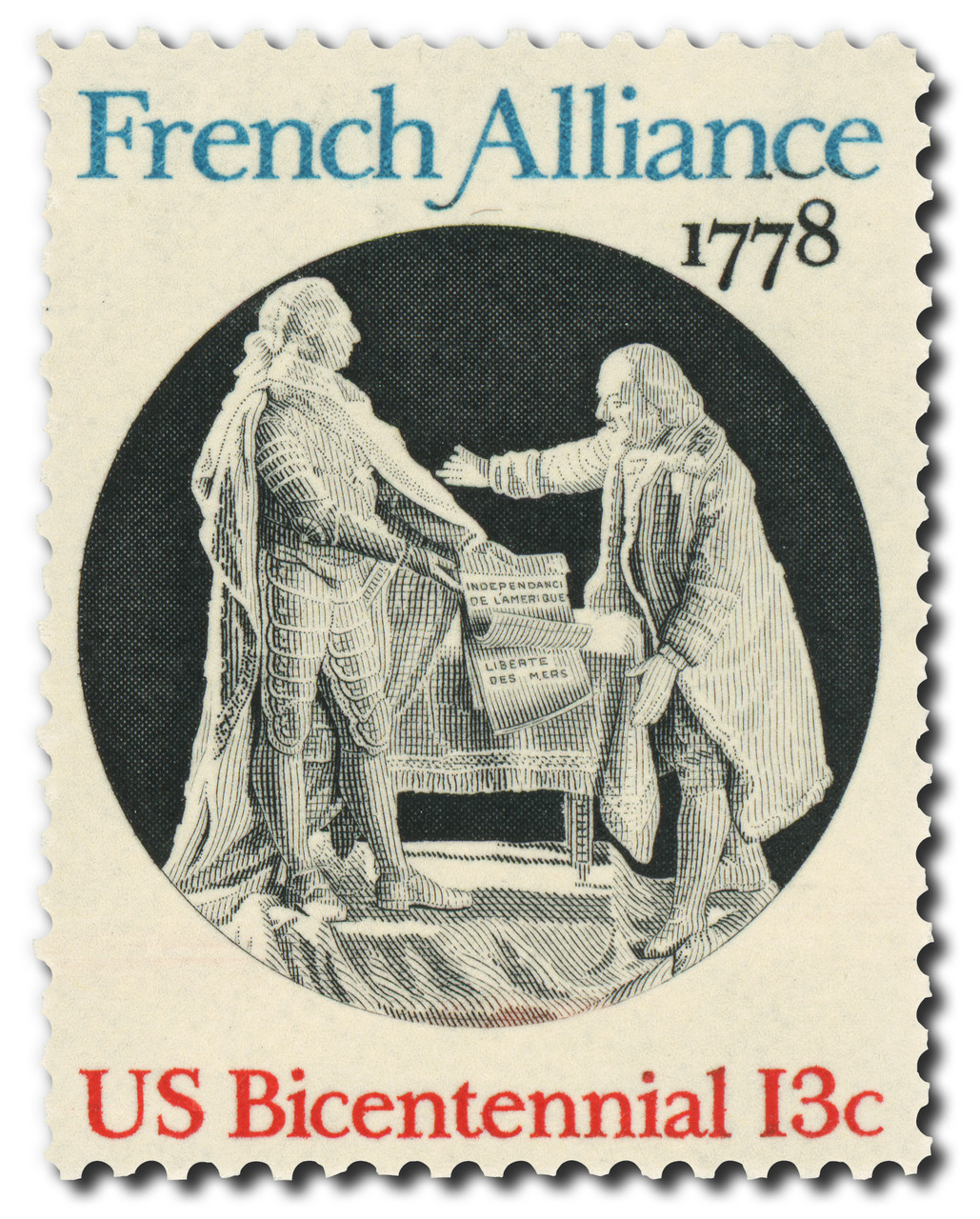
U.S. #1753
1978 13¢ French Alliance
Bicentennial Series
Issue Date: May 4, 1978
City: York, PA
Quantity: 102,856,000
Printed By: Bureau of Engraving and Printing
Printing Method: Giori press
Perforations: 11
Color: Blue, black and red
Issued on May 4, 1978, this 13-cent stamp marks the 200th anniversary of the Continental Congress's ratification of the Treaty of Alliance with France — one of the most consequential diplomatic agreements in American history. The first day city was York, Pennsylvania, where the Continental Congress was meeting when the treaty arrived by courier on May 2, 1778. The messenger was Simeon Deane, brother of American diplomat Silas Deane, who had helped negotiate the treaty in Paris. The stamp's design reproduces a sculptural figure group depicting King Louis XVI handing the signed treaty to Benjamin Franklin.
The treaty itself had been signed in Paris on February 6, 1778, at the Hotel de Crillon, where Franklin and fellow commissioners Arthur Lee and Silas Deane signed on behalf of the United States. France became the first nation to formally recognize American independence, and the agreement bound both countries to mutual military defense and prohibited either from signing a separate peace with Britain. The key moment that finally brought France to the table was the American victory at the Battle of Saratoga in October 1777, which proved to the French court that the colonists could win. Once Spain saw France commit, it entered the war as well through the Treaty of Aranjuez in 1779, further stretching British military resources.
U.S. #1753
1978 13¢ French Alliance
Bicentennial Series
Issue Date: May 4, 1978
City: York, PA
Quantity: 102,856,000
Printed By: Bureau of Engraving and Printing
Printing Method: Giori press
Perforations: 11
Color: Blue, black and red
Issued on May 4, 1978, this 13-cent stamp marks the 200th anniversary of the Continental Congress's ratification of the Treaty of Alliance with France — one of the most consequential diplomatic agreements in American history. The first day city was York, Pennsylvania, where the Continental Congress was meeting when the treaty arrived by courier on May 2, 1778. The messenger was Simeon Deane, brother of American diplomat Silas Deane, who had helped negotiate the treaty in Paris. The stamp's design reproduces a sculptural figure group depicting King Louis XVI handing the signed treaty to Benjamin Franklin.
The treaty itself had been signed in Paris on February 6, 1778, at the Hotel de Crillon, where Franklin and fellow commissioners Arthur Lee and Silas Deane signed on behalf of the United States. France became the first nation to formally recognize American independence, and the agreement bound both countries to mutual military defense and prohibited either from signing a separate peace with Britain. The key moment that finally brought France to the table was the American victory at the Battle of Saratoga in October 1777, which proved to the French court that the colonists could win. Once Spain saw France commit, it entered the war as well through the Treaty of Aranjuez in 1779, further stretching British military resources.


