

Zoom the image with the mouse
#20LUX3
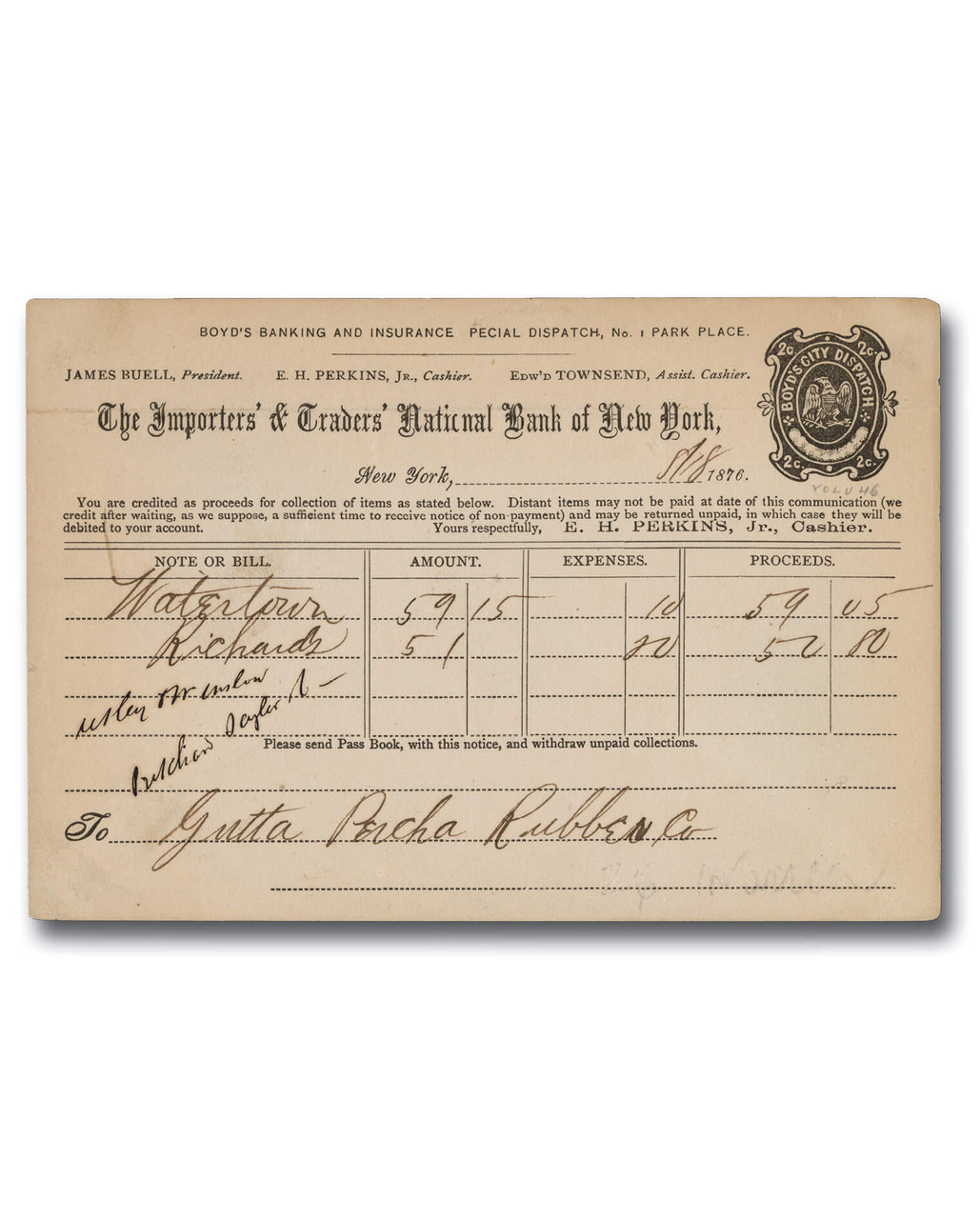
1876 2c Boyd's City Dispatch Bank Notice, Black, Complete Year Date
$305.00
Share:
Set Your Collection Apart with this 1876 Bank Notice
This piece of history belongs in your collection. The Importers’ & Traders’ National Bank of New York bank notice features a Boyd’s Dispatch stamp. Boyd’s was a private mail delivery service but expanded to delivering bank notices when its mail service decreased.
Boyd’s City Express Post
On June 17, 1844, Boyd’s City Express Post, one of the first local posts in the US, opened in New York City.
John T. Boyd created the post, and the initial office was located at 45 William Street, next to Wall Street, in downtown Manhattan. When he first opened, Boyd offered two deliveries every day – one at 9 am and one at 3 pm, for 2¢ up to 26th street, 3¢ to Brooklyn, or for free if sending a letter to a newspaper.
Boyd delivered mail for independent mail companies such as the American Letter Mail Company and Well’s Letter Express, among others. When he first opened, he advertised that he had 20 collecting stations (most likely mailboxes) for mailers to drop off their letters. During that first year, Boyd delivered mail from out of town. But in 1845, an act of Congress prohibited the delivery of mail between cities unless carried out by postal workers or contractors. In spite of this, Boyd continued to deliver the mail within the city.
By 1846, other posts had opened in the city and the government’s City Dispatch was losing business and ended up closing. Three years later, the government made another attempt to offer city delivery and created 25 letter deposit stations with four collections and deliveries every day. In response, Boyd claimed he had more than 1,000 collections boxes, with one on almost every block below 50th Street.
Also in 1849, Boyd took a major step forward by creating die-cut stamps. Though they cost a little bit more than the regular stamps, they were popular with businesses because the stamps were quicker and easier to separate.
As Boyd’s business grew, the government attempted to take control of local delivery again in 1851 with the passage of a new law that declared New York City streets to be postal routes. Boyd refused to back down and continued to operate his business.
After Boyd died in 1859, his 17-year-old son took over the business. A new postmaster general took office the same year and set out to close down private posts. He created new locked mailboxes and suggested Congress get rid of the drop letter rate for people that used their post office. Boyd’s son then reduced his rate to 1¢ for all classes of mail.
However, the following year, Boyd’s son decided to sell the business to William and Mary Blackham. They reinstated the 2¢ rate but offered a 1¢ rate for letters going to post office. The Blackhams focused on the bulk collection and delivery of circulars, bills, notices, and pamphlets. They also started keeping address lists and produced their first stamped envelopes in 1864.
In 1874, the company, known as Boyd’s Dispatch, began issuing bank notices for the Importers’ & Traders’ national Bank of New York bearing the Boyd’s Dispatch stamp design. This move was likely done to make up for lost revenue from the mail delivery service. The notices were likely filled out by the bank to be delivered to its customers by Boyd’s.
On May 4, 1883, Boyd’s was raided by government officials, but they continued to deliver the mail until 1885. After that, they turned to creating and selling mailing lists and address labels.
Few collectors know about this bank notice that has been preserved for a century and a half. Make room in your album for this scarce piece of postal and American history. Our stock is limited, so order yours now.
Set Your Collection Apart with this 1876 Bank Notice
This piece of history belongs in your collection. The Importers’ & Traders’ National Bank of New York bank notice features a Boyd’s Dispatch stamp. Boyd’s was a private mail delivery service but expanded to delivering bank notices when its mail service decreased.
Boyd’s City Express Post
On June 17, 1844, Boyd’s City Express Post, one of the first local posts in the US, opened in New York City.
John T. Boyd created the post, and the initial office was located at 45 William Street, next to Wall Street, in downtown Manhattan. When he first opened, Boyd offered two deliveries every day – one at 9 am and one at 3 pm, for 2¢ up to 26th street, 3¢ to Brooklyn, or for free if sending a letter to a newspaper.
Boyd delivered mail for independent mail companies such as the American Letter Mail Company and Well’s Letter Express, among others. When he first opened, he advertised that he had 20 collecting stations (most likely mailboxes) for mailers to drop off their letters. During that first year, Boyd delivered mail from out of town. But in 1845, an act of Congress prohibited the delivery of mail between cities unless carried out by postal workers or contractors. In spite of this, Boyd continued to deliver the mail within the city.
By 1846, other posts had opened in the city and the government’s City Dispatch was losing business and ended up closing. Three years later, the government made another attempt to offer city delivery and created 25 letter deposit stations with four collections and deliveries every day. In response, Boyd claimed he had more than 1,000 collections boxes, with one on almost every block below 50th Street.
Also in 1849, Boyd took a major step forward by creating die-cut stamps. Though they cost a little bit more than the regular stamps, they were popular with businesses because the stamps were quicker and easier to separate.
As Boyd’s business grew, the government attempted to take control of local delivery again in 1851 with the passage of a new law that declared New York City streets to be postal routes. Boyd refused to back down and continued to operate his business.
After Boyd died in 1859, his 17-year-old son took over the business. A new postmaster general took office the same year and set out to close down private posts. He created new locked mailboxes and suggested Congress get rid of the drop letter rate for people that used their post office. Boyd’s son then reduced his rate to 1¢ for all classes of mail.
However, the following year, Boyd’s son decided to sell the business to William and Mary Blackham. They reinstated the 2¢ rate but offered a 1¢ rate for letters going to post office. The Blackhams focused on the bulk collection and delivery of circulars, bills, notices, and pamphlets. They also started keeping address lists and produced their first stamped envelopes in 1864.
In 1874, the company, known as Boyd’s Dispatch, began issuing bank notices for the Importers’ & Traders’ national Bank of New York bearing the Boyd’s Dispatch stamp design. This move was likely done to make up for lost revenue from the mail delivery service. The notices were likely filled out by the bank to be delivered to its customers by Boyd’s.
On May 4, 1883, Boyd’s was raided by government officials, but they continued to deliver the mail until 1885. After that, they turned to creating and selling mailing lists and address labels.
Few collectors know about this bank notice that has been preserved for a century and a half. Make room in your album for this scarce piece of postal and American history. Our stock is limited, so order yours now.
Related Items

Save Up To 19%



Save Up To 11%


Most Orders Ship
within 1 Business Day
90 Day Return Policy
Satisfaction Guaranteed
Earn Reward Points
for FREE Stamps & More