


Zoom the image with the mouse
#21
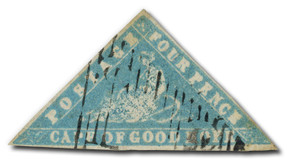
1874 Cape of Good Hope, "Hope" and Symbols of Colony
$69.00
Share:
If you've ever wondered why the Cape of Good Hope triangles hold such a special place in stamp collecting, the story is worth telling.
The Cape itself sits at the southern tip of Africa – first reached by Portuguese explorers in 1488, who originally called it the Cape of Storms. It was renamed the Cape of Good Hope to reflect the optimism of a new sea route to India and the East. It became a Dutch resupply station for the Dutch East India Company before Britain took control in 1814.
By 1853, the colony needed its own postage. But how to distinguish Cape stamps from the flood of British rectangular issues circulating across the empire? The answer was beautifully simple – make them triangular. The shape was chosen so that even someone who couldn't read would instantly recognize a Cape stamp. The design featured a figure of Hope seated on an anchor against finely engraved lines, and the stamps were printed by Perkins, Bacon & Co. of London.
The first values were 1d and 4d, later joined by 6d and 1sh denominations, all in use until demonetization in 1900.
By early 1861, the Cape was running dangerously low on 1d and 4d stamps. What the colony didn't know was that a fresh consignment from London had actually arrived the previous May, sitting unclaimed in port - the bills of lading had gone astray, and nobody knew the shipment was there. With no stamps and no sign of resupply, officials turned to a local firm, Messrs. Saul Solomon & Co., to produce an emergency issue.
Engraver C.J. Roberts went to work, cutting each individual stamp design into steel - 64 separate clichés for each denomination, each one carved by hand. No two were exactly alike. These clichés were then affixed to wooden blocks for printing, giving the stamps the nickname they carry to this day. The result is a set of stamps defined by their imperfections - subtle variations in line, depth, and impression that make each Woodblock genuinely one of a kind. Solomon's firm ultimately produced over 125,000 one penny and 113,000 four pence stamps before the lost London shipment was finally discovered and claimed nearly a year later.
The Woodblock crisis also set in motion a change in printers. The Crown Agents transferred the contract from Perkins, Bacon & Co. to De La Rue & Co., who produced one final series of triangulars in 1863–64. These De La Rue printings are distinguished by their slightly sharper impressions and subtly different colors — a noticeable refinement over both the original Perkins Bacon issues and the rough-hewn Woodblocks. They were the last triangular stamps the Cape would ever produce.
By 1864, the triangular shape was abandoned in favor of easier-to-separate rectangular perforated stamps. Browse our current selection of Cape stamps and add a piece of that history to your collection.
If you've ever wondered why the Cape of Good Hope triangles hold such a special place in stamp collecting, the story is worth telling.
The Cape itself sits at the southern tip of Africa – first reached by Portuguese explorers in 1488, who originally called it the Cape of Storms. It was renamed the Cape of Good Hope to reflect the optimism of a new sea route to India and the East. It became a Dutch resupply station for the Dutch East India Company before Britain took control in 1814.
By 1853, the colony needed its own postage. But how to distinguish Cape stamps from the flood of British rectangular issues circulating across the empire? The answer was beautifully simple – make them triangular. The shape was chosen so that even someone who couldn't read would instantly recognize a Cape stamp. The design featured a figure of Hope seated on an anchor against finely engraved lines, and the stamps were printed by Perkins, Bacon & Co. of London.
The first values were 1d and 4d, later joined by 6d and 1sh denominations, all in use until demonetization in 1900.
By early 1861, the Cape was running dangerously low on 1d and 4d stamps. What the colony didn't know was that a fresh consignment from London had actually arrived the previous May, sitting unclaimed in port - the bills of lading had gone astray, and nobody knew the shipment was there. With no stamps and no sign of resupply, officials turned to a local firm, Messrs. Saul Solomon & Co., to produce an emergency issue.
Engraver C.J. Roberts went to work, cutting each individual stamp design into steel - 64 separate clichés for each denomination, each one carved by hand. No two were exactly alike. These clichés were then affixed to wooden blocks for printing, giving the stamps the nickname they carry to this day. The result is a set of stamps defined by their imperfections - subtle variations in line, depth, and impression that make each Woodblock genuinely one of a kind. Solomon's firm ultimately produced over 125,000 one penny and 113,000 four pence stamps before the lost London shipment was finally discovered and claimed nearly a year later.
The Woodblock crisis also set in motion a change in printers. The Crown Agents transferred the contract from Perkins, Bacon & Co. to De La Rue & Co., who produced one final series of triangulars in 1863–64. These De La Rue printings are distinguished by their slightly sharper impressions and subtly different colors — a noticeable refinement over both the original Perkins Bacon issues and the rough-hewn Woodblocks. They were the last triangular stamps the Cape would ever produce.
By 1864, the triangular shape was abandoned in favor of easier-to-separate rectangular perforated stamps. Browse our current selection of Cape stamps and add a piece of that history to your collection.
Related Items



Most Orders Ship
within 1 Business Day
90 Day Return Policy
Satisfaction Guaranteed
Earn Reward Points
for FREE Stamps & More