


Zoom the image with the mouse
#221-39
1915 China Complete "First Peking Issue"
$2,600.00
Share:
In the early 1910s, China’s imperial system came to an end. Years of foreign pressure, internal unrest, and failed reform efforts had weakened confidence in the old order, and in 1911 a revolution brought more than two thousand years of imperial rule to a close. A new republic took its place, tasked with redefining how the country governed and how it presented itself to the world.
One of the republic’s early steps came in 1913, when it introduced a new definitive stamp series. The designs — a traditional junk, a rice farmer, and the Hall of Classics — were meant to reflect everyday life, work, and cultural tradition rather than imperial authority. They were created for China by American engraver William A. Grant, and printed in London by Waterlow & Sons, since China’s own printing bureau was not yet fully ready.
By 1915, that arrangement was no longer practical. World War I disrupted trade routes and made overseas printing uncertain. Faced with the risk of supply shortages, China made a decision it had never made before – it would produce those same stamp designs domestically, in Beijing.
That decision gave rise to what collectors now call the 1915 First Peking Printing — the first definitive stamps produced entirely by the Chinese Bureau of Engraving and Printing. Using the same designs introduced in 1913, China took full responsibility for producing its own postage for the first time. It was a quiet but meaningful step, signaling that the new republic was no longer dependent on foreign printers to carry out one of its most basic national functions.
The Junk – Tradition Meets Progress
The lowest values in the series feature a traditional Chinese junk — a broad-hulled sailing vessel that had been used for centuries for trade, fishing, and transport along China’s rivers and coastline. By the early 1900s, junks were still a familiar sight, quietly carrying goods and people the same way they had for generations.
Behind the ship, a modern railway bridge cuts across the horizon, a steam train crossing in motion. The pairing isn’t accidental. The junk represents long-established commerce and continuity. The train represents modernization and a country moving forward. Together, they reflect the balance China was trying to strike in the early years of the republic.
The Rice Farmer – The Foundation of Everyday Life
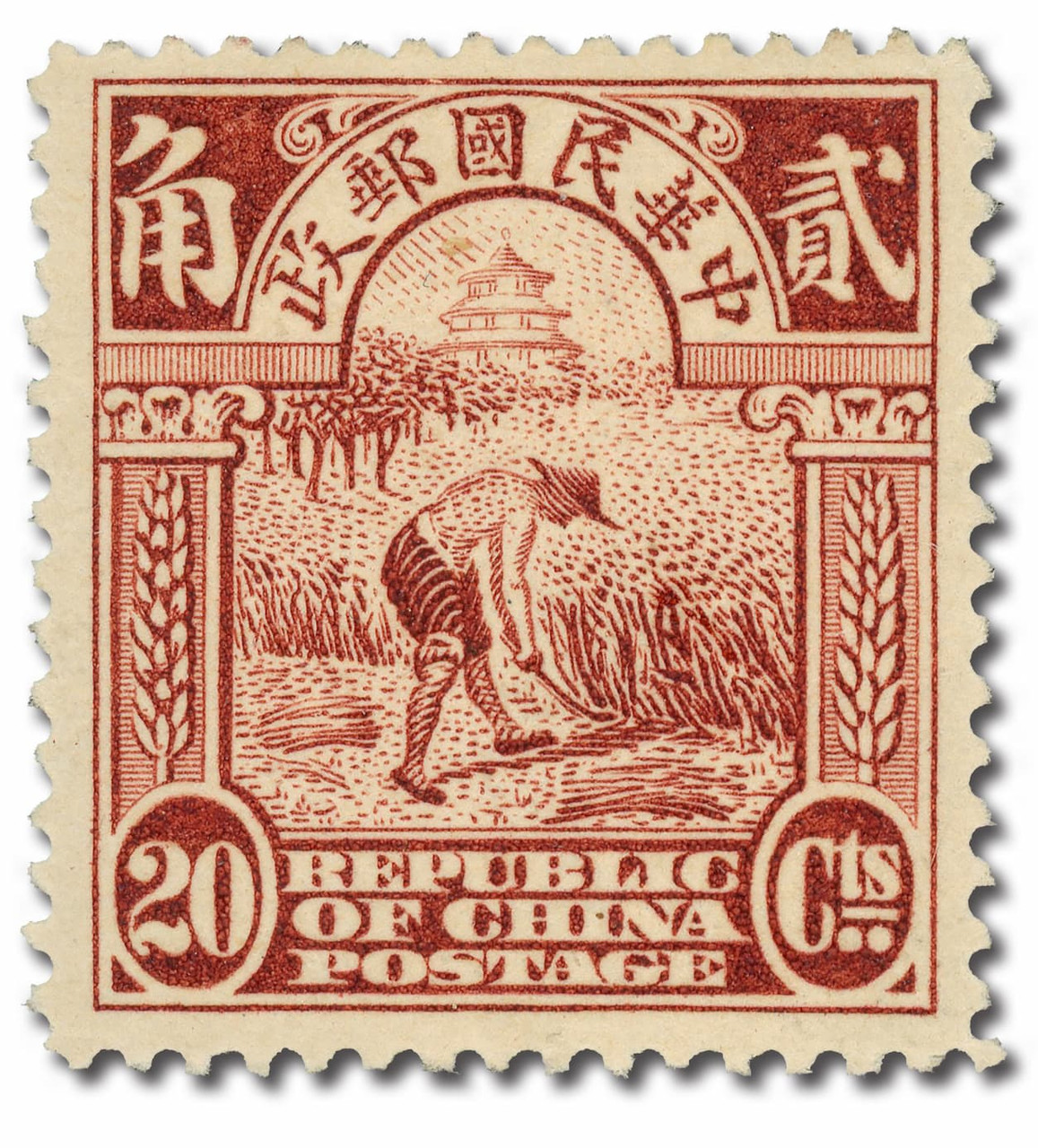
Mid-range values depict a farmer harvesting rice by hand. There’s nothing grand or ceremonial here — just daily work, carried out the same way it had been for generations.
This design quietly acknowledges the people who sustained the nation. At a time of political uncertainty, the farmer symbolized stability, continuity, and the rhythms of ordinary life that endured regardless of who was in power.
The Hall of Classics – A Link to the Past
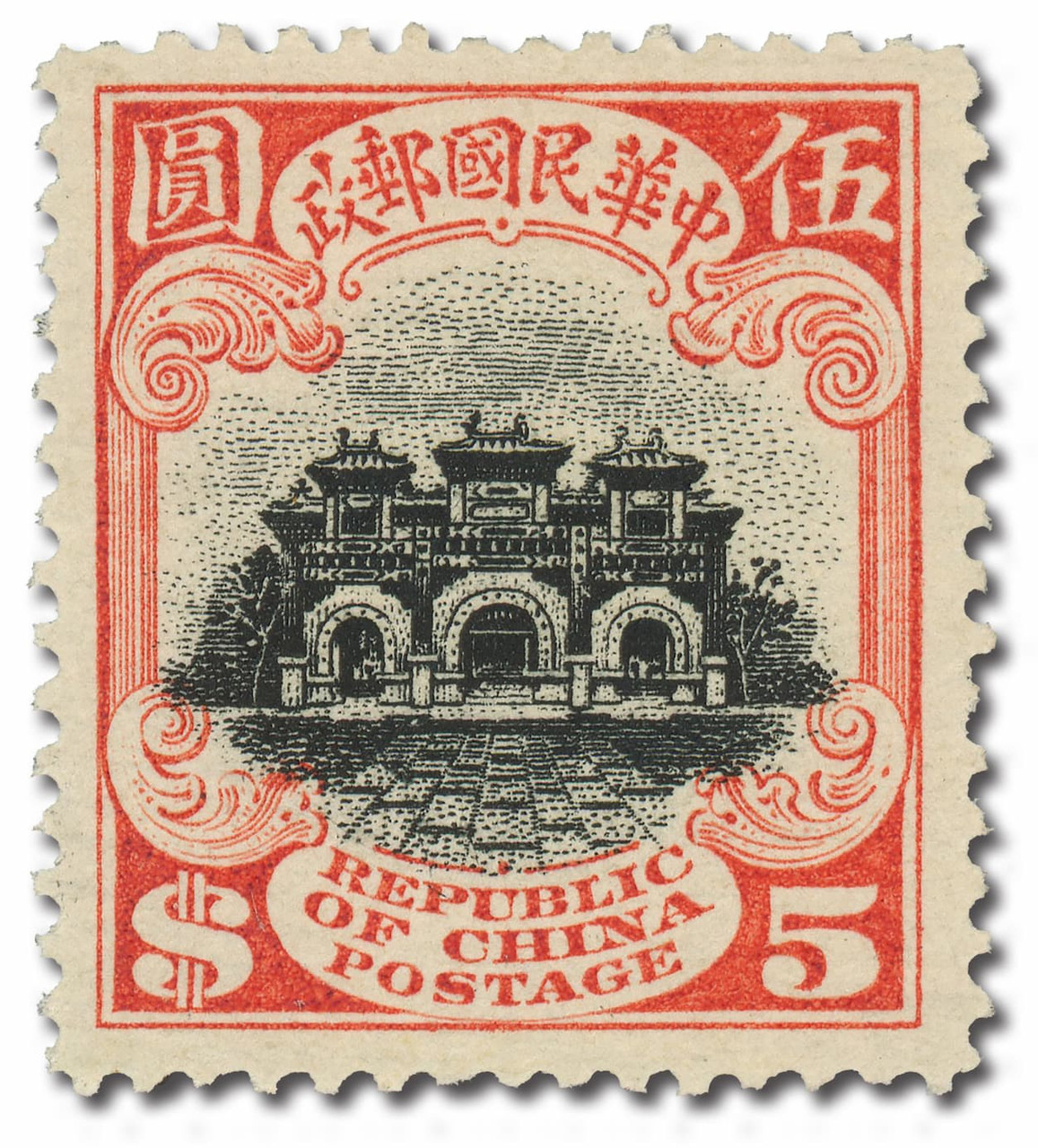
Highest value stamps in the series depict the gate to the Hall of Classics in Beijing, part of China’s Imperial Academy — the center of higher learning for centuries. This was where scholars studied Confucian texts and prepared for the civil service examinations that determined who would govern the country.
Even as China moved away from imperial rule, education, scholarship, and cultural continuity were still seen as foundations of the nation.
Just One Set Available
If you enjoy stamps that tell a story quietly — through design, craftsmanship, and timing — these belong on your radar. We currently have just one set of the 1915 First Peking Printing available. Make them yours while you can.
In the early 1910s, China’s imperial system came to an end. Years of foreign pressure, internal unrest, and failed reform efforts had weakened confidence in the old order, and in 1911 a revolution brought more than two thousand years of imperial rule to a close. A new republic took its place, tasked with redefining how the country governed and how it presented itself to the world.
One of the republic’s early steps came in 1913, when it introduced a new definitive stamp series. The designs — a traditional junk, a rice farmer, and the Hall of Classics — were meant to reflect everyday life, work, and cultural tradition rather than imperial authority. They were created for China by American engraver William A. Grant, and printed in London by Waterlow & Sons, since China’s own printing bureau was not yet fully ready.
By 1915, that arrangement was no longer practical. World War I disrupted trade routes and made overseas printing uncertain. Faced with the risk of supply shortages, China made a decision it had never made before – it would produce those same stamp designs domestically, in Beijing.
That decision gave rise to what collectors now call the 1915 First Peking Printing — the first definitive stamps produced entirely by the Chinese Bureau of Engraving and Printing. Using the same designs introduced in 1913, China took full responsibility for producing its own postage for the first time. It was a quiet but meaningful step, signaling that the new republic was no longer dependent on foreign printers to carry out one of its most basic national functions.
The Junk – Tradition Meets Progress
The lowest values in the series feature a traditional Chinese junk — a broad-hulled sailing vessel that had been used for centuries for trade, fishing, and transport along China’s rivers and coastline. By the early 1900s, junks were still a familiar sight, quietly carrying goods and people the same way they had for generations.
Behind the ship, a modern railway bridge cuts across the horizon, a steam train crossing in motion. The pairing isn’t accidental. The junk represents long-established commerce and continuity. The train represents modernization and a country moving forward. Together, they reflect the balance China was trying to strike in the early years of the republic.
The Rice Farmer – The Foundation of Everyday Life
Mid-range values depict a farmer harvesting rice by hand. There’s nothing grand or ceremonial here — just daily work, carried out the same way it had been for generations.
This design quietly acknowledges the people who sustained the nation. At a time of political uncertainty, the farmer symbolized stability, continuity, and the rhythms of ordinary life that endured regardless of who was in power.
The Hall of Classics – A Link to the Past
Highest value stamps in the series depict the gate to the Hall of Classics in Beijing, part of China’s Imperial Academy — the center of higher learning for centuries. This was where scholars studied Confucian texts and prepared for the civil service examinations that determined who would govern the country.
Even as China moved away from imperial rule, education, scholarship, and cultural continuity were still seen as foundations of the nation.
Just One Set Available
If you enjoy stamps that tell a story quietly — through design, craftsmanship, and timing — these belong on your radar. We currently have just one set of the 1915 First Peking Printing available. Make them yours while you can.
Related Items


Most Orders Ship
within 1 Business Day
90 Day Return Policy
Satisfaction Guaranteed
Earn Reward Points
for FREE Stamps & More