

Zoom the image with the mouse
#25
1865 Newfoundland
$375.00
Share:
Scott #25 is a 5-cent brown stamp from Newfoundland's First Cents Issue of 1865, engraved and printed by the American Bank Note Company of New York. The design features a Harp Seal resting on ice with a rocky coastline and what appears to be icebergs or cliffs in the background — a scene drawn directly from the Newfoundland landscape. "Newfoundland" and "Five" appear at the top, with "Five Cents" along the bottom border. The stamp is perforated, marking the transition from the hand-cut imperforate Pence Issues of the earlier era.
The Harp Seal was as central to Newfoundland's economy as the Atlantic Cod. Each spring, hundreds of thousands of Harp Seals gathered on the ice floes off Newfoundland and Labrador to give birth, and the annual seal hunt employed large numbers of men from outport communities around the island. Seal oil was used for lighting and lubrication, seal pelts were sold for clothing and leather goods, and the hunt provided crucial income during the lean winter months before the fishing season began. By the 1860s, the seal fishery was one of the pillars of the Newfoundland economy alongside the cod fishery, making the Harp Seal a fitting subject for a postage stamp.
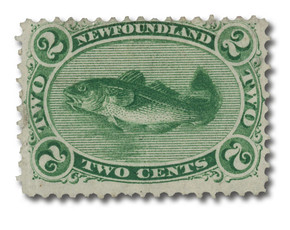
The First Cents Issue of 1865 was printed in New York by the American Bank Note Company, marking a shift away from the London-printed Pence Issues of 1857-62. The new series featured distinctly local subjects — codfish, harp seal, and portraits of royalty — giving Newfoundland's stamps a character all their own. The 5-cent Harp Seal remains one of the most recognizable and appealing designs in the entire run of Newfoundland stamps.
Scott #25 is a 5-cent brown stamp from Newfoundland's First Cents Issue of 1865, engraved and printed by the American Bank Note Company of New York. The design features a Harp Seal resting on ice with a rocky coastline and what appears to be icebergs or cliffs in the background — a scene drawn directly from the Newfoundland landscape. "Newfoundland" and "Five" appear at the top, with "Five Cents" along the bottom border. The stamp is perforated, marking the transition from the hand-cut imperforate Pence Issues of the earlier era.
The Harp Seal was as central to Newfoundland's economy as the Atlantic Cod. Each spring, hundreds of thousands of Harp Seals gathered on the ice floes off Newfoundland and Labrador to give birth, and the annual seal hunt employed large numbers of men from outport communities around the island. Seal oil was used for lighting and lubrication, seal pelts were sold for clothing and leather goods, and the hunt provided crucial income during the lean winter months before the fishing season began. By the 1860s, the seal fishery was one of the pillars of the Newfoundland economy alongside the cod fishery, making the Harp Seal a fitting subject for a postage stamp.
The First Cents Issue of 1865 was printed in New York by the American Bank Note Company, marking a shift away from the London-printed Pence Issues of 1857-62. The new series featured distinctly local subjects — codfish, harp seal, and portraits of royalty — giving Newfoundland's stamps a character all their own. The 5-cent Harp Seal remains one of the most recognizable and appealing designs in the entire run of Newfoundland stamps.
Related Items






Most Orders Ship
within 1 Business Day
90 Day Return Policy
Satisfaction Guaranteed
Earn Reward Points
for FREE Stamps & More