

Zoom the image with the mouse
#37
1920 Australia
$100.00
Share:
Australia's first uniform postage stamps had appeared in 1913, once the newly federated states finally standardized their postal rates, replacing individual state issues that had continued alongside a shared national label since Australia's formation as a commonwealth in 1901. That first series, known as the Kangaroo and Map issue, followed a design competition that drew more than five hundred artists before officials selected a map of Australia paired with a kangaroo silhouette rather than the portrait based entries many had submitted. King George V's portrait joined the country's stamps only with a later series, first appearing on an engraved one penny value before officials switched to a less costly typographic printing method for the remaining denominations.
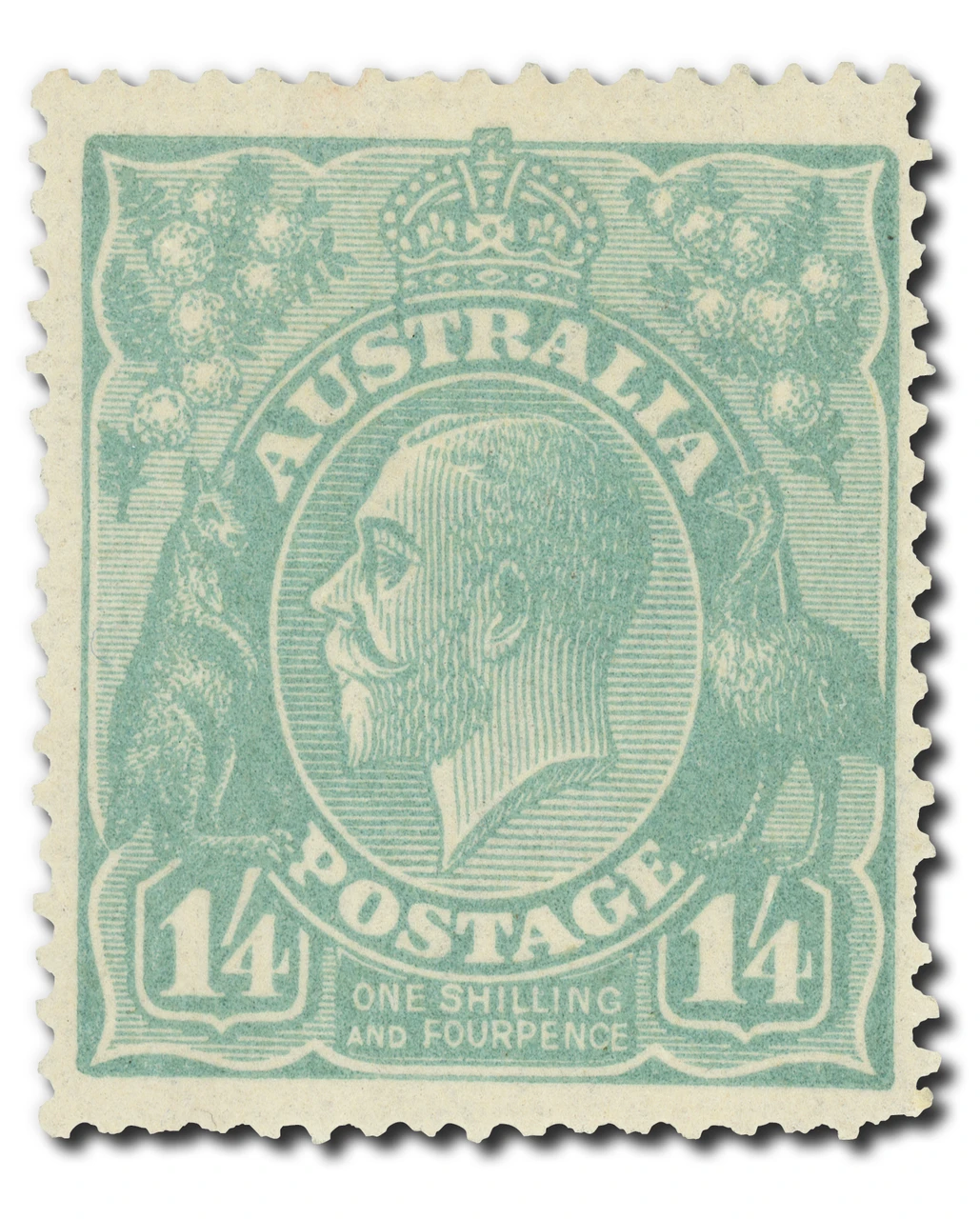
This one shilling and fourpence stamp belongs to that King George V series, showing the King's profile framed by a stylized native flowering plant design, with a kangaroo positioned on one side and an emu on the other, the same pairing of animals that appears on Australia's Coat of Arms. The kangaroo and emu have long served as national symbols for Australia, chosen in part because both animals are unable to walk backward, a trait sometimes interpreted as representing a nation always moving forward. High denominations like this one shilling and fourpence value covered heavier parcels and international mail rather than everyday domestic letters, making them less common in daily circulation than the lower value stamps used for standard postage.
The King George V series remained Australia's primary definitive issue for more than two decades, undergoing several printing and watermark changes over its long production run. Remarkably, certain values from the earlier Kangaroo and Map series continued to be printed alongside the King George V stamps, with the two shilling denomination remaining in production as late as 1945, well into the reign of King George VI. This overlap reflects the practical, sometimes overlapping way Australia's early postal system evolved as the country worked to establish a unified identity across its stamps in the decades following federation.
Australia's first uniform postage stamps had appeared in 1913, once the newly federated states finally standardized their postal rates, replacing individual state issues that had continued alongside a shared national label since Australia's formation as a commonwealth in 1901. That first series, known as the Kangaroo and Map issue, followed a design competition that drew more than five hundred artists before officials selected a map of Australia paired with a kangaroo silhouette rather than the portrait based entries many had submitted. King George V's portrait joined the country's stamps only with a later series, first appearing on an engraved one penny value before officials switched to a less costly typographic printing method for the remaining denominations.
This one shilling and fourpence stamp belongs to that King George V series, showing the King's profile framed by a stylized native flowering plant design, with a kangaroo positioned on one side and an emu on the other, the same pairing of animals that appears on Australia's Coat of Arms. The kangaroo and emu have long served as national symbols for Australia, chosen in part because both animals are unable to walk backward, a trait sometimes interpreted as representing a nation always moving forward. High denominations like this one shilling and fourpence value covered heavier parcels and international mail rather than everyday domestic letters, making them less common in daily circulation than the lower value stamps used for standard postage.
The King George V series remained Australia's primary definitive issue for more than two decades, undergoing several printing and watermark changes over its long production run. Remarkably, certain values from the earlier Kangaroo and Map series continued to be printed alongside the King George V stamps, with the two shilling denomination remaining in production as late as 1945, well into the reign of King George VI. This overlap reflects the practical, sometimes overlapping way Australia's early postal system evolved as the country worked to establish a unified identity across its stamps in the decades following federation.
Related Items


Most Orders Ship
within 1 Business Day
90 Day Return Policy
Satisfaction Guaranteed
Earn Reward Points
for FREE Stamps & More