
Save Up To 5%

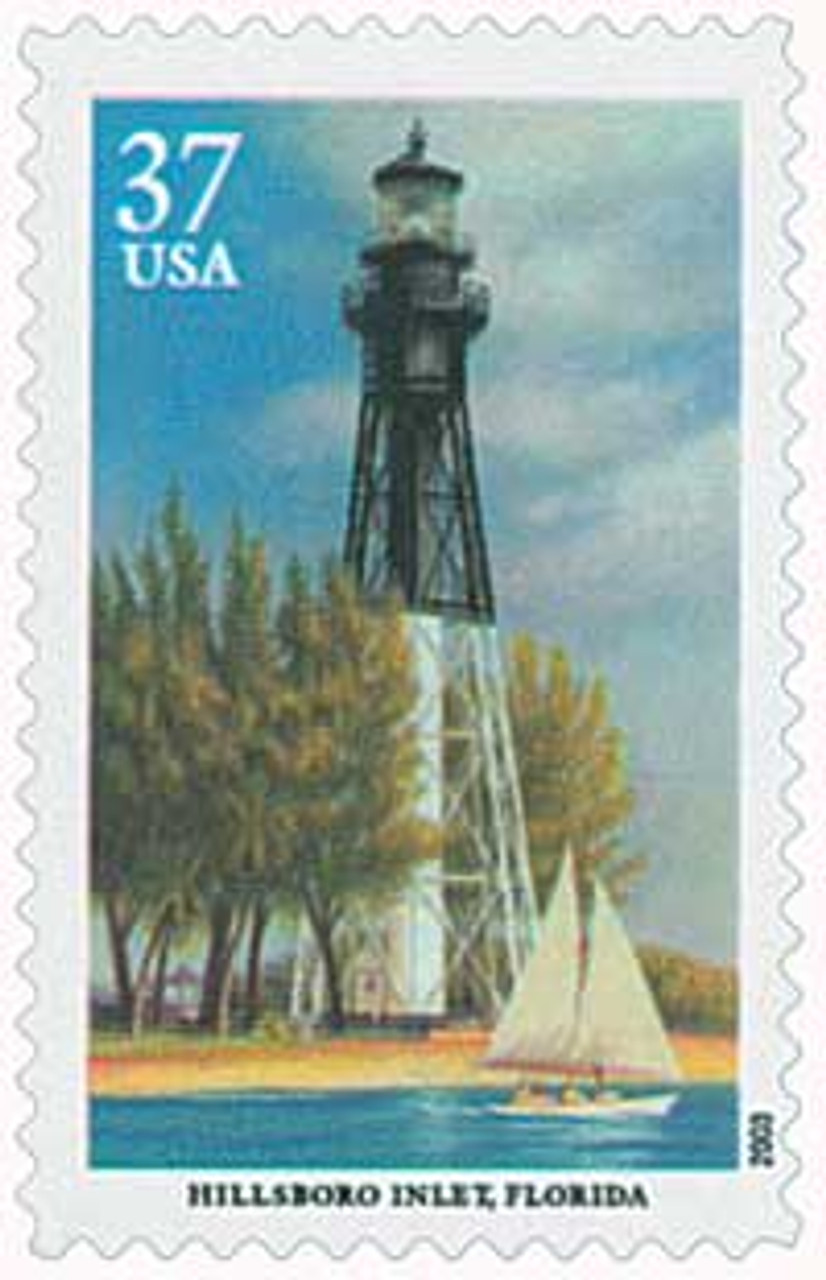
U.S. #3791
37¢ Hillsboro Inlet, FL
Southeastern Lighthouses
Issue Date: June 13, 2003
City: Tybee Island, GA
Quantity: 125,000,000
Printed By: American Packaging Corporation for Sennett Security Products
Printing Method: Photogravure
Perforations: Serpentine Die Cut 10.75 x 10.25
Color: Multicolored
In 2003, the romance of lighthouses was reflected in a strip of five commemorative stamps picturing historic beacons from America’s southeast (U.S. #3787-91). This stamp features the Hillsboro Inlet Lighthouse.
By 1900, most of the Florida coastline had been marked by lighthouses guiding ships safely along its dangerous reefs and shoals, with one notable exception. A dark ninety mile stretch of Atlantic coastline between the Jupiter Inlet Lighthouse and the Fowey Rocks Lighthouse near Key Biscayne remained unlit, creating a hazardous gap for ships navigating through the Florida Straits toward the Gulf of Mexico and Cuba. Congress had recognized the danger as early as 1855, when the Army Corps of Engineers first designated the Hillsboro Inlet as a navigational hazard, though funding delays meant more than fifty years would pass before construction actually began.
Congress finally approved funding in 1901, and the Russell Wheel and Foundry Company of Detroit, Michigan won the construction contract with the lowest bid at $24,000. The completed iron tower traveled an extraordinary four thousand nautical miles from Detroit to Florida, shipped by way of the Great Lakes, the Mississippi River, and the Gulf of Mexico before reaching Miami, where it continued north to the Hillsboro Inlet by barge. Workers reassembled the 137 foot skeletal iron structure on site, and Captain Alfred Alexander Berghell, the light station's first keeper, lit its incandescent oil vapor lamp for the first time at dusk on March 7, 1907.
The lighthouse earned the nickname Big Diamond for its lantern room, constructed of curved, diamond shaped French glass panes manufactured in Paris. Fitted with a second order Fresnel lens that originally rotated on a bed of mercury, the light became one of the most powerful in the world, with its beam visible up to 28 nautical miles out to sea. Electricity replaced the original oil lamps in 1932, and the Coast Guard fully automated the light in 1974, allowing this historic structure to continue guarding one of the last dark stretches of the Florida coastline more than a century after it first began casting its beam across the Atlantic.
U.S. #3791
37¢ Hillsboro Inlet, FL
Southeastern Lighthouses
Issue Date: June 13, 2003
City: Tybee Island, GA
Quantity: 125,000,000
Printed By: American Packaging Corporation for Sennett Security Products
Printing Method: Photogravure
Perforations: Serpentine Die Cut 10.75 x 10.25
Color: Multicolored
In 2003, the romance of lighthouses was reflected in a strip of five commemorative stamps picturing historic beacons from America’s southeast (U.S. #3787-91). This stamp features the Hillsboro Inlet Lighthouse.
By 1900, most of the Florida coastline had been marked by lighthouses guiding ships safely along its dangerous reefs and shoals, with one notable exception. A dark ninety mile stretch of Atlantic coastline between the Jupiter Inlet Lighthouse and the Fowey Rocks Lighthouse near Key Biscayne remained unlit, creating a hazardous gap for ships navigating through the Florida Straits toward the Gulf of Mexico and Cuba. Congress had recognized the danger as early as 1855, when the Army Corps of Engineers first designated the Hillsboro Inlet as a navigational hazard, though funding delays meant more than fifty years would pass before construction actually began.
Congress finally approved funding in 1901, and the Russell Wheel and Foundry Company of Detroit, Michigan won the construction contract with the lowest bid at $24,000. The completed iron tower traveled an extraordinary four thousand nautical miles from Detroit to Florida, shipped by way of the Great Lakes, the Mississippi River, and the Gulf of Mexico before reaching Miami, where it continued north to the Hillsboro Inlet by barge. Workers reassembled the 137 foot skeletal iron structure on site, and Captain Alfred Alexander Berghell, the light station's first keeper, lit its incandescent oil vapor lamp for the first time at dusk on March 7, 1907.
The lighthouse earned the nickname Big Diamond for its lantern room, constructed of curved, diamond shaped French glass panes manufactured in Paris. Fitted with a second order Fresnel lens that originally rotated on a bed of mercury, the light became one of the most powerful in the world, with its beam visible up to 28 nautical miles out to sea. Electricity replaced the original oil lamps in 1932, and the Coast Guard fully automated the light in 1974, allowing this historic structure to continue guarding one of the last dark stretches of the Florida coastline more than a century after it first began casting its beam across the Atlantic.


