

Zoom the image with the mouse
#479
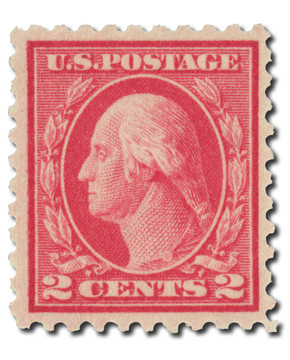
1917 $2 James Madison, Dark Blue, Unwatermarked, Perf. 10
$575.00
Share:
U.S. #479
Series of 1916-17 $2 Madison
Issue Date: March 22, 1917
Printed by: Bureau of Engraving and Printing
Printing Method: Flat plate
Watermark: None
Perforation: 10
Color: Dark blue
U.S. Scott #479 is a $2 dark blue stamp depicting President James Madison, issued on March 22, 1917, by the U.S. Post Office. The design is a reprint of the Series of 1902 $2 Madison stamp (Scott #312), originally issued June 5, 1903, with the portrait based on a painting by Gilbert Stuart. The 1917 reprint is distinguished from its 1902 predecessor by its perforation gauge of 10 rather than 12, and by its unwatermarked paper — the earlier issue having been printed on double-line watermark paper. The design itself, noted for its ornate frame and engraving, was the work of designer Raymond Ostrander Smith, with the portrait engraved by George F.C. Smillie.
The stamp was rushed into production in response to an urgent wartime need. By early 1917, American industries were shipping heavy machine parts and supplies to allies in Europe, and demand for high-value stamps to prepay postage and registry on these international packages had far outpaced the Post Office's dwindling inventory. With no time to prepare new designs, the Bureau of Engraving and Printing turned to the 1902 master dies — the original plates and transfer rollers having already been destroyed — to produce what would serve as a stop-gap issue. Scott #479 was also used to send Liberty Bond shipments during the war, and it remained in use into 1920, when it was finally superseded by a newly designed $2 Franklin stamp (Scott #523).
James Madison, born in 1751 and shown on the stamp with his birth and death years (1751–1836), is widely regarded as one of the most consequential of the Founding Fathers. Often called the "Father of the Constitution," he was the principal architect of that document as well as the author of the first ten amendments — the Bill of Rights. He co-authored the Federalist Papers alongside Alexander Hamilton and John Jay, and later served as the fourth President of the United States from 1809 to 1817. His presidency included the War of 1812, during which the White House itself was burned by British troops — one of the most dramatic episodes in the early history of the republic.
U.S. #479
Series of 1916-17 $2 Madison
Issue Date: March 22, 1917
Printed by: Bureau of Engraving and Printing
Printing Method: Flat plate
Watermark: None
Perforation: 10
Color: Dark blue
U.S. Scott #479 is a $2 dark blue stamp depicting President James Madison, issued on March 22, 1917, by the U.S. Post Office. The design is a reprint of the Series of 1902 $2 Madison stamp (Scott #312), originally issued June 5, 1903, with the portrait based on a painting by Gilbert Stuart. The 1917 reprint is distinguished from its 1902 predecessor by its perforation gauge of 10 rather than 12, and by its unwatermarked paper — the earlier issue having been printed on double-line watermark paper. The design itself, noted for its ornate frame and engraving, was the work of designer Raymond Ostrander Smith, with the portrait engraved by George F.C. Smillie.
The stamp was rushed into production in response to an urgent wartime need. By early 1917, American industries were shipping heavy machine parts and supplies to allies in Europe, and demand for high-value stamps to prepay postage and registry on these international packages had far outpaced the Post Office's dwindling inventory. With no time to prepare new designs, the Bureau of Engraving and Printing turned to the 1902 master dies — the original plates and transfer rollers having already been destroyed — to produce what would serve as a stop-gap issue. Scott #479 was also used to send Liberty Bond shipments during the war, and it remained in use into 1920, when it was finally superseded by a newly designed $2 Franklin stamp (Scott #523).
James Madison, born in 1751 and shown on the stamp with his birth and death years (1751–1836), is widely regarded as one of the most consequential of the Founding Fathers. Often called the "Father of the Constitution," he was the principal architect of that document as well as the author of the first ten amendments — the Bill of Rights. He co-authored the Federalist Papers alongside Alexander Hamilton and John Jay, and later served as the fourth President of the United States from 1809 to 1817. His presidency included the War of 1812, during which the White House itself was burned by British troops — one of the most dramatic episodes in the early history of the republic.
Related Items


#462-80
1916-17 Regular Issues, Unwatermarked, Perf. 10, Complete Set of 19 Stamps
$3,450.00 - $7,425.00


Most Orders Ship
within 1 Business Day
90 Day Return Policy
Satisfaction Guaranteed
Earn Reward Points
for FREE Stamps & More