


Stamp Category: Definitive
Set: Floral Geometry
Value: $10
First Day of Issue: February 24, 2023
First Day City: San Diego, CA
Quantity Issued: 500,000
Printed by: Banknote Corporation of America
Printing Method: Foil Stamping, Offset, Microprint
Format: Pane of 4
Self-Adhesive
Why the stamp was issued: Continued the Floral Geometry set begun in 2022 with the $2 and $5 denominations. The new $10 stamp was also intended for use on packages, large envelopes, and other mailings.
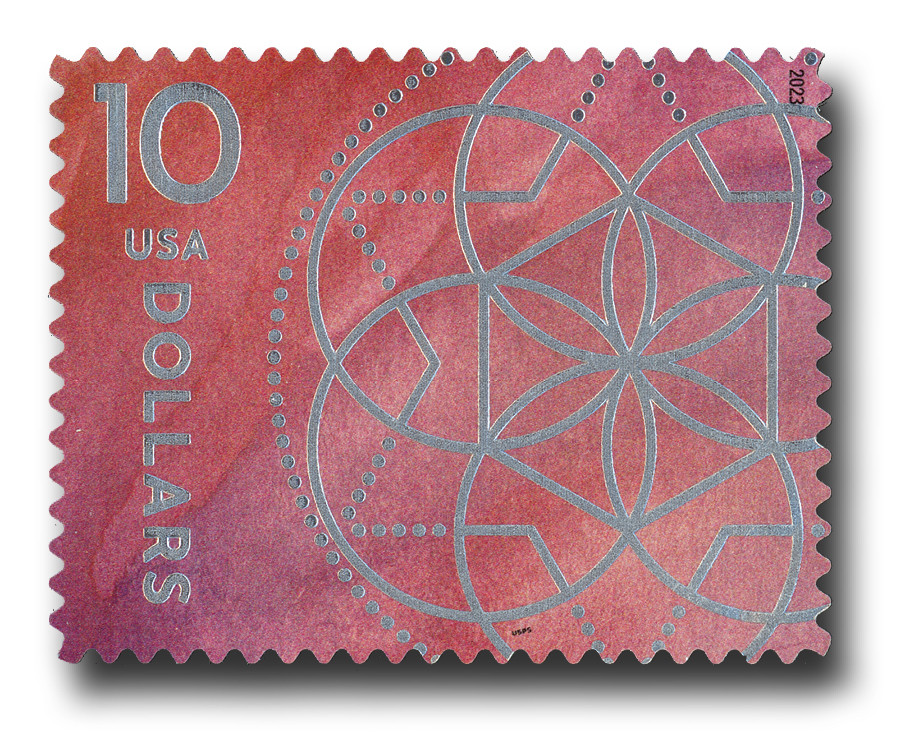
About the stamp design: Like previous Floral Geometry stamps, the $10 design includes a watercolor background, foil-stamped details, and typography to create an elegant, ornate look. The design is intended to mimic the geometric patterns found in flowers in nature. The stamp was designed and created by Spaeth Hill.
First Day City: This stamp’s First Day of Issue ceremony was held at the San Diego National Stamp Show in San Diego, California. It’s always fun and exciting when stamps are released at philatelic conventions.
About the Floral Geometry stamps: The first two were the $2 and $5 stamps issued in 2022. As the denomination increases, so does the complexity of the geometric design of the stamp, with the $10 being the most complex up to 2023. All three include watercolor backgrounds and foil stamping. The designs were created by Spaeth Hill.
History the stamp represents: Gyorgy Doczi, author of The Power of Limits said, “If we look closely at a flower, and likewise at other natural and manmade creations, we find a unity and an order common to all of them. This order can be seen in certain proportions which appear again and again, and also in the similarly dynamic way all things grow or are made – by a union of complementary opposites.” One of the most obvious examples of this idea is the geometric way flowers and other plants grow.
One of the reasons we find flowers beautiful is their interesting shapes. These shapes are determined by complex geometric principles. Petals are often arranged in spirals with symmetry that piques our interest. This is true of the blossoms themselves, as well as leaves, seeds, roots, stems, and even fruits.
Geometry affects more than just plants. When we look closely, there are geometric principles involved in almost everything. This includes rocks and minerals, snowflakes, insects, animals, and more. Samuel Colman sums it up in Nature’s Harmonic Unity when he says, “What is evident in the geometry of the face of a flower can remind us of the geometry that underlies all existence. Studying the geometry of flowers is therefore a powerful way to reconnect us with the idea that we are all one.”
Stamp Category: Definitive
Set: Floral Geometry
Value: $10
First Day of Issue: February 24, 2023
First Day City: San Diego, CA
Quantity Issued: 500,000
Printed by: Banknote Corporation of America
Printing Method: Foil Stamping, Offset, Microprint
Format: Pane of 4
Self-Adhesive
Why the stamp was issued: Continued the Floral Geometry set begun in 2022 with the $2 and $5 denominations. The new $10 stamp was also intended for use on packages, large envelopes, and other mailings.
About the stamp design: Like previous Floral Geometry stamps, the $10 design includes a watercolor background, foil-stamped details, and typography to create an elegant, ornate look. The design is intended to mimic the geometric patterns found in flowers in nature. The stamp was designed and created by Spaeth Hill.
First Day City: This stamp’s First Day of Issue ceremony was held at the San Diego National Stamp Show in San Diego, California. It’s always fun and exciting when stamps are released at philatelic conventions.
About the Floral Geometry stamps: The first two were the $2 and $5 stamps issued in 2022. As the denomination increases, so does the complexity of the geometric design of the stamp, with the $10 being the most complex up to 2023. All three include watercolor backgrounds and foil stamping. The designs were created by Spaeth Hill.
History the stamp represents: Gyorgy Doczi, author of The Power of Limits said, “If we look closely at a flower, and likewise at other natural and manmade creations, we find a unity and an order common to all of them. This order can be seen in certain proportions which appear again and again, and also in the similarly dynamic way all things grow or are made – by a union of complementary opposites.” One of the most obvious examples of this idea is the geometric way flowers and other plants grow.
One of the reasons we find flowers beautiful is their interesting shapes. These shapes are determined by complex geometric principles. Petals are often arranged in spirals with symmetry that piques our interest. This is true of the blossoms themselves, as well as leaves, seeds, roots, stems, and even fruits.
Geometry affects more than just plants. When we look closely, there are geometric principles involved in almost everything. This includes rocks and minerals, snowflakes, insects, animals, and more. Samuel Colman sums it up in Nature’s Harmonic Unity when he says, “What is evident in the geometry of the face of a flower can remind us of the geometry that underlies all existence. Studying the geometry of flowers is therefore a powerful way to reconnect us with the idea that we are all one.”


