

Zoom the image with the mouse
#6056
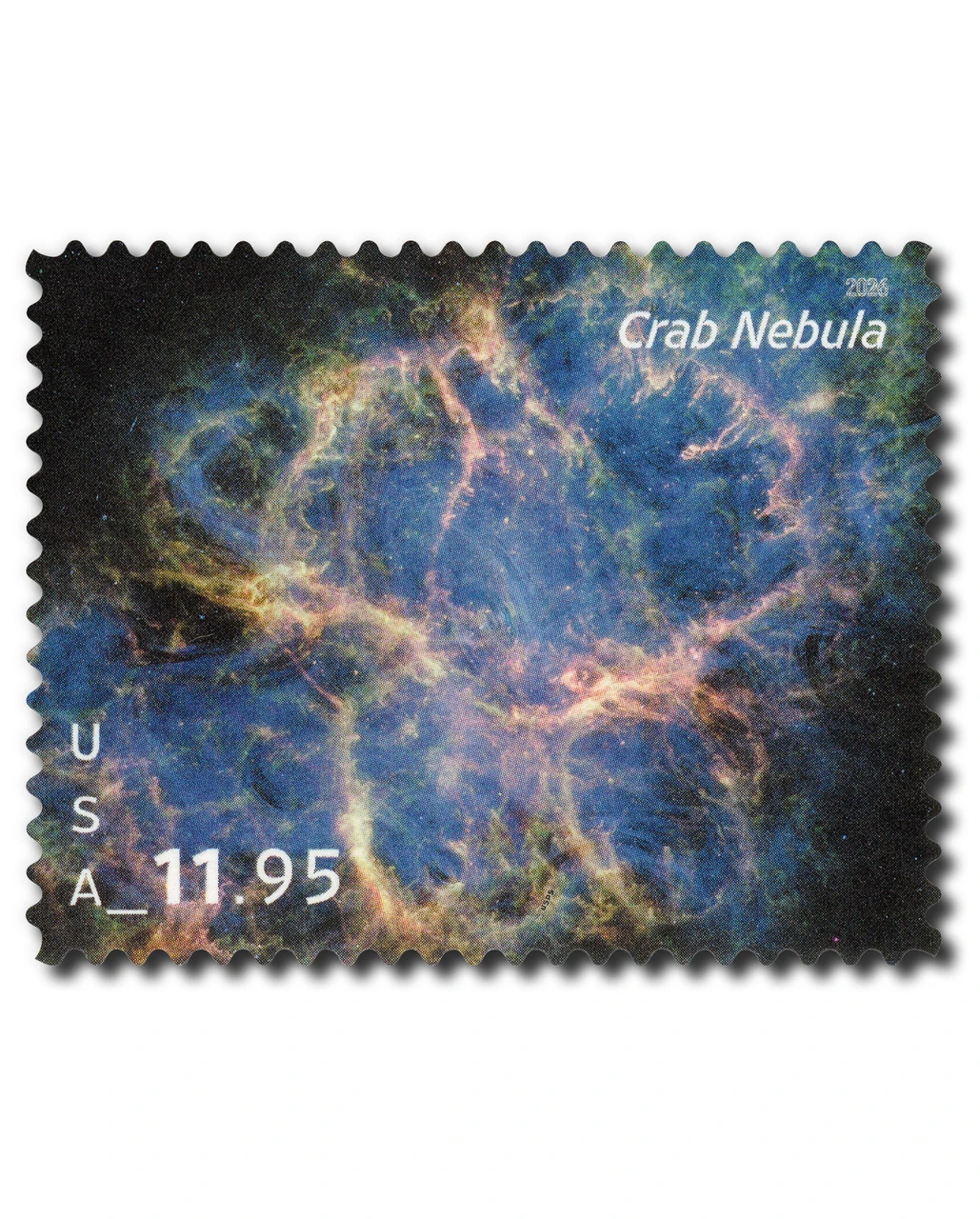
2026 $11.95 Crab Nebula Priority Mail
$22.95
Share:
US #6056
2026 Crab Nebula
- 2026 Priority Mail stamp
- Celebrates America’s deep space exploration
- Image from NASA’s James Webb Space Telescope
Stamp Category: Definitive,
Value: $11.95, Priority Mail Rate
First Day of Issue: February 24, 2026
First Day City: Kansas City, Missouri
Quantity Issued: 1,500,000
Printed by: Banknote Corporation of America
Printing Method: Offset, Flexographic
Format: Pane of 4
Why the stamp was issued: The stamp was issued in response to a rate increase.
About the stamp design: The Crab Nebula image was captured by NASA’s James Webb Space Telescope. USPS art director, Greg Breeding designed the stamp using a NASA photo.
First Day City: No official First Day of Issue ceremony took place.
History the stamp represents: A brilliant flash tore across the sky in July of 1054, visible even in daylight for weeks. Astronomers in China, Japan, and the Middle East recorded the sudden “guest star,” unknowingly witnessing the birth of one of the most studied remnants in our galaxy—the Crab Nebula.
Located in the constellation Taurus, this vast cloud is the debris of a massive star that ended its life in a supernova explosion. Spanning roughly eleven light-years, the nebula continues to expand, with tangled filaments of gas and dust forming a luminous record of stellar destruction. These structures have been captured in remarkable detail by instruments such as the Hubble Space Telescope.
At the nebula’s core spins a neutron star, known as the Crab Pulsar, rotating dozens of times each second. Its steady beams of radiation sweep through space like a cosmic lighthouse. Discovered in 1968, the pulsar confirmed theories about the violent deaths of massive stars and revealed the Crab Nebula as a powerful source of energy across the electromagnetic spectrum.
This stamp honors a rare convergence of recorded history and modern astronomy. It marks a celestial event observed nearly a millennium ago and reminds us that even the remnants of a dying star can illuminate the cosmos and deepen our understanding of it.
US #6056
2026 Crab Nebula
- 2026 Priority Mail stamp
- Celebrates America’s deep space exploration
- Image from NASA’s James Webb Space Telescope
Stamp Category: Definitive,
Value: $11.95, Priority Mail Rate
First Day of Issue: February 24, 2026
First Day City: Kansas City, Missouri
Quantity Issued: 1,500,000
Printed by: Banknote Corporation of America
Printing Method: Offset, Flexographic
Format: Pane of 4
Why the stamp was issued: The stamp was issued in response to a rate increase.
About the stamp design: The Crab Nebula image was captured by NASA’s James Webb Space Telescope. USPS art director, Greg Breeding designed the stamp using a NASA photo.
First Day City: No official First Day of Issue ceremony took place.
History the stamp represents: A brilliant flash tore across the sky in July of 1054, visible even in daylight for weeks. Astronomers in China, Japan, and the Middle East recorded the sudden “guest star,” unknowingly witnessing the birth of one of the most studied remnants in our galaxy—the Crab Nebula.
Located in the constellation Taurus, this vast cloud is the debris of a massive star that ended its life in a supernova explosion. Spanning roughly eleven light-years, the nebula continues to expand, with tangled filaments of gas and dust forming a luminous record of stellar destruction. These structures have been captured in remarkable detail by instruments such as the Hubble Space Telescope.
At the nebula’s core spins a neutron star, known as the Crab Pulsar, rotating dozens of times each second. Its steady beams of radiation sweep through space like a cosmic lighthouse. Discovered in 1968, the pulsar confirmed theories about the violent deaths of massive stars and revealed the Crab Nebula as a powerful source of energy across the electromagnetic spectrum.
This stamp honors a rare convergence of recorded history and modern astronomy. It marks a celestial event observed nearly a millennium ago and reminds us that even the remnants of a dying star can illuminate the cosmos and deepen our understanding of it.
Related Items

Save Up To 19%



Save Up To 11%


Most Orders Ship
within 1 Business Day
90 Day Return Policy
Satisfaction Guaranteed
Earn Reward Points
for FREE Stamps & More