


Zoom the image with the mouse
#616
1924 5c Jan Ribault Monument at Duval County, Florida, Dark Blue
$35.00
Share:
U.S. #616
1924 5¢ Monument at Mayport, Florida
Huguenot-Walloon Issue
Issue Date: May 1, 1924
First City: Various cities
Quantity Issued: 5,659,023
Printed by: Bureau of Engraving and Printing
Perforation: 11
Color: Dark blue
The monument on this stamp is located in Mayport, Florida, and marks another area where the Huguenots settled. The monument on U.S. #616 is called the Jean Ribaut Monument. Ribaut had helped organize early Huguenot settlements, but the colony settled in 1564 near Mayport, Florida, was too close to Spanish shipping lanes. The settlers were wiped out by the Spanish in 1565.
U.S. Scott #616 is the 5-cent value from the Huguenot-Walloon Tercentenary Issue, one of three commemorative stamps released on May 1, 1924, by the U.S. Post Office. Printed in blue by the Bureau of Engraving and Printing, the stamp depicts the Jean Ribault Monument at Mayport, Florida, at the mouth of the St. Johns River. The dates 1624 and 1924 appear in the upper corners, marking the 300th anniversary of the Walloon settlement of the New World, while the inscription encircling the vignette reads "Huguenot-Walloon Tercentenary."
The monument shown on the stamp commemorates the 1562 landing of French Huguenot explorer Jean Ribault, who erected a stone column bearing the French coat of arms to claim the territory for France. This marked the first attempt by the Huguenots — French Protestants who had fled religious persecution — to establish a permanent settlement in North America, nearly 60 years before the Pilgrims arrived at Plymouth Rock. In 1564, fellow Huguenot René Laudonnière returned to the site to build Fort Caroline, but the colony was ultimately destroyed by Spanish forces. The original stone column was replaced and rededicated in 1924, the same year this stamp was issued.
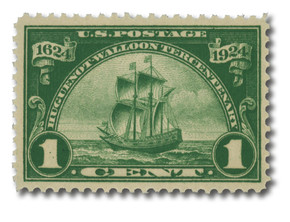
The 5-cent denomination was the highest value in the three-stamp set, which also included a 1-cent depicting the ship Nieu Nederland and a 2-cent showing the Walloon landing at Fort Orange (present-day Albany, New York). Scott #616 is a key stamp in the set and a favorite among collectors of early American commemoratives, colonial history topicals, and the classic issues of the 1920s. As the highest face value in the set, it typically saw use on heavier domestic mail and foreign correspondence.
U.S. #616
1924 5¢ Monument at Mayport, Florida
Huguenot-Walloon Issue
Issue Date: May 1, 1924
First City: Various cities
Quantity Issued: 5,659,023
Printed by: Bureau of Engraving and Printing
Perforation: 11
Color: Dark blue
The monument on this stamp is located in Mayport, Florida, and marks another area where the Huguenots settled. The monument on U.S. #616 is called the Jean Ribaut Monument. Ribaut had helped organize early Huguenot settlements, but the colony settled in 1564 near Mayport, Florida, was too close to Spanish shipping lanes. The settlers were wiped out by the Spanish in 1565.
U.S. Scott #616 is the 5-cent value from the Huguenot-Walloon Tercentenary Issue, one of three commemorative stamps released on May 1, 1924, by the U.S. Post Office. Printed in blue by the Bureau of Engraving and Printing, the stamp depicts the Jean Ribault Monument at Mayport, Florida, at the mouth of the St. Johns River. The dates 1624 and 1924 appear in the upper corners, marking the 300th anniversary of the Walloon settlement of the New World, while the inscription encircling the vignette reads "Huguenot-Walloon Tercentenary."
The monument shown on the stamp commemorates the 1562 landing of French Huguenot explorer Jean Ribault, who erected a stone column bearing the French coat of arms to claim the territory for France. This marked the first attempt by the Huguenots — French Protestants who had fled religious persecution — to establish a permanent settlement in North America, nearly 60 years before the Pilgrims arrived at Plymouth Rock. In 1564, fellow Huguenot René Laudonnière returned to the site to build Fort Caroline, but the colony was ultimately destroyed by Spanish forces. The original stone column was replaced and rededicated in 1924, the same year this stamp was issued.
The 5-cent denomination was the highest value in the three-stamp set, which also included a 1-cent depicting the ship Nieu Nederland and a 2-cent showing the Walloon landing at Fort Orange (present-day Albany, New York). Scott #616 is a key stamp in the set and a favorite among collectors of early American commemoratives, colonial history topicals, and the classic issues of the 1920s. As the highest face value in the set, it typically saw use on heavier domestic mail and foreign correspondence.
Related Items


Most Orders Ship
within 1 Business Day
90 Day Return Policy
Satisfaction Guaranteed
Earn Reward Points
for FREE Stamps & More