

Zoom the image with the mouse
#632
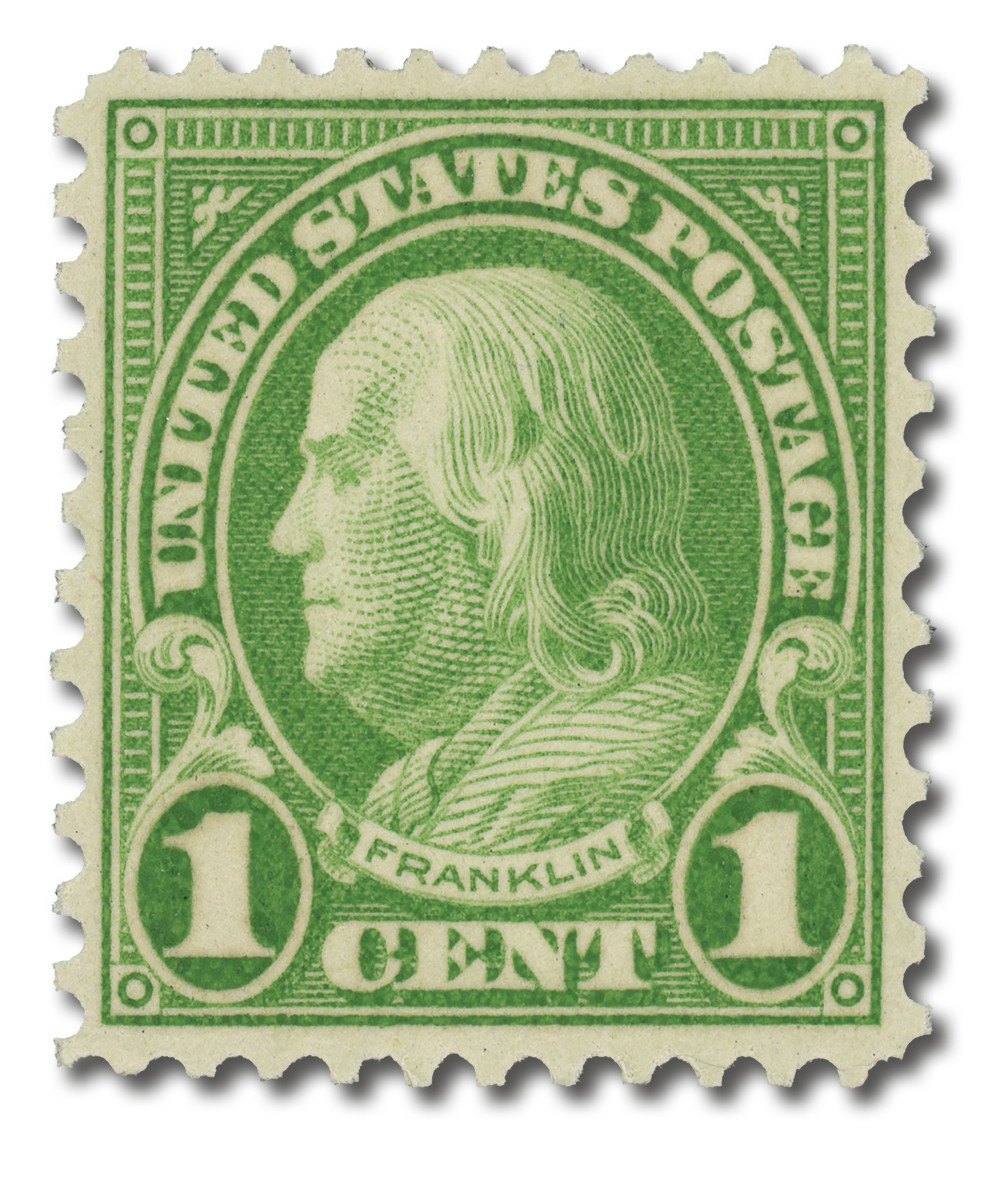
1927 1c Franklin, Green, Perf. 11x10.5
$0.50
Share:
U.S. #632
1926-28 Rotary Stamps
1¢ Benjamin Franklin
First Day of Issue: June 10, 1927
First City: Washington, DC
Printing Method: Rotary Press
Perforation: 11 x 10½
Color: Green
The portrait of Benjamin Franklin shown on this stamp had previously been used on at least eight other US stamps. It is based on a bust of the first Postmaster General created by Jean Jacques Caffieri in 1777.
Perfecting Perforations on Rotary Stamps
When the Bureau began printing sheets on the rotary press, they found 11 gauge perforations were too fine, causing the stamps to separate prematurely. This resulted in the perforations being changed back to 10 gauge perforations, which had first been used in 1915. Once again, objections were raised, and the Bureau began looking for a way to perforate the stamps so they were strong enough to resist premature separation, yet fine enough to be separated without difficulty. The solution was found in a compromise that resulted in a new perforation – the 10½ gauge.
This perforation seemed to please everyone and was adopted as the new standard for rotary press sheets. In the words of Linn’s author Gary Griffith, the 1926-28 Compound Perforation rotary stamps represent “if not perfection, then at least a high degree of achievement...”
U.S. #632
1926-28 Rotary Stamps
1¢ Benjamin Franklin
First Day of Issue: June 10, 1927
First City: Washington, DC
Printing Method: Rotary Press
Perforation: 11 x 10½
Color: Green
The portrait of Benjamin Franklin shown on this stamp had previously been used on at least eight other US stamps. It is based on a bust of the first Postmaster General created by Jean Jacques Caffieri in 1777.
Perfecting Perforations on Rotary Stamps
When the Bureau began printing sheets on the rotary press, they found 11 gauge perforations were too fine, causing the stamps to separate prematurely. This resulted in the perforations being changed back to 10 gauge perforations, which had first been used in 1915. Once again, objections were raised, and the Bureau began looking for a way to perforate the stamps so they were strong enough to resist premature separation, yet fine enough to be separated without difficulty. The solution was found in a compromise that resulted in a new perforation – the 10½ gauge.
This perforation seemed to please everyone and was adopted as the new standard for rotary press sheets. In the words of Linn’s author Gary Griffith, the 1926-28 Compound Perforation rotary stamps represent “if not perfection, then at least a high degree of achievement...”
Related Items


Most Orders Ship
within 1 Business Day
90 Day Return Policy
Satisfaction Guaranteed
Earn Reward Points
for FREE Stamps & More