


Zoom the image with the mouse
#96-99
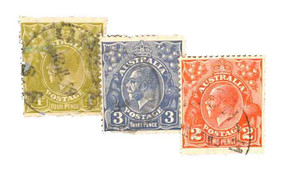
1929 Australia
$67.50
Share:
How the kangaroo-and-map design broke tradition—and stirred up a storm.
When Australia federated in 1901, it took more than a decade to issue a true national postage stamp. In 1911, the government announced a design competition. Over a thousand entries poured in. The winning design showed King George V surrounded by the six state crests, flanked by a kangaroo and emu.
But, as always, politics changed everything. When Charles Frazer became Postmaster-General in 1911, he was appalled by the result, calling the royal portrait “execrable.”
Frazer believed Australia’s stamps should advertise Australia — not Britain. He directed a new design: the outline of the continent with a kangaroo at its center. It was simple, bold, and unlike anything else in the British Empire. On January 2, 1913, the first Kangaroo and Map stamp appeared at post offices across the country.
The reaction was immediate — and fierce. Supporters saw it as a proud national symbol, a break from colonial convention. But critics erupted in protest. Loyalists complained it was unpatriotic to omit the King’s portrait. Some mocked it as “grotesque,” while others called it “childish” and “brainless.” One commentator sneered it depicted Australia as “an empty land with nothing but kangaroos.” Even Parliament joined the fray, with Frazer quipping that “licking the backside of a kangaroo” was no worse than licking the King.
The uproar soon had political consequences. By the end of 1913, a new government was ushered in and ordered stamps featuring King George V into production. For a time, both designs were issued side by side. Despite the controversy, the kangaroo endured. It was printed for 35 years, becoming one of Australia's most recognizable classics.
Identifying Your Kangaroos
The Kangaroo and Map stamps stayed in use for decades, coming out in several different printings. At a glance they all look the same, but you can tell them apart by checking the watermark in the paper. That little detail is the key to knowing which issue you’ve got…
1913: Wide Crown & Wide A
1915: Wide Crown & Narrow A
1915-1924: Narrow Crown & Narrow A
1929-30: Small Crown & A Multiples
1931-36, 1945
Small Crown & "C of A" Multiples
How the kangaroo-and-map design broke tradition—and stirred up a storm.
When Australia federated in 1901, it took more than a decade to issue a true national postage stamp. In 1911, the government announced a design competition. Over a thousand entries poured in. The winning design showed King George V surrounded by the six state crests, flanked by a kangaroo and emu.
But, as always, politics changed everything. When Charles Frazer became Postmaster-General in 1911, he was appalled by the result, calling the royal portrait “execrable.”
Frazer believed Australia’s stamps should advertise Australia — not Britain. He directed a new design: the outline of the continent with a kangaroo at its center. It was simple, bold, and unlike anything else in the British Empire. On January 2, 1913, the first Kangaroo and Map stamp appeared at post offices across the country.
The reaction was immediate — and fierce. Supporters saw it as a proud national symbol, a break from colonial convention. But critics erupted in protest. Loyalists complained it was unpatriotic to omit the King’s portrait. Some mocked it as “grotesque,” while others called it “childish” and “brainless.” One commentator sneered it depicted Australia as “an empty land with nothing but kangaroos.” Even Parliament joined the fray, with Frazer quipping that “licking the backside of a kangaroo” was no worse than licking the King.
The uproar soon had political consequences. By the end of 1913, a new government was ushered in and ordered stamps featuring King George V into production. For a time, both designs were issued side by side. Despite the controversy, the kangaroo endured. It was printed for 35 years, becoming one of Australia's most recognizable classics.
Identifying Your Kangaroos
The Kangaroo and Map stamps stayed in use for decades, coming out in several different printings. At a glance they all look the same, but you can tell them apart by checking the watermark in the paper. That little detail is the key to knowing which issue you’ve got…
1913: Wide Crown & Wide A
1915: Wide Crown & Narrow A
1915-1924: Narrow Crown & Narrow A
1929-30: Small Crown & A Multiples
1931-36, 1945
Small Crown & "C of A" Multiples
Related Items

Most Orders Ship
within 1 Business Day
90 Day Return Policy
Satisfaction Guaranteed
Earn Reward Points
for FREE Stamps & More