

Zoom the image with the mouse
#96202
1977 Alexander Hamilton
$1.25
Share:
Get Cover Honoring Constitution Signer Alexander Hamilton
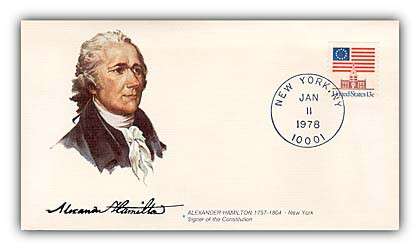
Own this cover commemorating Alexander Hamilton’s (1757-1804) contribution to the ratification of the US Constitution. It's part of the Official collection of the Signers of the Constitution and an official commemorative of the US Capitol Hisotircal Society. The Flag over Independence Hall stamp is tied to the cover with a New York, New York postmark. This city was Hamiliton’s adopted hometown. The date is the anniversary of his birth.
During the American Revolution, Hamilton served as aide-de-camp for George Washington. He was then a delegate to the convention that led to the drafting of the US Constitution. Hamilton wrote many of The Federalist Papers in support of ratifying the Constitution. He served as the first US Secretary of the Treasury.
Burr–Hamilton Duel
On July 11, 1804, former U.S. Secretary of the Treasury was mortally wounded in a duel with sitting Vice President Aaron Burr.
Long-time acquaintances during the fight for independence, Hamilton and Burr later became bitter political rivals. When a Burr supporter insulted Hamilton’s honor in 1801, his 19-year-old son Philip challenged the man to a duel. Philip Hamilton died of injuries he suffered during the duel, which was held in Weehawken, NJ. Three years later, Burr killed Alexander Hamilton in a duel in exactly the same location with the same pistol used to kill Hamilton’s son.
Their rivalry stemmed from the 1800 election, when the Federalists lost the presidency and control of Congress. Thomas Jefferson defeated John Adams and received enough electoral votes to tie with Aaron Burr. The tie for first place in the election was to be resolved by the House of Representatives, which was controlled by the Federalists.
In a lengthy debate, Hamilton convinced his colleagues that Jefferson was “by far not so dangerous a man” as Burr. After deadlocking in 35 ballots, the House of Representatives chose Jefferson by a margin of ten to four. Although he served one term as vice president, Burr’s refusal to concede defeat in 1800 caused Jefferson to replace him with New York Governor George Clinton in the 1804 election.
Aware that he was being replaced as Jefferson’s running mate in the 1804 election, Vice-President Aaron Burr announced his candidacy for the governorship of New York State. Hamilton joined the race and campaigned vigorously against him.
The years of animosity came to a head and Burr formally challenged Hamilton to a duel. And Hamilton accepted. Prior to the duel, Hamilton wrote a letter he called Statement on Impending Duel with Aaron Burr, in which he wrote, “I have resolved… if our interview is conducted in the usual manner, and it pleases God to give me the opportunity, to reserve and throw away my first fire, and I have thoughts even of reserving my second fire.”
The duel came on July 11, 1804, in Weehawken, New Jersey. Its unclear who shot first, but true to his word, Hamilton fired his gun into the air, a common act. Burr on the other hand, aimed directly at Hamilton and shot him in the lower abdomen, causing extensive internal injuries.
Hamilton died of his injuries the following day, and Burr was charged with murder. After his acquittal, Burr fled to South Carolina briefly and then west, where he allegedly planned to establish a new territory.
Get Cover Honoring Constitution Signer Alexander Hamilton
Own this cover commemorating Alexander Hamilton’s (1757-1804) contribution to the ratification of the US Constitution. It's part of the Official collection of the Signers of the Constitution and an official commemorative of the US Capitol Hisotircal Society. The Flag over Independence Hall stamp is tied to the cover with a New York, New York postmark. This city was Hamiliton’s adopted hometown. The date is the anniversary of his birth.
During the American Revolution, Hamilton served as aide-de-camp for George Washington. He was then a delegate to the convention that led to the drafting of the US Constitution. Hamilton wrote many of The Federalist Papers in support of ratifying the Constitution. He served as the first US Secretary of the Treasury.
Burr–Hamilton Duel
On July 11, 1804, former U.S. Secretary of the Treasury was mortally wounded in a duel with sitting Vice President Aaron Burr.
Long-time acquaintances during the fight for independence, Hamilton and Burr later became bitter political rivals. When a Burr supporter insulted Hamilton’s honor in 1801, his 19-year-old son Philip challenged the man to a duel. Philip Hamilton died of injuries he suffered during the duel, which was held in Weehawken, NJ. Three years later, Burr killed Alexander Hamilton in a duel in exactly the same location with the same pistol used to kill Hamilton’s son.
Their rivalry stemmed from the 1800 election, when the Federalists lost the presidency and control of Congress. Thomas Jefferson defeated John Adams and received enough electoral votes to tie with Aaron Burr. The tie for first place in the election was to be resolved by the House of Representatives, which was controlled by the Federalists.
In a lengthy debate, Hamilton convinced his colleagues that Jefferson was “by far not so dangerous a man” as Burr. After deadlocking in 35 ballots, the House of Representatives chose Jefferson by a margin of ten to four. Although he served one term as vice president, Burr’s refusal to concede defeat in 1800 caused Jefferson to replace him with New York Governor George Clinton in the 1804 election.
Aware that he was being replaced as Jefferson’s running mate in the 1804 election, Vice-President Aaron Burr announced his candidacy for the governorship of New York State. Hamilton joined the race and campaigned vigorously against him.
The years of animosity came to a head and Burr formally challenged Hamilton to a duel. And Hamilton accepted. Prior to the duel, Hamilton wrote a letter he called Statement on Impending Duel with Aaron Burr, in which he wrote, “I have resolved… if our interview is conducted in the usual manner, and it pleases God to give me the opportunity, to reserve and throw away my first fire, and I have thoughts even of reserving my second fire.”
The duel came on July 11, 1804, in Weehawken, New Jersey. Its unclear who shot first, but true to his word, Hamilton fired his gun into the air, a common act. Burr on the other hand, aimed directly at Hamilton and shot him in the lower abdomen, causing extensive internal injuries.
Hamilton died of his injuries the following day, and Burr was charged with murder. After his acquittal, Burr fled to South Carolina briefly and then west, where he allegedly planned to establish a new territory.
Related Items

Save Up To 19%



Save Up To 11%


Most Orders Ship
within 1 Business Day
90 Day Return Policy
Satisfaction Guaranteed
Earn Reward Points
for FREE Stamps & More