


Zoom the image with the mouse
#989-92
1950 National Capital Sesquicentennial, Complete Set of 4 Stamps
$1.80
Share:
Set of 4 Stamps Honors 150th Anniversary of National Capital
A set of four U.S. stamps was issued in 1950 in honor of the 150th anniversary of the establishment of Washington, D.C., as the nation's capital. The stamps portrayed the three branches of government (Executive, Judicial, Legislative), as well as the concepts of Liberty and Freedom.
The idea that the capital be a district that was not part of any state was first put forth by James Madison, in Essay No. 43 of the Federalist Papers. The Compromise of 1790 resulted in the federal government assuming the war debt of the individual states in return for the placement of the national capital in the South.
A provision in the U.S. Constitution allowed for an area like a square of 10-mile sides. The land was donated by both Maryland and Virginia. The City of Washington and the Territory of Columbia were originally two separate entities, but in 1801, both the territory and the city (as well as neighboring cities Georgetown and Alexandria) were placed under the direct control of Congress. The federal government officially moved into the District in 1800.
The “Statue of Freedom,” pictured in U.S. #989, was designed by Thomas Crawford. It stands on top of the Capitol Dome in Washington, D.C. The statue was originally designed in 1855 as wearing a “Phrygian” cap – a historic symbol of freedom from slavery. But Jefferson Davis, then Secretary of War and in charge of the construction of the statue, strongly objected. He felt the use of the cap was a commentary against the practice of slavery in the South.
U.S. #990 is part of the National Capital Sesquicentennial set, and honors the Executive branch of government as represented by the White House. The White House was planned by architect Francis Hoban and completed in 1802.
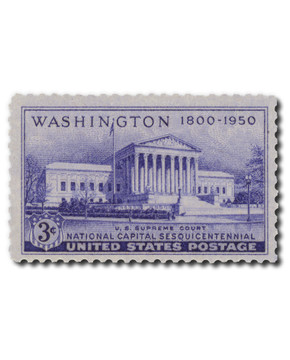
U.S. #991 pictures the U.S. Supreme Court Building to illustrate the Judicial branch of government. The building was completed in 1935. Before then, the Supreme Court met in various parts of the U.S. Capitol building.
The design for the US Capitol Building (shown on US #992) was the result of a 1792 competition. George Washington approved the design the following year and laid the cornerstone in September 1793. It wasn’t complete when the British set fire to it during the War if 1812. After repairs were made, construction and delays continued until the mid-1800s, when the dome was finally completed.
Set of 4 Stamps Honors 150th Anniversary of National Capital
A set of four U.S. stamps was issued in 1950 in honor of the 150th anniversary of the establishment of Washington, D.C., as the nation's capital. The stamps portrayed the three branches of government (Executive, Judicial, Legislative), as well as the concepts of Liberty and Freedom.
The idea that the capital be a district that was not part of any state was first put forth by James Madison, in Essay No. 43 of the Federalist Papers. The Compromise of 1790 resulted in the federal government assuming the war debt of the individual states in return for the placement of the national capital in the South.
A provision in the U.S. Constitution allowed for an area like a square of 10-mile sides. The land was donated by both Maryland and Virginia. The City of Washington and the Territory of Columbia were originally two separate entities, but in 1801, both the territory and the city (as well as neighboring cities Georgetown and Alexandria) were placed under the direct control of Congress. The federal government officially moved into the District in 1800.
The “Statue of Freedom,” pictured in U.S. #989, was designed by Thomas Crawford. It stands on top of the Capitol Dome in Washington, D.C. The statue was originally designed in 1855 as wearing a “Phrygian” cap – a historic symbol of freedom from slavery. But Jefferson Davis, then Secretary of War and in charge of the construction of the statue, strongly objected. He felt the use of the cap was a commentary against the practice of slavery in the South.
U.S. #990 is part of the National Capital Sesquicentennial set, and honors the Executive branch of government as represented by the White House. The White House was planned by architect Francis Hoban and completed in 1802.
U.S. #991 pictures the U.S. Supreme Court Building to illustrate the Judicial branch of government. The building was completed in 1935. Before then, the Supreme Court met in various parts of the U.S. Capitol building.
The design for the US Capitol Building (shown on US #992) was the result of a 1792 competition. George Washington approved the design the following year and laid the cornerstone in September 1793. It wasn’t complete when the British set fire to it during the War if 1812. After repairs were made, construction and delays continued until the mid-1800s, when the dome was finally completed.
Related Items
Save Up To 5%


Save Up To 10%


Most Orders Ship
within 1 Business Day
90 Day Return Policy
Satisfaction Guaranteed
Earn Reward Points
for FREE Stamps & More