Save Up To 5%


U.S. #1
1847 5¢ Benjamin Franklin, Red Brown
Value: 5¢ 1/2-Ounce Letter Rate (300 miles or less)
Issue Date: July 1, 1847
First Day City: Washington, DC
Type of Stamp: Definitive
Printed by: Rawdon, Wright, Hatch & Edson
Printing Method: Flat Plate
Format: Sheets of 200
Paper: Thin, Bluish Wove
Perforations: Imperforate
Quantity Printed: 3,600,000 (Estimate)
Own the One Stamp Every Collector Dreams Of... America's very first postage stamp. It's famous throughout the world and is in great demand among collectors everywhere.
On April 7, 1845, Postmaster General Cave Johnson received a letter from a concerned citizen named J. Smith Homan that read:
"Post offices are frequently closed before the business hours of merchants are over; and there are at present no conveniences for the pre-payment of postage after the offices are closed. Stamps for single and double letters, could be prepared with a trifling expense; and would secure the pre-payment of many thousand letters which otherwise w'd not be prepaid, in consequence of the inconvenience (in large cities particularly) of making payment in advance by the present method."
The 1840s were a time of rapid economic growth for the United States, and with that came a need for faster communication. With that in mind, it's likely Postmaster General Johnson received a number of letters such as this one asking for improved mailing policies.
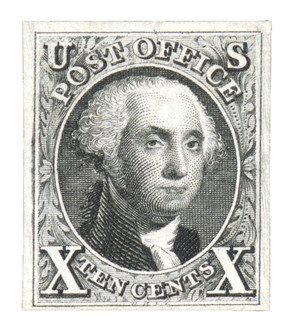
Great Britain had issued the world's first postage stamp in May 1840, but other countries took longer to adopt the idea. The United States instated new postal rates in 1845, then finally issued the first postage stamps on July 1, 1845. This included a 5c denomination with a portrait of Benjamin Franklin, America's first Postmaster General, and 10c stamp picturing George Washington. (Interestingly, Andrew Jackson was almost pictured instead of Franklin!)
Rawdon, Wright, Hatch & Edson was the firm selected to produce America's first postage stamps. They printed the 5c denomination in red brown, though a number of other collectible shades exist too. There are countless printing varieties available, as well as folded letters or envelopes with the stamp on-cover.
The 5¢ red-brown stamp was legal postage for any letter weighing up to half an ounce and being sent less than 300 miles. The portrait of Benjamin Franklin was based on a drawing by James Longacre. Nicknamed the "Father of America's Postal Service," the scientist, inventor, and statesman earned his place on America's first postage stamp.
The first US postage stamps were issued in large sheets without perforations. Postal clerks simply cut the stamps away from the sheet by hand. It's a miracle these stamps have survived over 175 years. Think of the caring hands that have protected it all this time. And now you can take your turn in preserving this scarce stamp for generations to come.
Now America’s first stamp is scarce. And attached to an original postally used cover, it’s even scarcer. In the past, collectors often removed the stamps and discarded the cover. Today they are both treasured.
Each cover is a unique piece of history – in the 1840s, commercially manufactured envelopes were scarcely seen in the U.S. People simply folded a piece of paper around their letter, sealing it with wax or another gum-like substance. These “homemade covers” are the forerunners of envelopes. And each one is different, so when you own one, you’re preserving history.
When you examine the detailed engraving of U.S. #1, it’s important to remember the primitive conditions in which these historic stamps were created over 175 years ago. There was no electric light - U.S. #1 stamps were produced by skilled craftsmen working by the light of whale-oil lamps. All things considered, it’s amazing those early printers were able to make the stamps as well as they did.
Other factors also contributed to poor alignment of U.S. stamps. As you know, America’s first postage stamps were issued imperforate (without perforations). Postal clerks separated them with a pair of scissors. It’s quite common to find U.S. #1 stamps with margins clipped close to the design or missing altogether. So although every one of these stamps is extremely desirable, examples with three or four margins intact are especially hard to find. And on cover – so much harder!
U.S. #1
1847 5¢ Benjamin Franklin, Red Brown
Value: 5¢ 1/2-Ounce Letter Rate (300 miles or less)
Issue Date: July 1, 1847
First Day City: Washington, DC
Type of Stamp: Definitive
Printed by: Rawdon, Wright, Hatch & Edson
Printing Method: Flat Plate
Format: Sheets of 200
Paper: Thin, Bluish Wove
Perforations: Imperforate
Quantity Printed: 3,600,000 (Estimate)
Own the One Stamp Every Collector Dreams Of... America's very first postage stamp. It's famous throughout the world and is in great demand among collectors everywhere.
On April 7, 1845, Postmaster General Cave Johnson received a letter from a concerned citizen named J. Smith Homan that read:
"Post offices are frequently closed before the business hours of merchants are over; and there are at present no conveniences for the pre-payment of postage after the offices are closed. Stamps for single and double letters, could be prepared with a trifling expense; and would secure the pre-payment of many thousand letters which otherwise w'd not be prepaid, in consequence of the inconvenience (in large cities particularly) of making payment in advance by the present method."
The 1840s were a time of rapid economic growth for the United States, and with that came a need for faster communication. With that in mind, it's likely Postmaster General Johnson received a number of letters such as this one asking for improved mailing policies.
Great Britain had issued the world's first postage stamp in May 1840, but other countries took longer to adopt the idea. The United States instated new postal rates in 1845, then finally issued the first postage stamps on July 1, 1845. This included a 5c denomination with a portrait of Benjamin Franklin, America's first Postmaster General, and 10c stamp picturing George Washington. (Interestingly, Andrew Jackson was almost pictured instead of Franklin!)
Rawdon, Wright, Hatch & Edson was the firm selected to produce America's first postage stamps. They printed the 5c denomination in red brown, though a number of other collectible shades exist too. There are countless printing varieties available, as well as folded letters or envelopes with the stamp on-cover.
The 5¢ red-brown stamp was legal postage for any letter weighing up to half an ounce and being sent less than 300 miles. The portrait of Benjamin Franklin was based on a drawing by James Longacre. Nicknamed the "Father of America's Postal Service," the scientist, inventor, and statesman earned his place on America's first postage stamp.
The first US postage stamps were issued in large sheets without perforations. Postal clerks simply cut the stamps away from the sheet by hand. It's a miracle these stamps have survived over 175 years. Think of the caring hands that have protected it all this time. And now you can take your turn in preserving this scarce stamp for generations to come.
Now America’s first stamp is scarce. And attached to an original postally used cover, it’s even scarcer. In the past, collectors often removed the stamps and discarded the cover. Today they are both treasured.
Each cover is a unique piece of history – in the 1840s, commercially manufactured envelopes were scarcely seen in the U.S. People simply folded a piece of paper around their letter, sealing it with wax or another gum-like substance. These “homemade covers” are the forerunners of envelopes. And each one is different, so when you own one, you’re preserving history.
When you examine the detailed engraving of U.S. #1, it’s important to remember the primitive conditions in which these historic stamps were created over 175 years ago. There was no electric light - U.S. #1 stamps were produced by skilled craftsmen working by the light of whale-oil lamps. All things considered, it’s amazing those early printers were able to make the stamps as well as they did.
Other factors also contributed to poor alignment of U.S. stamps. As you know, America’s first postage stamps were issued imperforate (without perforations). Postal clerks separated them with a pair of scissors. It’s quite common to find U.S. #1 stamps with margins clipped close to the design or missing altogether. So although every one of these stamps is extremely desirable, examples with three or four margins intact are especially hard to find. And on cover – so much harder!