

Zoom the image with the mouse
#C3-4
1931 Egypt
$180.00
Share:
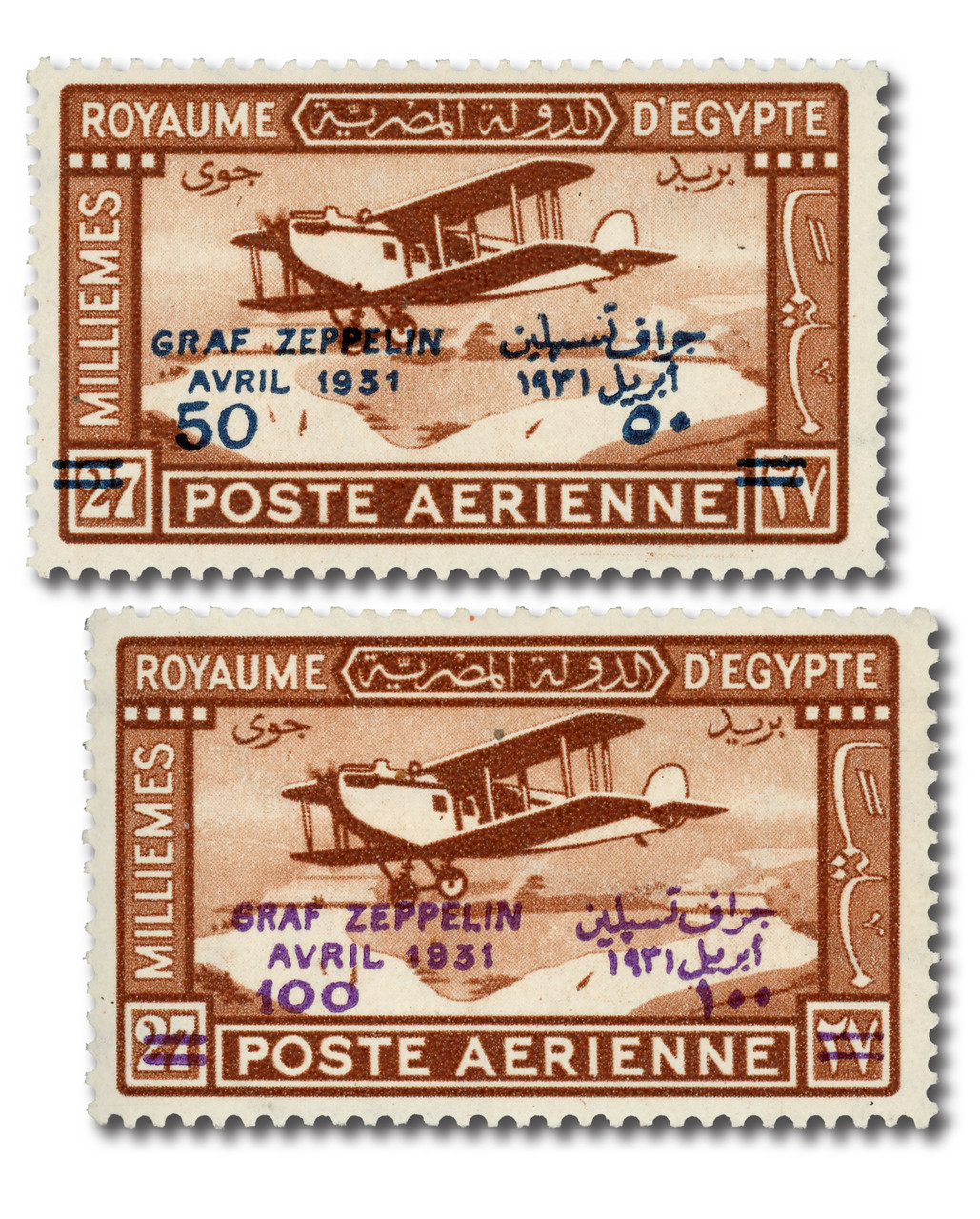
These Egyptian airmail stamps are associated with one of the most notable events in early aviation history: the 1931 flight of the Graf Zeppelin across the Middle East and Africa.
During the late 1920s and early 1930s, rigid airships such as the Graf Zeppelin represented the leading edge of long-distance air travel. Capable of carrying passengers, cargo, and mail over vast distances, Zeppelin flights captured worldwide attention and symbolized a brief but ambitious chapter in the development of international transportation and communication.
Rather than issuing entirely new stamp designs, Egypt adapted an existing airmail stamp first issued in 1929. For the Graf Zeppelin’s visit in April 1931, these stamps were overprinted with text identifying the flight and surcharged with new denominations appropriate for Zeppelin mail. This approach was common at the time, allowing postal administrations to quickly mark significant aviation events using stamps already in circulation.
The inscriptions appear in both French and Arabic, reflecting Egypt’s role as an international crossroads linking Europe, Africa, and the Middle East, as well as the multilingual nature of its postal system during the period. The underlying design depicts an aircraft flying over a desert landscape, reinforcing the theme of aviation overcoming geographic distance and challenging terrain.
These overprinted stamps form part of a broader group of Zeppelin-related postal material produced by countries along the airship’s routes. Together, they document an era when lighter-than-air flight briefly stood at the forefront of global transportation, before advances in airplane technology brought that chapter to a close.
Today, these stamps serve as a record of the Zeppelin age and Egypt’s place within the early history of long-distance air travel.
These Egyptian airmail stamps are associated with one of the most notable events in early aviation history: the 1931 flight of the Graf Zeppelin across the Middle East and Africa.
During the late 1920s and early 1930s, rigid airships such as the Graf Zeppelin represented the leading edge of long-distance air travel. Capable of carrying passengers, cargo, and mail over vast distances, Zeppelin flights captured worldwide attention and symbolized a brief but ambitious chapter in the development of international transportation and communication.
Rather than issuing entirely new stamp designs, Egypt adapted an existing airmail stamp first issued in 1929. For the Graf Zeppelin’s visit in April 1931, these stamps were overprinted with text identifying the flight and surcharged with new denominations appropriate for Zeppelin mail. This approach was common at the time, allowing postal administrations to quickly mark significant aviation events using stamps already in circulation.
The inscriptions appear in both French and Arabic, reflecting Egypt’s role as an international crossroads linking Europe, Africa, and the Middle East, as well as the multilingual nature of its postal system during the period. The underlying design depicts an aircraft flying over a desert landscape, reinforcing the theme of aviation overcoming geographic distance and challenging terrain.
These overprinted stamps form part of a broader group of Zeppelin-related postal material produced by countries along the airship’s routes. Together, they document an era when lighter-than-air flight briefly stood at the forefront of global transportation, before advances in airplane technology brought that chapter to a close.
Today, these stamps serve as a record of the Zeppelin age and Egypt’s place within the early history of long-distance air travel.
Related Items





Most Orders Ship
within 1 Business Day
90 Day Return Policy
Satisfaction Guaranteed
Earn Reward Points
for FREE Stamps & More