


Zoom the image with the mouse
#CZCO8
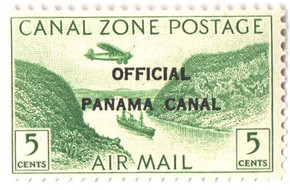
1941 5c Canal Zone Official Airmail, Gaillard Cut, Yellow Green, Panama Canal Overprint Type II
$275.00
Share:
This stamp began as a standard Canal Zone airmail issue depicting the Gaillard Cut, a critical section of the Panama Canal carved through the Continental Divide. Originally known as Culebra Cut, this stretch of the canal was renamed in 1915 to honor Colonel David du Bose Gaillard, the Army engineer who oversaw much of the excavation work through the unstable, landslide prone terrain before his death in 1913. The Gaillard Cut connected Gamboa on the Chagres River to Pedro Miguel on the Pacific side and remains one of the most demanding engineering achievements of the entire canal project.
In 1941, Canal Zone officials began overprinting existing airmail stamps with OFFICIAL and PANAMA CANAL for use by federal offices located within the territory. This practice continued through 1951, allowing government agencies to use a distinct stamp for official correspondence rather than stamps intended for general public sale. Roughly 51,000 of the 5 cent airmail stamps received this official overprint during the program's run, with two distinct overprint types produced over the years, identified by collectors as Type I and Type II based on small variations in the lettering.
The Panama Canal Zone existed as an unorganized United States territory from 1903 until 1979, governed under an agreement that granted the United States control over a strip of land roughly five miles wide on either side of the canal. Stamps like this one supported the daily administrative operations of that territory, moving official mail between the many federal offices stationed there. The Canal Zone's postal system continued issuing stamps until the territory was formally abolished in 1979 and the land returned to Panama.
This stamp began as a standard Canal Zone airmail issue depicting the Gaillard Cut, a critical section of the Panama Canal carved through the Continental Divide. Originally known as Culebra Cut, this stretch of the canal was renamed in 1915 to honor Colonel David du Bose Gaillard, the Army engineer who oversaw much of the excavation work through the unstable, landslide prone terrain before his death in 1913. The Gaillard Cut connected Gamboa on the Chagres River to Pedro Miguel on the Pacific side and remains one of the most demanding engineering achievements of the entire canal project.
In 1941, Canal Zone officials began overprinting existing airmail stamps with OFFICIAL and PANAMA CANAL for use by federal offices located within the territory. This practice continued through 1951, allowing government agencies to use a distinct stamp for official correspondence rather than stamps intended for general public sale. Roughly 51,000 of the 5 cent airmail stamps received this official overprint during the program's run, with two distinct overprint types produced over the years, identified by collectors as Type I and Type II based on small variations in the lettering.
The Panama Canal Zone existed as an unorganized United States territory from 1903 until 1979, governed under an agreement that granted the United States control over a strip of land roughly five miles wide on either side of the canal. Stamps like this one supported the daily administrative operations of that territory, moving official mail between the many federal offices stationed there. The Canal Zone's postal system continued issuing stamps until the territory was formally abolished in 1979 and the land returned to Panama.
Related Items


Most Orders Ship
within 1 Business Day
90 Day Return Policy
Satisfaction Guaranteed
Earn Reward Points
for FREE Stamps & More