


Zoom the image with the mouse
#DWI6e
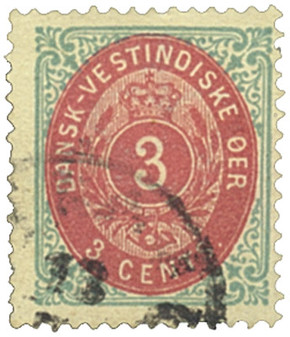
1874 3c Greenish Blue & Lake, Danish West Indies, Thick, Paper, Inverted Frame
$29.50
Share:
This 3-cent stamp from the Danish West Indies is part of the bicolor numeral series introduced in 1874, the first issue to replace the earlier coat of arms design that had served the colony since 1856. The design mirrors the numeral stamps then in use in Denmark itself, with a central oval bearing the denomination, royal crown, and colony name printed in one color, surrounded by an outer frame of intricate scrollwork printed in a contrasting color. On this stamp the frame runs greenish blue and the center lake red, a combination that required two separate passes through the press. The inverted frame variety occurs when the outer frame plate was fed into the press upside down relative to the center, producing a stamp where the scrollwork is rotated 180 degrees from its normal orientation. On the lower values of this series, including the 3-cent, inverted frames were produced in sufficient numbers that they were not considered errors at the time and were issued and used without remark.
The Danish West Indies consisted of three Caribbean islands — St. Thomas, St. John, and St. Croix — that Denmark had held since the 1670s, when the Danish West India Company established sugar plantations there using enslaved African labor. By 1874, when this stamp was issued, the sugar economy that had originally driven Danish colonial interest was in serious decline, undercut by European beet sugar production and the abolition of slavery in the islands in 1848. St. Thomas had reinvented itself as a free port and regional shipping hub, and its harbor remained one of the busiest in the Caribbean, but the broader colony was operating at a loss that Denmark would carry for decades.
The United States had attempted to purchase the Danish West Indies as far back as 1867, when Secretary of State William Seward negotiated a treaty of sale that the U.S. Senate ultimately failed to ratify. Negotiations resumed periodically over the following half century, and in 1917 Denmark finally sold the islands to the United States for $25 million in gold coin. The stamps of the Danish West Indies were then replaced by U.S. issues, and the colony was renamed the U.S. Virgin Islands. The name on this stamp, Dansk-Vestindiske Oer, translates simply as Danish West Indian Islands.
This 3-cent stamp from the Danish West Indies is part of the bicolor numeral series introduced in 1874, the first issue to replace the earlier coat of arms design that had served the colony since 1856. The design mirrors the numeral stamps then in use in Denmark itself, with a central oval bearing the denomination, royal crown, and colony name printed in one color, surrounded by an outer frame of intricate scrollwork printed in a contrasting color. On this stamp the frame runs greenish blue and the center lake red, a combination that required two separate passes through the press. The inverted frame variety occurs when the outer frame plate was fed into the press upside down relative to the center, producing a stamp where the scrollwork is rotated 180 degrees from its normal orientation. On the lower values of this series, including the 3-cent, inverted frames were produced in sufficient numbers that they were not considered errors at the time and were issued and used without remark.
The Danish West Indies consisted of three Caribbean islands — St. Thomas, St. John, and St. Croix — that Denmark had held since the 1670s, when the Danish West India Company established sugar plantations there using enslaved African labor. By 1874, when this stamp was issued, the sugar economy that had originally driven Danish colonial interest was in serious decline, undercut by European beet sugar production and the abolition of slavery in the islands in 1848. St. Thomas had reinvented itself as a free port and regional shipping hub, and its harbor remained one of the busiest in the Caribbean, but the broader colony was operating at a loss that Denmark would carry for decades.
The United States had attempted to purchase the Danish West Indies as far back as 1867, when Secretary of State William Seward negotiated a treaty of sale that the U.S. Senate ultimately failed to ratify. Negotiations resumed periodically over the following half century, and in 1917 Denmark finally sold the islands to the United States for $25 million in gold coin. The stamps of the Danish West Indies were then replaced by U.S. issues, and the colony was renamed the U.S. Virgin Islands. The name on this stamp, Dansk-Vestindiske Oer, translates simply as Danish West Indian Islands.
Related Items


Most Orders Ship
within 1 Business Day
90 Day Return Policy
Satisfaction Guaranteed
Earn Reward Points
for FREE Stamps & More