

Zoom the image with the mouse
#EP161
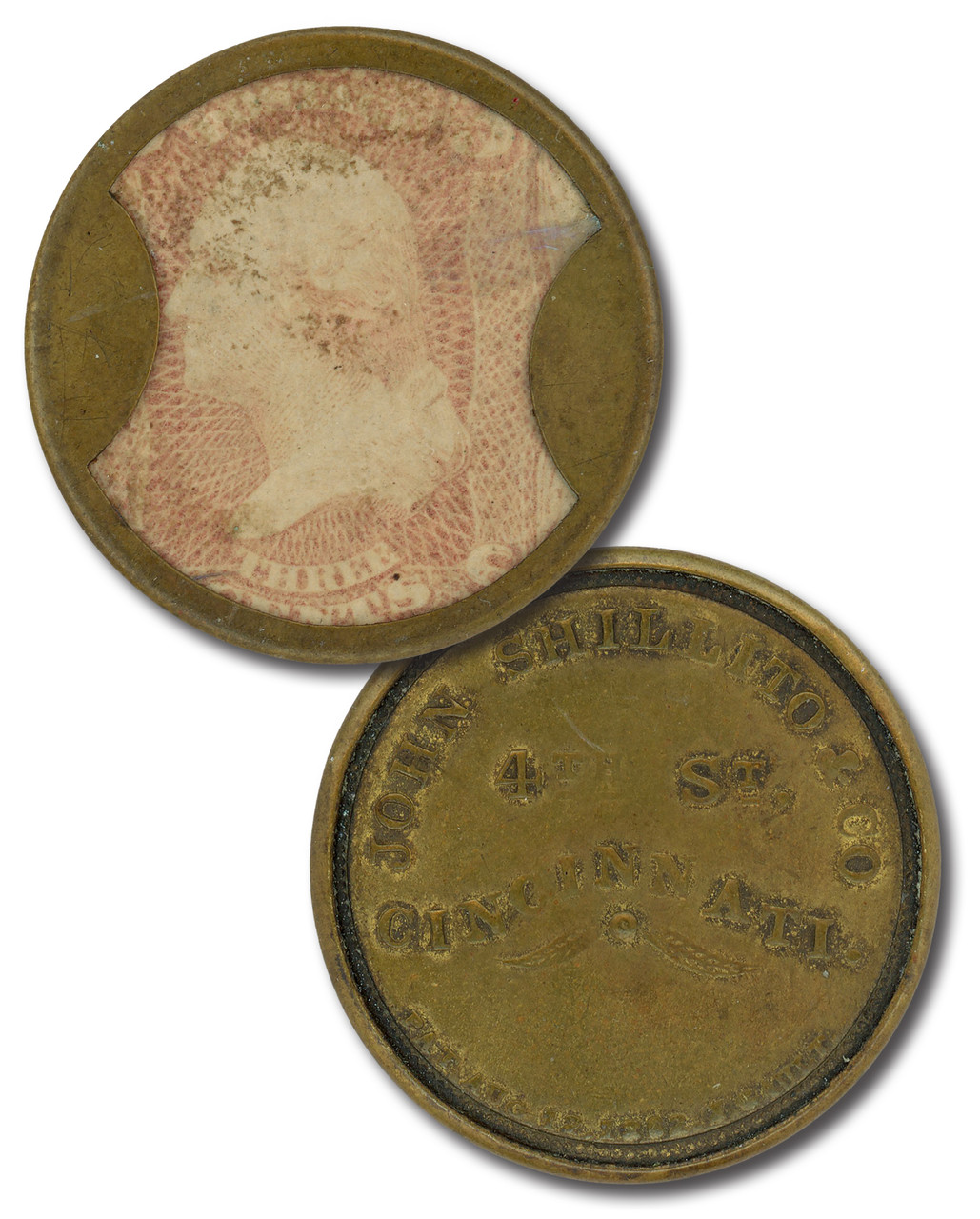
1862 3c Washington, John Shillito & Co., Cincinnati, Encased Postage
$995.00
Share:
By the summer of 1862, something alarming was happening in shops, markets, and counting houses across America — coins had all but vanished from everyday life.
It wasn't a mystery what was happening. The Civil War had shaken confidence in the future so thoroughly that ordinary people were doing what frightened people always do: they were holding on to anything that felt solid. Gold and silver disappeared into mattresses, tin boxes, and coat pockets. Even copper pennies were worth hoarding. And without small change, commerce started to seize up. Shopkeepers couldn't make change. Customers couldn't pay exact amounts. A simple transaction — a loaf of bread, a newspaper, a stamp — became a minor ordeal.
The U.S. government tried to bridge the gap by declaring that postage stamps could be used as currency. It was a practical idea that ran headlong into a practical problem: loose stamps are flimsy things. They stick together, they tear, they disintegrate in a coat pocket after a few days of handling. Spending them was harder than it sounded.
A Boston businessman named John Gault saw the problem and patented a solution. He designed a small brass frame — about the size of a large button — that held a postage stamp behind a protective window of mica. The denomination was visible through the front. The back was a flat brass disc, and Gault had the insight to sell that space to advertisers: druggists, dry goods merchants, patent medicine makers, sewing machine companies. Businesses from across the country paid to put their names on something that was passing through American hands dozens of times a day.
Encased postage was in active use for only about a year before the Treasury introduced fractional paper currency and made them obsolete. That short window — combined with the fragility of the mica and the stamps inside — is a big part of why survivors in decent condition are so hard to come by today.
What you're looking at, when you hold one of these, is a small brass artifact that was handled by real people in one of the most uncertain years in American history. It was spent at a counter somewhere, pocketed and passed on, doing the quiet work of keeping daily life moving while the country tore itself apart around it.
John Shillito & Co., commonly known as Shillito's, was Cincinnati's first department store, founded in 1830 when John Shillito established a dry goods partnership on Main Street. Born in Pennsylvania in 1808, Shillito arrived in Cincinnati at age nine and spent thirteen years working for local merchants before striking out on his own. Through a series of partnerships and buyouts he gained sole control of the business, building a four-story Renaissance Revival store on Fourth Street in 1857 and then an even grander flagship at Race and Seventh Streets in 1878. That landmark building, modeled after Paris's Le Bon Marché, featured marble staircases, passenger elevators, a 58-foot skylight dome, and fireproof iron construction, and was marketed as the largest department store west of New York City.
John Shillito died in 1879, just a year after the new flagship opened, and his sons carried the business forward under the company slogan "Truth Always, Facts Only." After the 1925 death of his son Stewart, the store was sold to the Lazarus family of Columbus, Ohio, who revitalized it through modernization and a major Depression-era expansion. The Lazarus acquisition made Shillito's a founding anchor of what became Federated Department Stores, and the chain was eventually rebranded as Lazarus in 1986 before being absorbed into Macy's. The original 1878 building still stands in downtown Cincinnati, today converted into condominiums.
By the summer of 1862, something alarming was happening in shops, markets, and counting houses across America — coins had all but vanished from everyday life.
It wasn't a mystery what was happening. The Civil War had shaken confidence in the future so thoroughly that ordinary people were doing what frightened people always do: they were holding on to anything that felt solid. Gold and silver disappeared into mattresses, tin boxes, and coat pockets. Even copper pennies were worth hoarding. And without small change, commerce started to seize up. Shopkeepers couldn't make change. Customers couldn't pay exact amounts. A simple transaction — a loaf of bread, a newspaper, a stamp — became a minor ordeal.
The U.S. government tried to bridge the gap by declaring that postage stamps could be used as currency. It was a practical idea that ran headlong into a practical problem: loose stamps are flimsy things. They stick together, they tear, they disintegrate in a coat pocket after a few days of handling. Spending them was harder than it sounded.
A Boston businessman named John Gault saw the problem and patented a solution. He designed a small brass frame — about the size of a large button — that held a postage stamp behind a protective window of mica. The denomination was visible through the front. The back was a flat brass disc, and Gault had the insight to sell that space to advertisers: druggists, dry goods merchants, patent medicine makers, sewing machine companies. Businesses from across the country paid to put their names on something that was passing through American hands dozens of times a day.
Encased postage was in active use for only about a year before the Treasury introduced fractional paper currency and made them obsolete. That short window — combined with the fragility of the mica and the stamps inside — is a big part of why survivors in decent condition are so hard to come by today.
What you're looking at, when you hold one of these, is a small brass artifact that was handled by real people in one of the most uncertain years in American history. It was spent at a counter somewhere, pocketed and passed on, doing the quiet work of keeping daily life moving while the country tore itself apart around it.
John Shillito & Co., commonly known as Shillito's, was Cincinnati's first department store, founded in 1830 when John Shillito established a dry goods partnership on Main Street. Born in Pennsylvania in 1808, Shillito arrived in Cincinnati at age nine and spent thirteen years working for local merchants before striking out on his own. Through a series of partnerships and buyouts he gained sole control of the business, building a four-story Renaissance Revival store on Fourth Street in 1857 and then an even grander flagship at Race and Seventh Streets in 1878. That landmark building, modeled after Paris's Le Bon Marché, featured marble staircases, passenger elevators, a 58-foot skylight dome, and fireproof iron construction, and was marketed as the largest department store west of New York City.
John Shillito died in 1879, just a year after the new flagship opened, and his sons carried the business forward under the company slogan "Truth Always, Facts Only." After the 1925 death of his son Stewart, the store was sold to the Lazarus family of Columbus, Ohio, who revitalized it through modernization and a major Depression-era expansion. The Lazarus acquisition made Shillito's a founding anchor of what became Federated Department Stores, and the chain was eventually rebranded as Lazarus in 1986 before being absorbed into Macy's. The original 1878 building still stands in downtown Cincinnati, today converted into condominiums.
Related Items


Most Orders Ship
within 1 Business Day
90 Day Return Policy
Satisfaction Guaranteed
Earn Reward Points
for FREE Stamps & More