

Zoom the image with the mouse
#H30
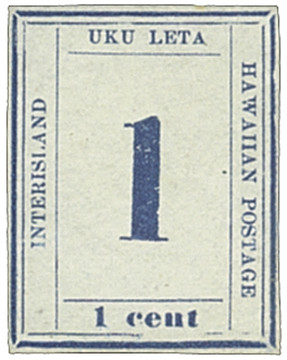
1886 1c Princess Victoria Kamamalu, Purple, Hawaii
$22.00
Share:
This 1¢ stamp was issued to cover the inland postage rate on printed material. It was designed by Thomas G. Thrum, a publisher and stamp collector, who lived in Honolulu. First issued in mauve (this stamp was printed in purple), it is easily mistaken for a faded stamp, because the stamps were such a pale shade when they were originally printed.
This stamp depicts Princess Victoria Kamamalu, one of the most prominent figures in 19th century Hawaiian royal history. Born in 1838 at the Honolulu Fort, she was the granddaughter of Kamehameha I, the founder of the unified Hawaiian Kingdom, and the sister of two kings — Alexander Liholiho, who reigned as Kamehameha IV, and Lot Kamehameha, who reigned as Kamehameha V. At 16 she was named Kuhina Nui, a position roughly equivalent to prime minister that carried equal authority to the king in matters of government. She held that office for nearly a decade, and when her brother Kamehameha IV died unexpectedly in 1863 without having named an heir, it was Victoria who formally proclaimed Lot the rightful successor, a constitutional act that helped secure the peaceful transfer of power.
She was also named heiress apparent to the throne in 1863, meaning that had she outlived her brother, she would have become queen. She did not. Victoria Kamamalu died in May 1866 at the age of 27 from an illness that was never clearly identified, leaving her vast landholdings and her place in the line of succession behind. She had also founded the Kaahumanu Society just two years before her death, an organization devoted to the care of the elderly and ill that remains the oldest Hawaiian civic society in existence. This stamp was issued in 1886, twenty years after her death, as part of a Hawaiian definitives series that honored the kingdom's royal figures. The denomination is expressed in Hawaiian as Akahi Keneta, meaning one cent.
Hawaii operated its own postal system as an independent kingdom until annexation by the United States in 1898, after which Hawaiian stamps were replaced by U.S. issues. The stamps from this period document a sovereign postal history that lasted less than half a century, and the portraits they carry are among the few widely distributed likenesses of the Hawaiian royalty who shaped the kingdom in its final decades.
This 1¢ stamp was issued to cover the inland postage rate on printed material. It was designed by Thomas G. Thrum, a publisher and stamp collector, who lived in Honolulu. First issued in mauve (this stamp was printed in purple), it is easily mistaken for a faded stamp, because the stamps were such a pale shade when they were originally printed.
This stamp depicts Princess Victoria Kamamalu, one of the most prominent figures in 19th century Hawaiian royal history. Born in 1838 at the Honolulu Fort, she was the granddaughter of Kamehameha I, the founder of the unified Hawaiian Kingdom, and the sister of two kings — Alexander Liholiho, who reigned as Kamehameha IV, and Lot Kamehameha, who reigned as Kamehameha V. At 16 she was named Kuhina Nui, a position roughly equivalent to prime minister that carried equal authority to the king in matters of government. She held that office for nearly a decade, and when her brother Kamehameha IV died unexpectedly in 1863 without having named an heir, it was Victoria who formally proclaimed Lot the rightful successor, a constitutional act that helped secure the peaceful transfer of power.
She was also named heiress apparent to the throne in 1863, meaning that had she outlived her brother, she would have become queen. She did not. Victoria Kamamalu died in May 1866 at the age of 27 from an illness that was never clearly identified, leaving her vast landholdings and her place in the line of succession behind. She had also founded the Kaahumanu Society just two years before her death, an organization devoted to the care of the elderly and ill that remains the oldest Hawaiian civic society in existence. This stamp was issued in 1886, twenty years after her death, as part of a Hawaiian definitives series that honored the kingdom's royal figures. The denomination is expressed in Hawaiian as Akahi Keneta, meaning one cent.
Hawaii operated its own postal system as an independent kingdom until annexation by the United States in 1898, after which Hawaiian stamps were replaced by U.S. issues. The stamps from this period document a sovereign postal history that lasted less than half a century, and the portraits they carry are among the few widely distributed likenesses of the Hawaiian royalty who shaped the kingdom in its final decades.
Related Items




Most Orders Ship
within 1 Business Day
90 Day Return Policy
Satisfaction Guaranteed
Earn Reward Points
for FREE Stamps & More