


Zoom the image with the mouse
#H57
1893 2c Princess Victoria Kamamalu, Dull Violet, Hawaii, Red Overprint
$8.50
Share:
1893 Hawaii Overprints Document Political Changes
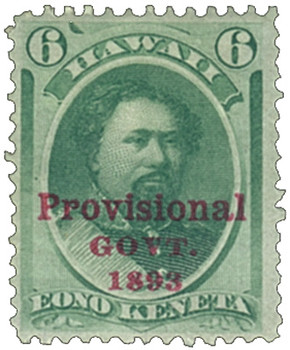
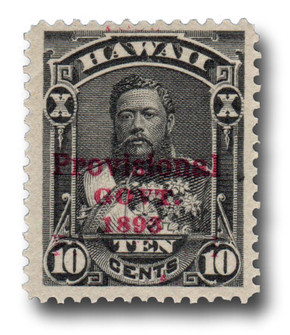
Scott #H57 is a 2-cent dull violet Hawaii stamp from the Kingdom of Hawaii's regular issue, overprinted "Provisional GOVT. 1893" in red. The underlying stamp features a portrait of Princess Victoria Kamamalu, granddaughter of King Kamehameha I and sister of Kings Kamehameha IV and V. The red overprint color was chosen because it provided the best contrast against the violet background of this particular stamp. Overprinting of the stamps was carried out with considerable haste by the Hawaiian Gazette Company, and the first overprinted stamps went on sale to the public on May 20, 1893.
The story behind the overprint is one of the most dramatic in Hawaiian history. On January 17, 1893, Queen Liliuokalani — the last reigning monarch of Hawaii — was overthrown by a group of American and European businessmen who wanted the islands annexed by the United States. U.S. Marines from the warship USS Boston came ashore that day, and a provisional government was established the following day under Sanford B. Dole. When annexation stalled in Washington, the provisional government found itself presiding over a kingdom in limbo. The existing stamps, bearing the portraits of Hawaiian royalty, were an awkward symbol for the new regime — so on April 5, 1893, the provisional Cabinet voted to overprint them as a practical stopgap while the political situation sorted itself out.
News of the overprint sale was widely publicized, and collectors, dealers, and speculators traveled from the United States and Europe to obtain examples on the first day of issue. The crowds were so large that ordinary Hawaiian residents had difficulty buying postage stamps for several days. A total of 13 stamp denominations were overprinted in red and 10 in black, depending on which color provided better contrast. The stamps remained on sale until December 31, 1896, when remaining inventory was destroyed. Hawaii was ultimately annexed by the United States on July 7, 1898, and U.S. stamps replaced Hawaiian issues on June 14, 1900.
1893 Hawaii Overprints Document Political Changes
Scott #H57 is a 2-cent dull violet Hawaii stamp from the Kingdom of Hawaii's regular issue, overprinted "Provisional GOVT. 1893" in red. The underlying stamp features a portrait of Princess Victoria Kamamalu, granddaughter of King Kamehameha I and sister of Kings Kamehameha IV and V. The red overprint color was chosen because it provided the best contrast against the violet background of this particular stamp. Overprinting of the stamps was carried out with considerable haste by the Hawaiian Gazette Company, and the first overprinted stamps went on sale to the public on May 20, 1893.
The story behind the overprint is one of the most dramatic in Hawaiian history. On January 17, 1893, Queen Liliuokalani — the last reigning monarch of Hawaii — was overthrown by a group of American and European businessmen who wanted the islands annexed by the United States. U.S. Marines from the warship USS Boston came ashore that day, and a provisional government was established the following day under Sanford B. Dole. When annexation stalled in Washington, the provisional government found itself presiding over a kingdom in limbo. The existing stamps, bearing the portraits of Hawaiian royalty, were an awkward symbol for the new regime — so on April 5, 1893, the provisional Cabinet voted to overprint them as a practical stopgap while the political situation sorted itself out.
News of the overprint sale was widely publicized, and collectors, dealers, and speculators traveled from the United States and Europe to obtain examples on the first day of issue. The crowds were so large that ordinary Hawaiian residents had difficulty buying postage stamps for several days. A total of 13 stamp denominations were overprinted in red and 10 in black, depending on which color provided better contrast. The stamps remained on sale until December 31, 1896, when remaining inventory was destroyed. Hawaii was ultimately annexed by the United States on July 7, 1898, and U.S. stamps replaced Hawaiian issues on June 14, 1900.
Related Items





Most Orders Ship
within 1 Business Day
90 Day Return Policy
Satisfaction Guaranteed
Earn Reward Points
for FREE Stamps & More