

Zoom the image with the mouse
#M3225
Danzig, 25 Different Stamps
$16.00
Share:
A City-State That No Longer Exists —
25 Different Stamps from the Free City of Danzig
The Free City of Danzig existed for exactly 19 years — from 1920, when the Treaty of Versailles stripped Germany of the Baltic port city and placed it under League of Nations protection, until September 1, 1939, when Nazi Germany annexed it on the first day of World War II. In those 19 years, this semi-autonomous city-state on the Baltic coast issued its own stamps, its own currency, and governed its own internal affairs — a political arrangement without parallel in modern European history.
Today the city is Gdańsk, Poland. The stamps of the Free City of Danzig are all that remain of its brief postal sovereignty, and every one of them was printed during one of the most turbulent decades in European history: hyperinflation, economic depression, the rise of Nazism, and the final crisis that triggered the Second World War.
Selections will vary, but here are some stamps and topics you may find in your packet:
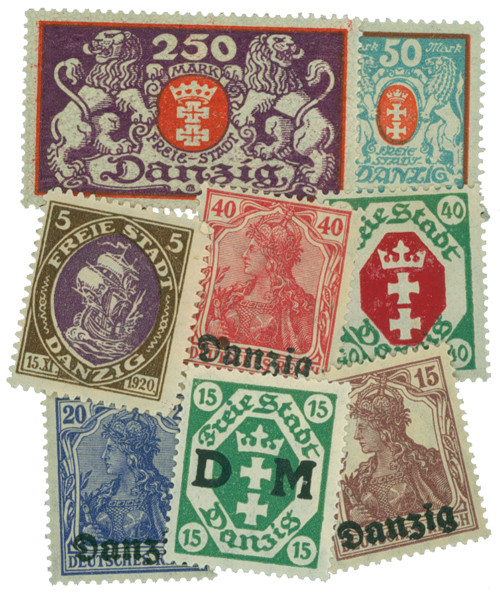
- German "Germania" stamps overprinted "Danzig" — the first Danzig stamps were simply German Empire stamps — featuring the allegorical female figure known as Germania — overprinted with the word "Danzig" in 1920. These transitional issues, available in blue, red, brown, and other colors across multiple denominations, mark the exact moment the city changed postal administrations. Some values were also printed with a fine network of lines called burelage on the paper, a security measure to prevent cleaning and reuse.
- Hanseatic trading ship (Freie Stadt Danzig, 1921) — the first stamps designed specifically for the Free City, issued January 31, 1921. The design features a medieval Hanseatic sailing ship, a deliberate nod to Danzig's centuries-old membership in the Hanseatic League trading network. When the League of Nations refused Danzig's request to be officially named the "Free Hanseatic City of Danzig," the city put its Hanseatic identity on its stamps instead.
- Coat of arms definitives — two distinct coat of arms designs anchor the Danzig definitive series. One places the shield — the Danzig cross surmounted by a Polish crown — in an octagonal frame; the other flanks it with two lions in a larger, more formal heraldic composition. High-denomination values in the latter design, reaching 250 Mark and 50 Mark, were printed during the hyperinflation of 1923, when postal rates were rising faster than new stamps could be printed.
- "D.M." official stamps — coat of arms stamps overprinted "D M," an abbreviation for Dienstmarke (official stamp), were issued from 1921 to 1924 for use on government correspondence. These are a distinct collecting category within the Danzig catalog, used only on official mail of the Free City's administration.
Twenty-five stamps from a city-state that lasted less than two decades before being erased from the map — making every Danzig stamp a document of a world that no longer exists. Every packet is different — order today and see what you get.
A City-State That No Longer Exists —
25 Different Stamps from the Free City of Danzig
The Free City of Danzig existed for exactly 19 years — from 1920, when the Treaty of Versailles stripped Germany of the Baltic port city and placed it under League of Nations protection, until September 1, 1939, when Nazi Germany annexed it on the first day of World War II. In those 19 years, this semi-autonomous city-state on the Baltic coast issued its own stamps, its own currency, and governed its own internal affairs — a political arrangement without parallel in modern European history.
Today the city is Gdańsk, Poland. The stamps of the Free City of Danzig are all that remain of its brief postal sovereignty, and every one of them was printed during one of the most turbulent decades in European history: hyperinflation, economic depression, the rise of Nazism, and the final crisis that triggered the Second World War.
Selections will vary, but here are some stamps and topics you may find in your packet:
- German "Germania" stamps overprinted "Danzig" — the first Danzig stamps were simply German Empire stamps — featuring the allegorical female figure known as Germania — overprinted with the word "Danzig" in 1920. These transitional issues, available in blue, red, brown, and other colors across multiple denominations, mark the exact moment the city changed postal administrations. Some values were also printed with a fine network of lines called burelage on the paper, a security measure to prevent cleaning and reuse.
- Hanseatic trading ship (Freie Stadt Danzig, 1921) — the first stamps designed specifically for the Free City, issued January 31, 1921. The design features a medieval Hanseatic sailing ship, a deliberate nod to Danzig's centuries-old membership in the Hanseatic League trading network. When the League of Nations refused Danzig's request to be officially named the "Free Hanseatic City of Danzig," the city put its Hanseatic identity on its stamps instead.
- Coat of arms definitives — two distinct coat of arms designs anchor the Danzig definitive series. One places the shield — the Danzig cross surmounted by a Polish crown — in an octagonal frame; the other flanks it with two lions in a larger, more formal heraldic composition. High-denomination values in the latter design, reaching 250 Mark and 50 Mark, were printed during the hyperinflation of 1923, when postal rates were rising faster than new stamps could be printed.
- "D.M." official stamps — coat of arms stamps overprinted "D M," an abbreviation for Dienstmarke (official stamp), were issued from 1921 to 1924 for use on government correspondence. These are a distinct collecting category within the Danzig catalog, used only on official mail of the Free City's administration.
Twenty-five stamps from a city-state that lasted less than two decades before being erased from the map — making every Danzig stamp a document of a world that no longer exists. Every packet is different — order today and see what you get.
Related Items

Save Up To 19%



Save Up To 11%


Most Orders Ship
within 1 Business Day
90 Day Return Policy
Satisfaction Guaranteed
Earn Reward Points
for FREE Stamps & More