

Zoom the image with the mouse
#MCV516
1965 Pope Paul VI, 6 Travel Covers
$14.95
$7.95
Save Up To 47%
Share:
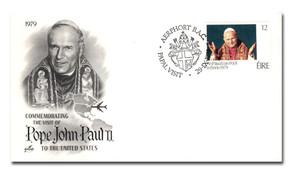
This group of covers commemorates one of the most historically significant events of the 1960s — Pope Paul VI's visit to New York City on October 4, 1965, which marked the first time a reigning pope had ever set foot in the United States, or anywhere in the Americas. The primary purpose of the trip was to address the United Nations General Assembly on the subject of world peace, with the date deliberately chosen to coincide with the feast day of Saint Francis of Assisi — the namesake of San Francisco, where the United Nations had been founded. An estimated one million people saw the pope in person during his visit, while 100 million watched on television, making it one of the most widely witnessed events of the era.
The covers reflect the philatelic enthusiasm this landmark event generated. The cachets, boldly illustrated in blue and black with portraits of Paul VI and images of St. Peter's Basilica, carry the inscription "Commemorating the Visit of Pope Paul VI to the United Nations — New York." The stamps and cancels visible across the group are equally varied and interesting — including U.S. International Cooperation Year stamps, United Nations "Live Together in Peace" issues, and a striking group of Vatican "Paulus VI P.M. Pacis Nuntius" stamps — with cancels from New York, the Bronx, Jamaica, and the 1965 World's Fair. The addresses on several covers read "Pray for Peace, 1776 Springfield Avenue, Maplewood, New Jersey," a detail that adds a touching period character to the group.
During his UN address, Paul VI delivered what became one of the most quoted papal speeches of the 20th century, pleading for disarmament and declaring "No more war — war never again!" He also met with President Lyndon B. Johnson at the Waldorf Astoria, celebrated Mass at Yankee Stadium before a crowd of 90,000, and visited the Vatican Pavilion at the New York World's Fair. Pope Paul VI — known as "the Pilgrim Pope" for his extensive travels — was canonized by Pope Francis in October 2018. These covers stand as a direct philatelic record of a singular moment in modern papal and world history.
This group of covers commemorates one of the most historically significant events of the 1960s — Pope Paul VI's visit to New York City on October 4, 1965, which marked the first time a reigning pope had ever set foot in the United States, or anywhere in the Americas. The primary purpose of the trip was to address the United Nations General Assembly on the subject of world peace, with the date deliberately chosen to coincide with the feast day of Saint Francis of Assisi — the namesake of San Francisco, where the United Nations had been founded. An estimated one million people saw the pope in person during his visit, while 100 million watched on television, making it one of the most widely witnessed events of the era.
The covers reflect the philatelic enthusiasm this landmark event generated. The cachets, boldly illustrated in blue and black with portraits of Paul VI and images of St. Peter's Basilica, carry the inscription "Commemorating the Visit of Pope Paul VI to the United Nations — New York." The stamps and cancels visible across the group are equally varied and interesting — including U.S. International Cooperation Year stamps, United Nations "Live Together in Peace" issues, and a striking group of Vatican "Paulus VI P.M. Pacis Nuntius" stamps — with cancels from New York, the Bronx, Jamaica, and the 1965 World's Fair. The addresses on several covers read "Pray for Peace, 1776 Springfield Avenue, Maplewood, New Jersey," a detail that adds a touching period character to the group.
During his UN address, Paul VI delivered what became one of the most quoted papal speeches of the 20th century, pleading for disarmament and declaring "No more war — war never again!" He also met with President Lyndon B. Johnson at the Waldorf Astoria, celebrated Mass at Yankee Stadium before a crowd of 90,000, and visited the Vatican Pavilion at the New York World's Fair. Pope Paul VI — known as "the Pilgrim Pope" for his extensive travels — was canonized by Pope Francis in October 2018. These covers stand as a direct philatelic record of a singular moment in modern papal and world history.
Related Items

Save Up To 46%


Most Orders Ship
within 1 Business Day
90 Day Return Policy
Satisfaction Guaranteed
Earn Reward Points
for FREE Stamps & More