

Zoom the image with the mouse
#MP1013
Czech Republic, 50 Different Stamps
$13.00
Share:
From the Velvet Revolution
to the Heart of Europe —
50 Different Czech Republic Stamps
The Czech Republic was born peacefully. In November 1989, hundreds of thousands of citizens took to the streets of Prague in a series of nonviolent protests that brought down four decades of communist rule in just ten days. The world called it the Velvet Revolution. On January 1, 1993, the country completed its transformation when Czechoslovakia amicably divided into two nations — and the Czech Republic began issuing its own stamps, inscribed ČESKÁ REPUBLIKA, for the first time.
What followed was a postal catalog that reflects one of Central Europe's richest cultures: a country of medieval castles, Gothic cathedrals, world-class composers, and ancient forests. The Czech Republic joined the European Union in 2004, a milestone that appears on its stamps as clearly as any portrait or landscape. And throughout it all, Czech stamp designers have maintained one of the finest engraving traditions in European philately — producing stamps that are prized for their artistic quality as much as their subjects.
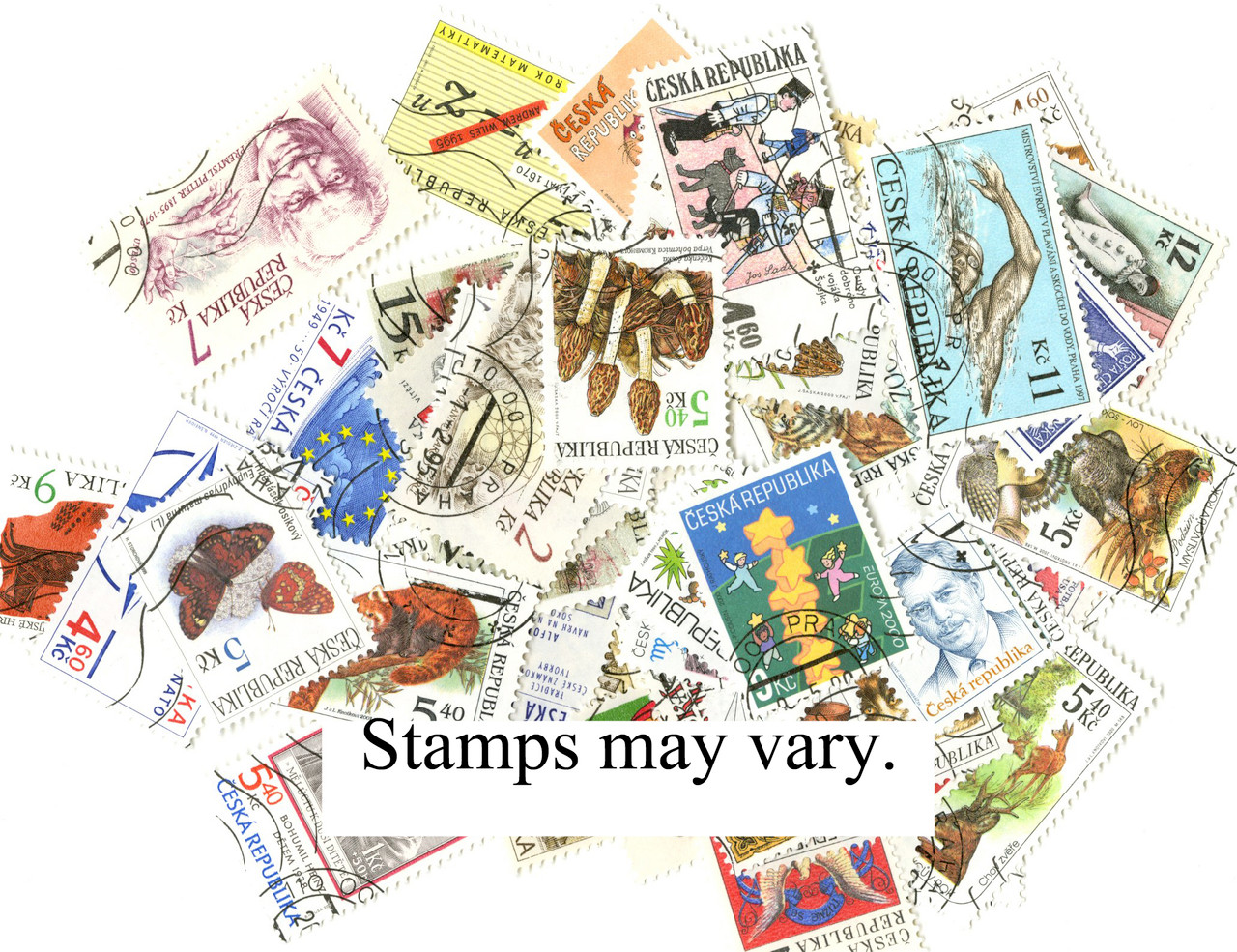
Selections will vary, but here are some stamps and topics you may find in your packet:
- Wildlife and nature definitives — Czech stamps have long celebrated the country's remarkable biodiversity. You may find richly illustrated butterflies, birds of prey, freshwater fish, bears, or forest flora — all rendered with the precise, detailed style that distinguishes Czech nature issues from those of any other European nation. Pinecones, fungi, and botanical subjects appear alongside fauna in a catalog that treats the natural world as seriously as any museum.
- EU accession commemoratives — the Czech Republic joined the European Union on May 1, 2004, alongside nine other nations in the largest single expansion in EU history. Stamps marking this milestone — often featuring the EU's circle of stars against blue — are a philatelic record of a defining moment in post-Cold War European history, and a direct product of the democratic transformation that began with the Velvet Revolution.
- Historical figures and portraits — Czech stamps honor a long roll call of the country's composers, writers, scientists, and statesmen. The engraved portrait tradition that Czechoslovakia perfected over decades continues in the Czech Republic's issues, producing stamps whose fine line work rivals the best European intaglio printing of any era.
- Postal history commemoratives — the image of a courier on horseback, visible in many Czech stamp series, connects the modern republic to the long tradition of Central European postal routes that once linked the cities of the Austro-Hungarian Empire. These historical mail subjects are popular with both postal history collectors and European thematic specialists.
Fifty stamps from a country that transformed itself from behind the Iron Curtain to the heart of a united Europe — all within living memory. Every packet is different — order today and see what you get.
From the Velvet Revolution
to the Heart of Europe —
50 Different Czech Republic Stamps
The Czech Republic was born peacefully. In November 1989, hundreds of thousands of citizens took to the streets of Prague in a series of nonviolent protests that brought down four decades of communist rule in just ten days. The world called it the Velvet Revolution. On January 1, 1993, the country completed its transformation when Czechoslovakia amicably divided into two nations — and the Czech Republic began issuing its own stamps, inscribed ČESKÁ REPUBLIKA, for the first time.
What followed was a postal catalog that reflects one of Central Europe's richest cultures: a country of medieval castles, Gothic cathedrals, world-class composers, and ancient forests. The Czech Republic joined the European Union in 2004, a milestone that appears on its stamps as clearly as any portrait or landscape. And throughout it all, Czech stamp designers have maintained one of the finest engraving traditions in European philately — producing stamps that are prized for their artistic quality as much as their subjects.
Selections will vary, but here are some stamps and topics you may find in your packet:
- Wildlife and nature definitives — Czech stamps have long celebrated the country's remarkable biodiversity. You may find richly illustrated butterflies, birds of prey, freshwater fish, bears, or forest flora — all rendered with the precise, detailed style that distinguishes Czech nature issues from those of any other European nation. Pinecones, fungi, and botanical subjects appear alongside fauna in a catalog that treats the natural world as seriously as any museum.
- EU accession commemoratives — the Czech Republic joined the European Union on May 1, 2004, alongside nine other nations in the largest single expansion in EU history. Stamps marking this milestone — often featuring the EU's circle of stars against blue — are a philatelic record of a defining moment in post-Cold War European history, and a direct product of the democratic transformation that began with the Velvet Revolution.
- Historical figures and portraits — Czech stamps honor a long roll call of the country's composers, writers, scientists, and statesmen. The engraved portrait tradition that Czechoslovakia perfected over decades continues in the Czech Republic's issues, producing stamps whose fine line work rivals the best European intaglio printing of any era.
- Postal history commemoratives — the image of a courier on horseback, visible in many Czech stamp series, connects the modern republic to the long tradition of Central European postal routes that once linked the cities of the Austro-Hungarian Empire. These historical mail subjects are popular with both postal history collectors and European thematic specialists.
Fifty stamps from a country that transformed itself from behind the Iron Curtain to the heart of a united Europe — all within living memory. Every packet is different — order today and see what you get.
Related Items

Save Up To 19%



Save Up To 11%


Most Orders Ship
within 1 Business Day
90 Day Return Policy
Satisfaction Guaranteed
Earn Reward Points
for FREE Stamps & More