

Zoom the image with the mouse
#MP2098
Armenia Stamps, 48 Different
$79.95
Share:
From Ancient Kingdom to Soviet Republic —
Own 48 Stamps That Survived One of History's
Most Dramatic Transformations
Few countries have packed as much heartbreak, resilience, and sheer drama into a few short years as Armenia did between 1918 and 1923. In that span, a proud nation declared its independence for the first time in over 500 years — then watched it slip away as Soviet forces swept in and rewrote everything, right down to the postage stamps.
That's exactly what makes Armenian stamps from this era so extraordinary. These 48 different stamps document a country in the midst of seismic change. You'll hold stamps from the newly independent Republic of Armenia — imbued with the national symbols of a people who had just survived genocide and fought off invasion to claim their freedom. Then, almost overnight, the imagery shifts: hammers and sickles appear, Soviet stars replace eagles, and the triumphant slogan "Proletarians of All Countries, Unite!" is printed in Armenian script across stamps measured in millions of rubles, as hyperinflation consumed the economy.
Few other stamp-issuing periods in the world capture a nation's identity being literally overwritten in real time.
Armenia itself is ancient beyond measure — a civilization stretching back more than 3,000 years, home to the world's first Christian nation (Armenia adopted Christianity as its state religion in 301 AD, more than a decade before Rome), and cradled by the shadow of Mount Ararat, the biblical mountain where Noah's Ark came to rest. Ararat isn't just geography to Armenians — it's soul. It appears again and again on these stamps, a snow-capped twin-peaked presence that watched over a people through conquest after conquest, and endured.
The Armenian language, with its unique alphabet created by the monk Mesrop Mashtots in 405 AD, adorns every stamp in this collection — itself a quiet act of cultural defiance across regimes.
While selections will vary, the one I looked through had some fascinating stamps:
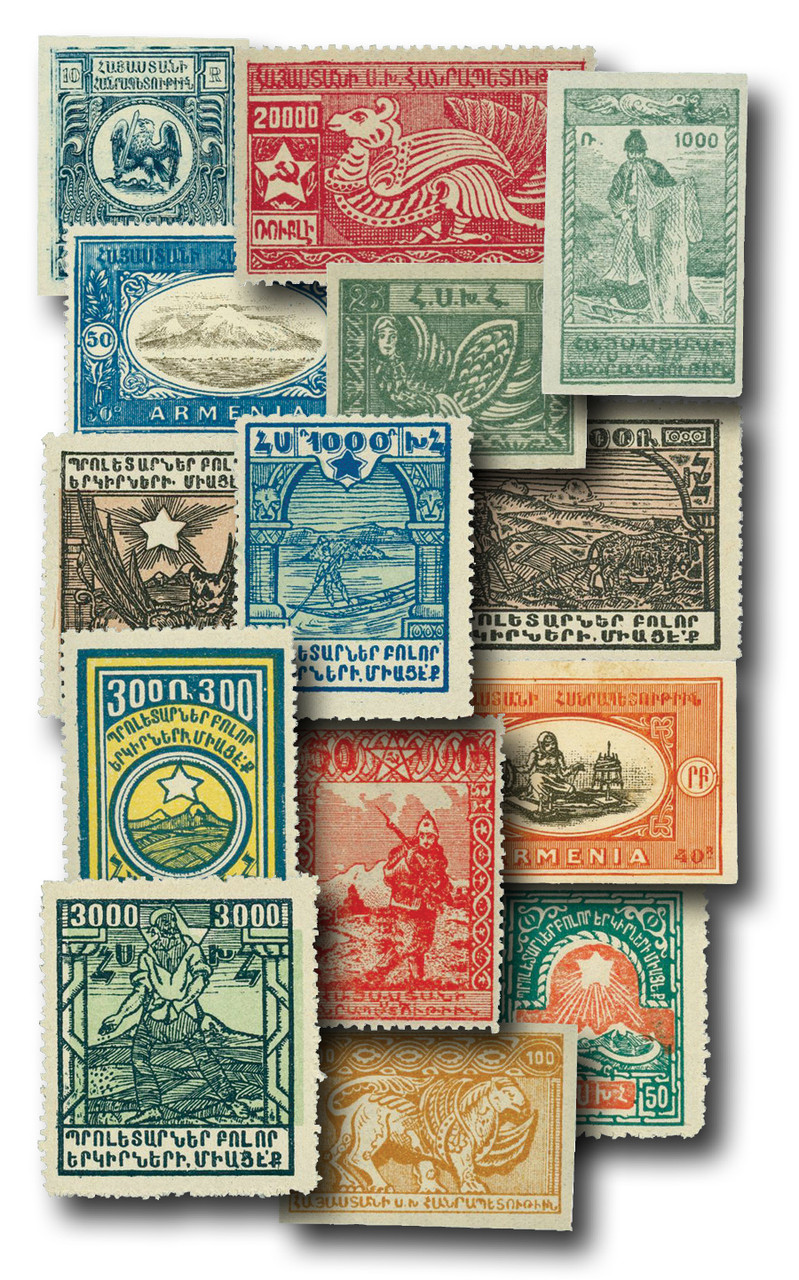
- Republic of Armenia pictorials — the Eagle, Mount Ararat, and Woman Spinning — The stamps of the short-lived Republic carry three beloved national images: Armenia's eagle with outstretched wings and sword raised, set in an ornate circular frame; the twin snow-capped peaks of Mount Ararat rising within a decorative oval, with "ARMENIA" in Roman letters below; and a traditionally dressed Armenian woman seated at her spinning wheel and loom, engraved within a bold orange frame. These images — national bird, sacred mountain, enduring culture — were carefully chosen to tell the world who Armenia was. They speak just as clearly today.
- Soviet Armenia's recurring symbols — After the Soviet takeover in late 1920, the imagery shifted sharply. The stamps in this packet from the Soviet era share a visual language: Mount Ararat now crowned with a Soviet star, the hammer and sickle superimposed on Armenia's most sacred landscape, and the Armenian-script motto "Proletarians of All Countries, Unite!" ringing circular emblems and border designs. Seeing these symbols — Soviet ideology wrapped around Armenian national imagery — tells you everything about the tug-of-war this country was living through.
- Lake Sevan stamp (1,000 Rubles, blue) — One of the most striking designs of the Soviet Armenia period. It depicts the ancient stone monastery on the shores of Lake Sevan — one of the world's great high-altitude lakes and a sacred site in Armenian Christianity — rendered beneath a Soviet star. Few stamps so quietly capture a civilization being asked to forget itself.
- The 3,000 Ruble sower and the 20,000 Ruble winged creature — These high-denomination Soviet issues tell a story of their own: the face values alone reflect the runaway inflation that was consuming the early Soviet Republic's economy. The sower — a figure scattering grain across a field — is rendered in bold, almost woodcut-like printmaking. The 20,000-ruble stamp features a magnificent, winged creature in deep red with the hammer and sickle displayed prominently. Both are harder to find with crisp printing, given the difficult conditions of the era.
This is the kind of collection that rewards the curious. Pull one out and you're holding a tiny artifact of a nation at its most vulnerable — and its most defiant. Armenian philately is one of the most complex and rewarding specialties in the classic worldwide field.
Each of these 48 stamps is a genuine postal issue from one of the most turbulent and fascinating chapters in 20th-century history. Add this packet to your collection today — and own a piece of Armenian history that has endured far longer than the regimes that created it.
From Ancient Kingdom to Soviet Republic —
Own 48 Stamps That Survived One of History's
Most Dramatic Transformations
Few countries have packed as much heartbreak, resilience, and sheer drama into a few short years as Armenia did between 1918 and 1923. In that span, a proud nation declared its independence for the first time in over 500 years — then watched it slip away as Soviet forces swept in and rewrote everything, right down to the postage stamps.
That's exactly what makes Armenian stamps from this era so extraordinary. These 48 different stamps document a country in the midst of seismic change. You'll hold stamps from the newly independent Republic of Armenia — imbued with the national symbols of a people who had just survived genocide and fought off invasion to claim their freedom. Then, almost overnight, the imagery shifts: hammers and sickles appear, Soviet stars replace eagles, and the triumphant slogan "Proletarians of All Countries, Unite!" is printed in Armenian script across stamps measured in millions of rubles, as hyperinflation consumed the economy.
Few other stamp-issuing periods in the world capture a nation's identity being literally overwritten in real time.
Armenia itself is ancient beyond measure — a civilization stretching back more than 3,000 years, home to the world's first Christian nation (Armenia adopted Christianity as its state religion in 301 AD, more than a decade before Rome), and cradled by the shadow of Mount Ararat, the biblical mountain where Noah's Ark came to rest. Ararat isn't just geography to Armenians — it's soul. It appears again and again on these stamps, a snow-capped twin-peaked presence that watched over a people through conquest after conquest, and endured.
The Armenian language, with its unique alphabet created by the monk Mesrop Mashtots in 405 AD, adorns every stamp in this collection — itself a quiet act of cultural defiance across regimes.
While selections will vary, the one I looked through had some fascinating stamps:
- Republic of Armenia pictorials — the Eagle, Mount Ararat, and Woman Spinning — The stamps of the short-lived Republic carry three beloved national images: Armenia's eagle with outstretched wings and sword raised, set in an ornate circular frame; the twin snow-capped peaks of Mount Ararat rising within a decorative oval, with "ARMENIA" in Roman letters below; and a traditionally dressed Armenian woman seated at her spinning wheel and loom, engraved within a bold orange frame. These images — national bird, sacred mountain, enduring culture — were carefully chosen to tell the world who Armenia was. They speak just as clearly today.
- Soviet Armenia's recurring symbols — After the Soviet takeover in late 1920, the imagery shifted sharply. The stamps in this packet from the Soviet era share a visual language: Mount Ararat now crowned with a Soviet star, the hammer and sickle superimposed on Armenia's most sacred landscape, and the Armenian-script motto "Proletarians of All Countries, Unite!" ringing circular emblems and border designs. Seeing these symbols — Soviet ideology wrapped around Armenian national imagery — tells you everything about the tug-of-war this country was living through.
- Lake Sevan stamp (1,000 Rubles, blue) — One of the most striking designs of the Soviet Armenia period. It depicts the ancient stone monastery on the shores of Lake Sevan — one of the world's great high-altitude lakes and a sacred site in Armenian Christianity — rendered beneath a Soviet star. Few stamps so quietly capture a civilization being asked to forget itself.
- The 3,000 Ruble sower and the 20,000 Ruble winged creature — These high-denomination Soviet issues tell a story of their own: the face values alone reflect the runaway inflation that was consuming the early Soviet Republic's economy. The sower — a figure scattering grain across a field — is rendered in bold, almost woodcut-like printmaking. The 20,000-ruble stamp features a magnificent, winged creature in deep red with the hammer and sickle displayed prominently. Both are harder to find with crisp printing, given the difficult conditions of the era.
This is the kind of collection that rewards the curious. Pull one out and you're holding a tiny artifact of a nation at its most vulnerable — and its most defiant. Armenian philately is one of the most complex and rewarding specialties in the classic worldwide field.
Each of these 48 stamps is a genuine postal issue from one of the most turbulent and fascinating chapters in 20th-century history. Add this packet to your collection today — and own a piece of Armenian history that has endured far longer than the regimes that created it.
Related Items

Save Up To 19%



Save Up To 11%


Most Orders Ship
within 1 Business Day
90 Day Return Policy
Satisfaction Guaranteed
Earn Reward Points
for FREE Stamps & More