

Zoom the image with the mouse
#NW2643
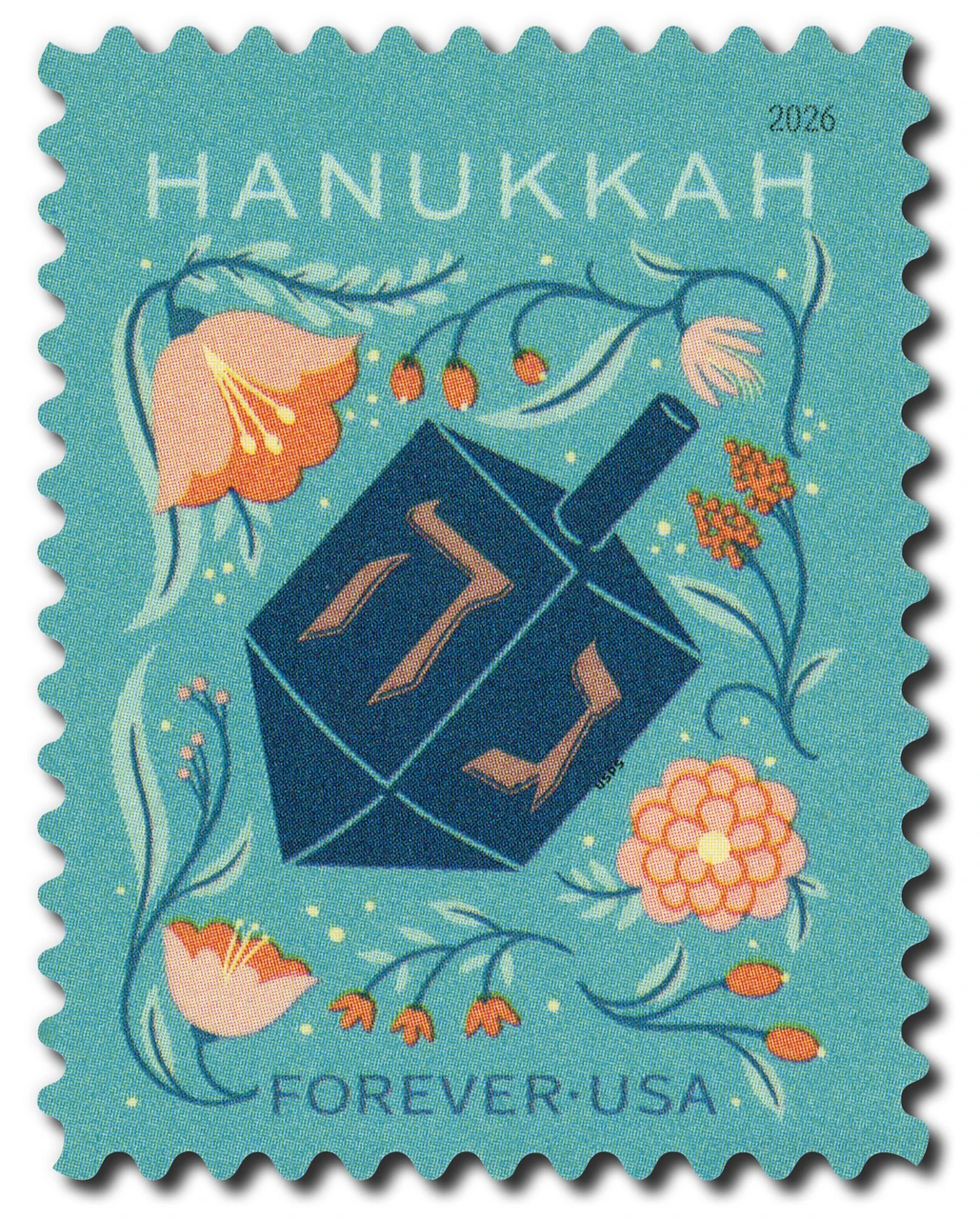
2026 First-Class Forever Stamp,Hanukkah
$1.95
Share:
2026 Hanukkah
- 9th stamp in Hanukkah series
- Pictures a dreidel, a toy traditional used during the holiday
Stamp Category: Special
Set: Holiday Celebrations
Value: 82¢, First Class Mail Rate
First Day of Issue: September 29, 2026
First Day City: New Orleans, Louisiana
Quantity Issued: 10,000,000
Printed by: Banknote Corporation of America
Printing Method: Offset, Microprint
Format: Pane of 20
Why the stamp was issued: This stamp was issued in honor of the 2026 winter holiday season
About the stamp design: Illustrator Lisa Perrin created the image of a blue dreidel surrounded by flowers.
First Day City: The release of this stamp was celebrated at the Touro Synagogue in New Orleans.
About the Holiday Celebration Series: The USPS introduced the Holiday Celebration series in 1996 with a stamp honoring the Jewish festival, Hanukkah. The series commemorated a different cultural or religious holiday each year such as Hanukkah, Kwanzaa, Eid, and others.
History the stamp represents: A dreidel looks like a toy, but for eight nights each winter, this small spinning top carries centuries of history on its four sides.
Long before Jewish communities ever spun a dreidel, a similar toy existed across parts of Europe, its sides marked with letters or numbers. Later, the Jewish people assigned Hebrew - nun, gimel, hei, shin – to each side. Not only did they relay the rules of the game, they were shorthand for “a great miracle happened there,” a nod to the oil that burned eight nights instead of one. Dreidels made in Israel swap that last letter for a pey, so the phrase reads “happened here” instead.
A popular story holds that Jewish children once used the game to disguise forbidden Torah study, spinning a dreidel to look innocent if enemy soldiers came near. The story likely grew up around the dreidel generations later, once the game and the holiday had already found each other.
Centuries later, the game remains largely unchanged. Players ante into a shared pile of gelt (traditionally coins, today usually chocolate). Each spin decides the spinner’s fate: nun does nothing, gimel takes it all, hei splits the pot in half, shin means adding a piece back in. A small game, easy to overlook - a toy in one hand, a story in the other.
Related Items

Save Up To 19%



Save Up To 11%


Most Orders Ship
within 1 Business Day
90 Day Return Policy
Satisfaction Guaranteed
Earn Reward Points
for FREE Stamps & More