

Zoom the image with the mouse
#PHC1
1926 2c Philippine Islands Airmail, Jose Rizal, Green, Madrid-Manila Overprint in Red
$27.50
Share:
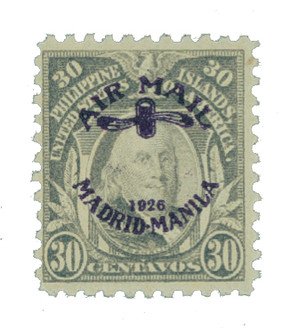
Scott #PHC1 is a 2-centavo green stamp — the first airmail stamp ever issued for the Philippine Islands — created by overprinting the standard José Rizal definitive with "Air Mail / Madrid-Manila / 1926" and a propeller design in red. The entire series of regular-issue Philippine stamps was overprinted to commemorate the occasion, making this the lowest denomination in the set. The red overprint with its tiny propeller vignette is a charming piece of early airmail philatelic design.
The flight being commemorated was one of the great aviation achievements of the 1920s. On April 5, 1926, three Spanish military pilots — Captains Eduardo González-Gallarza, Joaquín Loriga, and Rafael Martínez Estévez — departed Madrid in three Breguet XIX biplanes named Elcano, Magallanes, and Legazpi. The route covered over 17,000 kilometers through North Africa, the Middle East, South Asia, and Southeast Asia. The third plane was forced down in the desert and never reached Manila, but Gallarza and Loriga pressed on through dust storms, emergency landings, and mechanical failures. They touched down in Manila on May 13, 1926, after 128 hours of flight time, escorted in by 12 U.S. Army aircraft as they approached the city.
The flight had deep symbolic meaning beyond the aviation achievement itself. The Philippines had been a Spanish colony for over 300 years before passing to U.S. administration after the Spanish-American War in 1898, and many Filipinos still felt strong ties to Spain. The aviators were greeted with enormous celebrations and were even awarded honorary doctorates by the University of Santo Tomás. The Philippine postal authorities honored the occasion by issuing this overprinted series — the islands' very first airmail stamps.
Scott #PHC1 is a 2-centavo green stamp — the first airmail stamp ever issued for the Philippine Islands — created by overprinting the standard José Rizal definitive with "Air Mail / Madrid-Manila / 1926" and a propeller design in red. The entire series of regular-issue Philippine stamps was overprinted to commemorate the occasion, making this the lowest denomination in the set. The red overprint with its tiny propeller vignette is a charming piece of early airmail philatelic design.
The flight being commemorated was one of the great aviation achievements of the 1920s. On April 5, 1926, three Spanish military pilots — Captains Eduardo González-Gallarza, Joaquín Loriga, and Rafael Martínez Estévez — departed Madrid in three Breguet XIX biplanes named Elcano, Magallanes, and Legazpi. The route covered over 17,000 kilometers through North Africa, the Middle East, South Asia, and Southeast Asia. The third plane was forced down in the desert and never reached Manila, but Gallarza and Loriga pressed on through dust storms, emergency landings, and mechanical failures. They touched down in Manila on May 13, 1926, after 128 hours of flight time, escorted in by 12 U.S. Army aircraft as they approached the city.
The flight had deep symbolic meaning beyond the aviation achievement itself. The Philippines had been a Spanish colony for over 300 years before passing to U.S. administration after the Spanish-American War in 1898, and many Filipinos still felt strong ties to Spain. The aviators were greeted with enormous celebrations and were even awarded honorary doctorates by the University of Santo Tomás. The Philippine postal authorities honored the occasion by issuing this overprinted series — the islands' very first airmail stamps.
Related Items




Most Orders Ship
within 1 Business Day
90 Day Return Policy
Satisfaction Guaranteed
Earn Reward Points
for FREE Stamps & More