


Zoom the image with the mouse
#PHC26
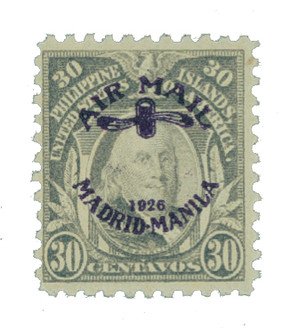
1928 26c Philippine Islands Airmail, Francisco Carriedo, Blue Green, LOF Overprint in Red
$30.00
Share:
Scott #PHC26 is a 26-centavo blue green Philippine Islands stamp from 1928, overprinted in red with "L.O.F. / 1928" and the silhouette of a Fairey IIID seaplane — one of eleven stamps in the London-Orient Flight series (Scott C18–C28) issued on November 9, 1928. The underlying stamp features a portrait of Francisco Carriedo, a Spanish colonial official remembered for his historic contribution to Manila's water supply.
The flight being commemorated was a remarkable long-distance journey by a squadron of British Royal Air Force Supermarine Southampton flying boats, which flew from England to the Far East in 1927–1928 to demonstrate the capabilities of long-range seaplane aviation. The route passed through India, Southeast Asia, and into the Philippines, demonstrating that Britain's far-flung empire could potentially be connected by air. The arrival in Manila was a significant event, and the Philippine postal authorities marked the occasion with this overprinted series — just as they had done for the 1926 Madrid-Manila flight two years earlier.
Francisco Carriedo, honored on the underlying stamp, was an 18th-century Spanish captain and philanthropist who left a bequest in his will that eventually funded the construction of Manila's first public water system, completed in 1882. His legacy of public service made him a fitting choice for a definitive stamp of this era.
Scott #PHC26 is a 26-centavo blue green Philippine Islands stamp from 1928, overprinted in red with "L.O.F. / 1928" and the silhouette of a Fairey IIID seaplane — one of eleven stamps in the London-Orient Flight series (Scott C18–C28) issued on November 9, 1928. The underlying stamp features a portrait of Francisco Carriedo, a Spanish colonial official remembered for his historic contribution to Manila's water supply.
The flight being commemorated was a remarkable long-distance journey by a squadron of British Royal Air Force Supermarine Southampton flying boats, which flew from England to the Far East in 1927–1928 to demonstrate the capabilities of long-range seaplane aviation. The route passed through India, Southeast Asia, and into the Philippines, demonstrating that Britain's far-flung empire could potentially be connected by air. The arrival in Manila was a significant event, and the Philippine postal authorities marked the occasion with this overprinted series — just as they had done for the 1926 Madrid-Manila flight two years earlier.
Francisco Carriedo, honored on the underlying stamp, was an 18th-century Spanish captain and philanthropist who left a bequest in his will that eventually funded the construction of Manila's first public water system, completed in 1882. His legacy of public service made him a fitting choice for a definitive stamp of this era.
Related Items



Most Orders Ship
within 1 Business Day
90 Day Return Policy
Satisfaction Guaranteed
Earn Reward Points
for FREE Stamps & More