

Zoom the image with the mouse
#PHY2//YT2
1898-99 Filipino Revolutionary Government Stamps, Set of 5 Stamps
$14.45
$12.95
Save Up To 10%
Share:
Get 5 Filipino Revolutionary Government Stamps
These 5 unused stamps were issued before the Philippines became a US territory, as the country fought for its independence from Spain.
Echoes of a Nation's First Breath
When General Emilio Aguinaldo declared Philippine independence on June 12, 1898, from the balcony of his home in Kawit, Cavite, he unfurled not just a flag but the dream of a sovereign nation. Within months, his Revolutionary Government established something remarkable: a complete postal system with stamps designed to fund the war effort and assert the legitimacy of the First Philippine Republic. They were declarations of identity, sovereignty stamped in ink and purpose.
Symbols Forged in Revolution
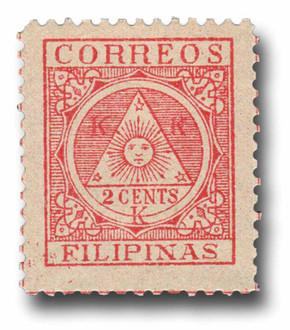
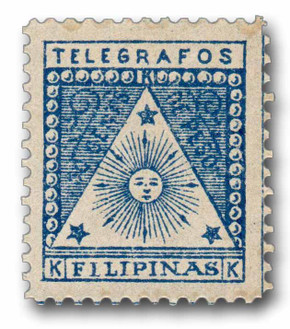
Each stamp carries the weight of meaning. The triangle. The sun radiating eight defiant rays. Three stars holding the archipelago's promise. These weren't arbitrary design choices—they were the visual language of revolution itself, with some designs showing Masonic influence that reflected the secret societies that sparked the uprising.
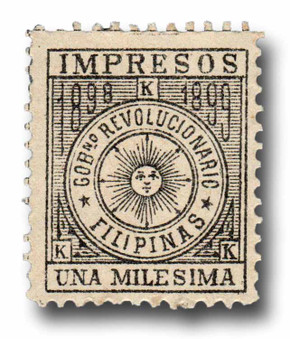
The mysterious three K’s on each stamp whispers the name of the Katipunan—the secret revolutionary society whose full name, Kataas-taasang, Kagalang-galangang Katipunan ng mga Anak ng Bayan (Supreme and Venerable Association of the Children of the Nation), ignited the flame of Filipino independence.
Designer Marcelino Gomez and his Manila-based Lithographica de Gomez created approximately 14 different stamps between 1898 and 1901, each serving a distinct purpose in building the infrastructure of nationhood.
A Complete Government in Miniature
What You’ll Get:
CORREOS (2 cents, red) — The crimson standard-bearer of Philippine postal independence, carrying letters across a nation in birth
CERTIFICADO (8 cents, green) — The registration stamp that documented the Revolutionary Government's official correspondence
RECIBOS (10 centavos de peso, brown) — Revenue stamps that collected the taxes and fees necessary to sustain a sovereign state
TELEGRAFOS (50 centavos, blue) — Telegraph stamps that transmitted messages across the islands at the speed of electricity
IMPRESOS (1 mil, black) — Newspaper stamps ensuring that the voice of the revolution could reach every province
These provisional stamps saw active use primarily in the central part of Luzon, beginning around November 10, 1898, and continuing through early 1901—a brief but brilliant window when Filipinos governed themselves before the Philippine-American War altered their destiny.
Why They Vanished
Here's the haunting part: used copies of these stamps are scarce to rare, as recipients often destroyed correspondence bearing them, fearing accusations of participating in what Americans termed an "insurrection". The very mail that proved Filipino self-governance became dangerous evidence to possess.
American forces actively confiscated or burned these stamps during the Philippine-American War to prevent their circulation, attempting to erase this paper trail of sovereignty.
What Makes These Specimens Exceptional
- Unused condition — These stamps never fulfilled their postal mission, preserved in their original state
- Complete functional set — Representing all major stamp categories the Revolutionary Government issued
- Documented provenance — Part of the historical record preserved by philatelists and institutions like the Smithsonian
- Educational significance — Each stamp tells the story of a specific governmental function
The Brief Republic That Dared
The Malolos Constitution was proclaimed on January 21, 1899, establishing the formal government with Aguinaldo as president. But on February 4, 1899, war with the United States began. By March 23, 1901, Aguinaldo was captured, and on April 19 he took an oath of allegiance to the United States, formally ending the First Republic.
These stamps existed in that compressed timeframe—roughly two and a half years when Filipinos governed themselves, built institutions, and imagined a future that history would postpone.
Your Place in the Story
While rare varieties on original covers command premium prices, unused sets like these remain surprisingly accessible to collectors who understand their significance. They represent one of philately's most meaningful categories: stamps that documented a nation's first steps toward self-determination.
Every collector who preserves these stamps becomes a custodian of memory. They ensure that the First Philippine Republic—though brief, ultimately defeated—remains more than a footnote. It remains real, tangible, provable.
These five stamps are that proof, which you can hold in your hands.
Includes: PHYF1, PHYP1, PHYR1, PHYT2, PHY2
Get 5 Filipino Revolutionary Government Stamps
These 5 unused stamps were issued before the Philippines became a US territory, as the country fought for its independence from Spain.
Echoes of a Nation's First Breath
When General Emilio Aguinaldo declared Philippine independence on June 12, 1898, from the balcony of his home in Kawit, Cavite, he unfurled not just a flag but the dream of a sovereign nation. Within months, his Revolutionary Government established something remarkable: a complete postal system with stamps designed to fund the war effort and assert the legitimacy of the First Philippine Republic. They were declarations of identity, sovereignty stamped in ink and purpose.
Symbols Forged in Revolution
Each stamp carries the weight of meaning. The triangle. The sun radiating eight defiant rays. Three stars holding the archipelago's promise. These weren't arbitrary design choices—they were the visual language of revolution itself, with some designs showing Masonic influence that reflected the secret societies that sparked the uprising.
The mysterious three K’s on each stamp whispers the name of the Katipunan—the secret revolutionary society whose full name, Kataas-taasang, Kagalang-galangang Katipunan ng mga Anak ng Bayan (Supreme and Venerable Association of the Children of the Nation), ignited the flame of Filipino independence.
Designer Marcelino Gomez and his Manila-based Lithographica de Gomez created approximately 14 different stamps between 1898 and 1901, each serving a distinct purpose in building the infrastructure of nationhood.
A Complete Government in Miniature
What You’ll Get:
CORREOS (2 cents, red) — The crimson standard-bearer of Philippine postal independence, carrying letters across a nation in birth
CERTIFICADO (8 cents, green) — The registration stamp that documented the Revolutionary Government's official correspondence
RECIBOS (10 centavos de peso, brown) — Revenue stamps that collected the taxes and fees necessary to sustain a sovereign state
TELEGRAFOS (50 centavos, blue) — Telegraph stamps that transmitted messages across the islands at the speed of electricity
IMPRESOS (1 mil, black) — Newspaper stamps ensuring that the voice of the revolution could reach every province
These provisional stamps saw active use primarily in the central part of Luzon, beginning around November 10, 1898, and continuing through early 1901—a brief but brilliant window when Filipinos governed themselves before the Philippine-American War altered their destiny.
Why They Vanished
Here's the haunting part: used copies of these stamps are scarce to rare, as recipients often destroyed correspondence bearing them, fearing accusations of participating in what Americans termed an "insurrection". The very mail that proved Filipino self-governance became dangerous evidence to possess.
American forces actively confiscated or burned these stamps during the Philippine-American War to prevent their circulation, attempting to erase this paper trail of sovereignty.
What Makes These Specimens Exceptional
- Unused condition — These stamps never fulfilled their postal mission, preserved in their original state
- Complete functional set — Representing all major stamp categories the Revolutionary Government issued
- Documented provenance — Part of the historical record preserved by philatelists and institutions like the Smithsonian
- Educational significance — Each stamp tells the story of a specific governmental function
The Brief Republic That Dared
The Malolos Constitution was proclaimed on January 21, 1899, establishing the formal government with Aguinaldo as president. But on February 4, 1899, war with the United States began. By March 23, 1901, Aguinaldo was captured, and on April 19 he took an oath of allegiance to the United States, formally ending the First Republic.
These stamps existed in that compressed timeframe—roughly two and a half years when Filipinos governed themselves, built institutions, and imagined a future that history would postpone.
Your Place in the Story
While rare varieties on original covers command premium prices, unused sets like these remain surprisingly accessible to collectors who understand their significance. They represent one of philately's most meaningful categories: stamps that documented a nation's first steps toward self-determination.
Every collector who preserves these stamps becomes a custodian of memory. They ensure that the First Philippine Republic—though brief, ultimately defeated—remains more than a footnote. It remains real, tangible, provable.
These five stamps are that proof, which you can hold in your hands.
Includes: PHYF1, PHYP1, PHYR1, PHYT2, PHY2
Related Items



Most Orders Ship
within 1 Business Day
90 Day Return Policy
Satisfaction Guaranteed
Earn Reward Points
for FREE Stamps & More