

Zoom the image with the mouse
#RD276
1948 $10 Stock Transfer Stamp, Bright Green
$109.00
Share:
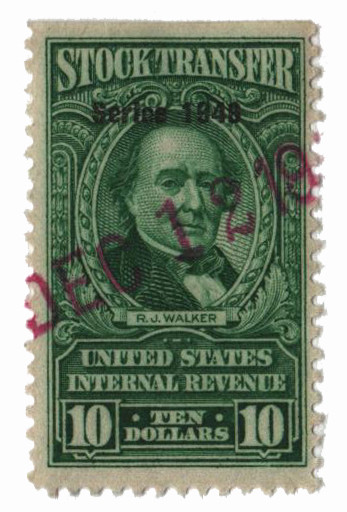
Scott #RD276 is a $10 bright green Stock Transfer revenue stamp from the Series 1948 issue, featuring a portrait of Robert J. Walker, the 18th Secretary of the Treasury. The red "DEC 12" date cancel visible on this example documents its use in an actual stock transaction, providing a precise date of use that financial historians and postal historians alike find appealing. At the $10 denomination, this stamp was applied to documentation for substantial stock transfers, reflecting the scale of securities transactions taking place in postwar American financial markets.
Robert J. Walker served as Secretary of the Treasury from 1845 to 1849 under President James K. Polk. He is best remembered for the Walker Tariff of 1846, which significantly lowered import duties and shifted U.S. trade policy away from protectionism — a landmark piece of legislation that shaped American commerce for years afterward. Walker also reorganized the Treasury's financial operations and helped finance the Mexican-American War through bond issues. Before his Treasury appointment, he had served as a U.S. Senator from Mississippi, and he later played a role in the heated debates over Kansas statehood in the 1850s.
The $10 denomination places this stamp among the higher values in the 1948 Stock Transfer series, used on the largest transactions of the year. The red date cancel — applied by hand at the time of use — is a reminder that these stamps had a practical financial purpose, not merely a philatelic one.
Scott #RD276 is a $10 bright green Stock Transfer revenue stamp from the Series 1948 issue, featuring a portrait of Robert J. Walker, the 18th Secretary of the Treasury. The red "DEC 12" date cancel visible on this example documents its use in an actual stock transaction, providing a precise date of use that financial historians and postal historians alike find appealing. At the $10 denomination, this stamp was applied to documentation for substantial stock transfers, reflecting the scale of securities transactions taking place in postwar American financial markets.
Robert J. Walker served as Secretary of the Treasury from 1845 to 1849 under President James K. Polk. He is best remembered for the Walker Tariff of 1846, which significantly lowered import duties and shifted U.S. trade policy away from protectionism — a landmark piece of legislation that shaped American commerce for years afterward. Walker also reorganized the Treasury's financial operations and helped finance the Mexican-American War through bond issues. Before his Treasury appointment, he had served as a U.S. Senator from Mississippi, and he later played a role in the heated debates over Kansas statehood in the 1850s.
The $10 denomination places this stamp among the higher values in the 1948 Stock Transfer series, used on the largest transactions of the year. The red date cancel — applied by hand at the time of use — is a reminder that these stamps had a practical financial purpose, not merely a philatelic one.
Related Items




Most Orders Ship
within 1 Business Day
90 Day Return Policy
Satisfaction Guaranteed
Earn Reward Points
for FREE Stamps & More