


Zoom the image with the mouse
#RF12
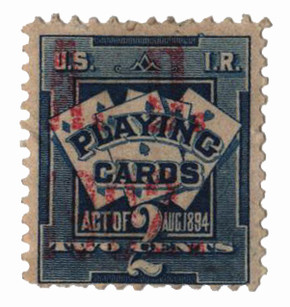
1918 Class A Playing Card Stamp, Blue, Roulette 14
$325.00
Share:
This stamp is part of the playing card tax series that began with the Act of August 1894, a law that placed a tax on playing cards sold in the United States. By 1918, manufacturers were required to purchase these stamps in different classes based on the retail price of the deck, with this example representing the Class A rate. Playing cards were first taxed back in 1862 to help fund the Union's Civil War effort, and that original law gave companies taxed under the proprietary schedules the option to design their own tax stamps in exchange for a discount and the right to advertise on them. The tax lapsed after 1871 and was revived in 1894, leading to this later series of stamps used well into the twentieth century.
The design centers on the four card suit symbols, a spade, heart, diamond, and club, arranged within a decorative circular frame topped with a floral design. A banner below the suits reads "Class A," identifying the pricing tier for this particular stamp. The top of the design reads "U.S. Int. Rev." and the overall look echoes the ornate engraving style common to revenue issues of this era. This example carries a printed overprint reading "N.Y.C.C. Co.," identifying the manufacturer that used this particular stamp on its packaging, along with a "Cancelled" overprint applied to void the stamp once the tax obligation had been fulfilled.
Printed in blue and showing roulette 14 separations, this stamp reflects a later stage in the long history of American playing card taxation, when the tax structure had grown more detailed with multiple pricing classes.
This stamp is part of the playing card tax series that began with the Act of August 1894, a law that placed a tax on playing cards sold in the United States. By 1918, manufacturers were required to purchase these stamps in different classes based on the retail price of the deck, with this example representing the Class A rate. Playing cards were first taxed back in 1862 to help fund the Union's Civil War effort, and that original law gave companies taxed under the proprietary schedules the option to design their own tax stamps in exchange for a discount and the right to advertise on them. The tax lapsed after 1871 and was revived in 1894, leading to this later series of stamps used well into the twentieth century.
The design centers on the four card suit symbols, a spade, heart, diamond, and club, arranged within a decorative circular frame topped with a floral design. A banner below the suits reads "Class A," identifying the pricing tier for this particular stamp. The top of the design reads "U.S. Int. Rev." and the overall look echoes the ornate engraving style common to revenue issues of this era. This example carries a printed overprint reading "N.Y.C.C. Co.," identifying the manufacturer that used this particular stamp on its packaging, along with a "Cancelled" overprint applied to void the stamp once the tax obligation had been fulfilled.
Printed in blue and showing roulette 14 separations, this stamp reflects a later stage in the long history of American playing card taxation, when the tax structure had grown more detailed with multiple pricing classes.
Related Items



Most Orders Ship
within 1 Business Day
90 Day Return Policy
Satisfaction Guaranteed
Earn Reward Points
for FREE Stamps & More