This 5-cent private die playing card revenue stamp was issued by Lawrence & Cohen, one of the oldest and most storied names in American playing card manufacturing. The firm traced its origins directly to Lewis I. Cohen, a Lancaster, Pennsylvania native who came to New York in the early 19th century and transformed the playing card industry. In 1835, Cohen registered a color-printing machine capable of printing four colors in a single pass, an innovation that revolutionized card production in the United States and helped establish New York as the center of the American playing card trade. When Cohen retired, his son Solomon and nephew John M. Lawrence took over the business, and the firm eventually became Lawrence & Cohen, operating out of 184 William Street in lower Manhattan.
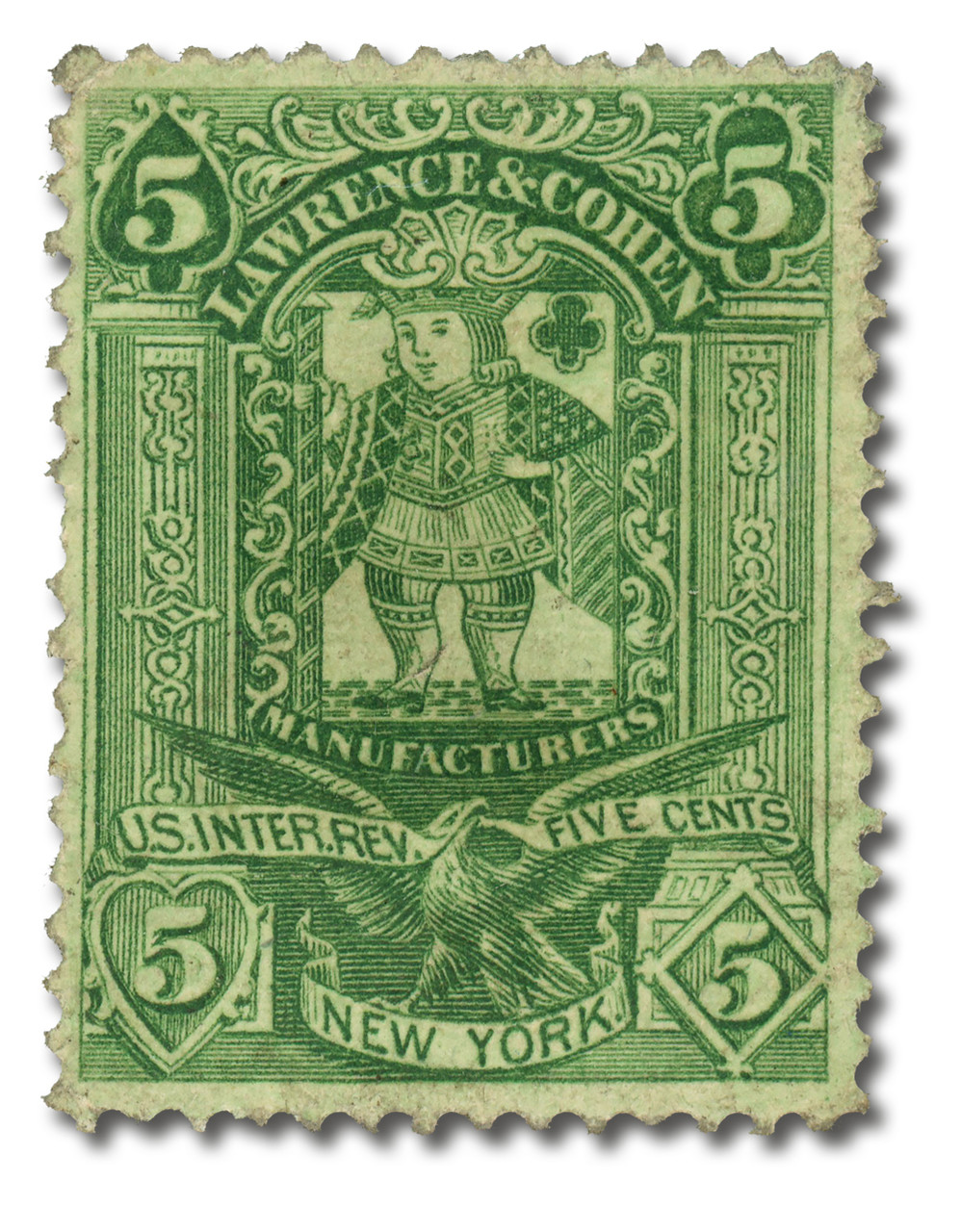
The design of this stamp is one of the most elaborate in the playing card revenue series, and it draws directly from the product it taxed. At the center stands a playing card king in full regalia, rendered in careful engraving detail, framed by ornate columns and scrollwork. The denomination appears in four corners in different decorative treatments, including a heart and a diamond, a knowing nod to the suits of the very cards these stamps were applied to. An eagle fills the lower portion of the design beneath the U.S. Internal Revenue inscription, giving the stamp both a patriotic flourish and a nod to the Stars and Eagle Ace of Spades that the Cohen firm had made famous for decades. The experimental silk paper printing places this among the more specialized varieties in the series.
In 1871, the same year this stamp series began, Lawrence & Cohen merged with Samuel Hart & Co. and John J. Levy to form the New York Consolidated Card Company, making this stamp one of the last artifacts issued under the Lawrence & Cohen name before it disappeared into the consolidated firm. That new company went on to win a gold medal at the 1878 Paris Exposition for its Squeezers playing cards, and was eventually acquired by the United States Playing Card Company in 1894. The Lawrence & Cohen stamp thus captures a company at the very end of its independent existence, on the verge of a merger that would shape American playing cards for generations.
This 5-cent private die playing card revenue stamp was issued by Lawrence & Cohen, one of the oldest and most storied names in American playing card manufacturing. The firm traced its origins directly to Lewis I. Cohen, a Lancaster, Pennsylvania native who came to New York in the early 19th century and transformed the playing card industry. In 1835, Cohen registered a color-printing machine capable of printing four colors in a single pass, an innovation that revolutionized card production in the United States and helped establish New York as the center of the American playing card trade. When Cohen retired, his son Solomon and nephew John M. Lawrence took over the business, and the firm eventually became Lawrence & Cohen, operating out of 184 William Street in lower Manhattan.
The design of this stamp is one of the most elaborate in the playing card revenue series, and it draws directly from the product it taxed. At the center stands a playing card king in full regalia, rendered in careful engraving detail, framed by ornate columns and scrollwork. The denomination appears in four corners in different decorative treatments, including a heart and a diamond, a knowing nod to the suits of the very cards these stamps were applied to. An eagle fills the lower portion of the design beneath the U.S. Internal Revenue inscription, giving the stamp both a patriotic flourish and a nod to the Stars and Eagle Ace of Spades that the Cohen firm had made famous for decades. The experimental silk paper printing places this among the more specialized varieties in the series.
In 1871, the same year this stamp series began, Lawrence & Cohen merged with Samuel Hart & Co. and John J. Levy to form the New York Consolidated Card Company, making this stamp one of the last artifacts issued under the Lawrence & Cohen name before it disappeared into the consolidated firm. That new company went on to win a gold medal at the 1878 Paris Exposition for its Squeezers playing cards, and was eventually acquired by the United States Playing Card Company in 1894. The Lawrence & Cohen stamp thus captures a company at the very end of its independent existence, on the verge of a merger that would shape American playing cards for generations.