

Zoom the image with the mouse
#UX21
1910 1c William McKinley, Blue, Bluish Paper, Postal Card
$22.50
Share:
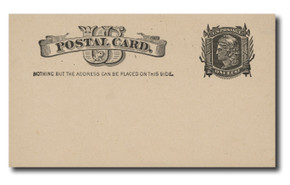
U.S. Scott #UX21 is a 1-cent domestic postal card issued in 1910 featuring a portrait of President William McKinley printed in blue against a shaded background. The indicia appears in the upper right corner of the address side in a decorative oval frame inscribed "U.S. Postal Card" with the denomination "One Cent" at the bottom. The address side also bears the printed instruction "This Side of Card Is for Address Only" in an ornate bordered panel — standard text on U.S. postal cards of this era to guide correspondents unfamiliar with the relatively new format. UX21 is distinguished from the earlier McKinley cards in the series by its shaded background in the portrait vignette.
William McKinley served as the 25th President of the United States from 1897 until his assassination in September 1901, and his image appeared on several U.S. postal card issues in the years following his death as the country continued to honor him. By 1910, the postal card had been a fixture of American correspondence for nearly four decades, having been introduced by the U.S. Post Office in 1873 at a rate of one cent — half the cost of mailing a standard letter. Postal cards were enormously popular for business correspondence, trade, and personal communication precisely because of their economy and convenience.
U.S. Scott #UX21 is a 1-cent domestic postal card issued in 1910 featuring a portrait of President William McKinley printed in blue against a shaded background. The indicia appears in the upper right corner of the address side in a decorative oval frame inscribed "U.S. Postal Card" with the denomination "One Cent" at the bottom. The address side also bears the printed instruction "This Side of Card Is for Address Only" in an ornate bordered panel — standard text on U.S. postal cards of this era to guide correspondents unfamiliar with the relatively new format. UX21 is distinguished from the earlier McKinley cards in the series by its shaded background in the portrait vignette.
William McKinley served as the 25th President of the United States from 1897 until his assassination in September 1901, and his image appeared on several U.S. postal card issues in the years following his death as the country continued to honor him. By 1910, the postal card had been a fixture of American correspondence for nearly four decades, having been introduced by the U.S. Post Office in 1873 at a rate of one cent — half the cost of mailing a standard letter. Postal cards were enormously popular for business correspondence, trade, and personal communication precisely because of their economy and convenience.
Related Items




Most Orders Ship
within 1 Business Day
90 Day Return Policy
Satisfaction Guaranteed
Earn Reward Points
for FREE Stamps & More