
Save Up To 5%

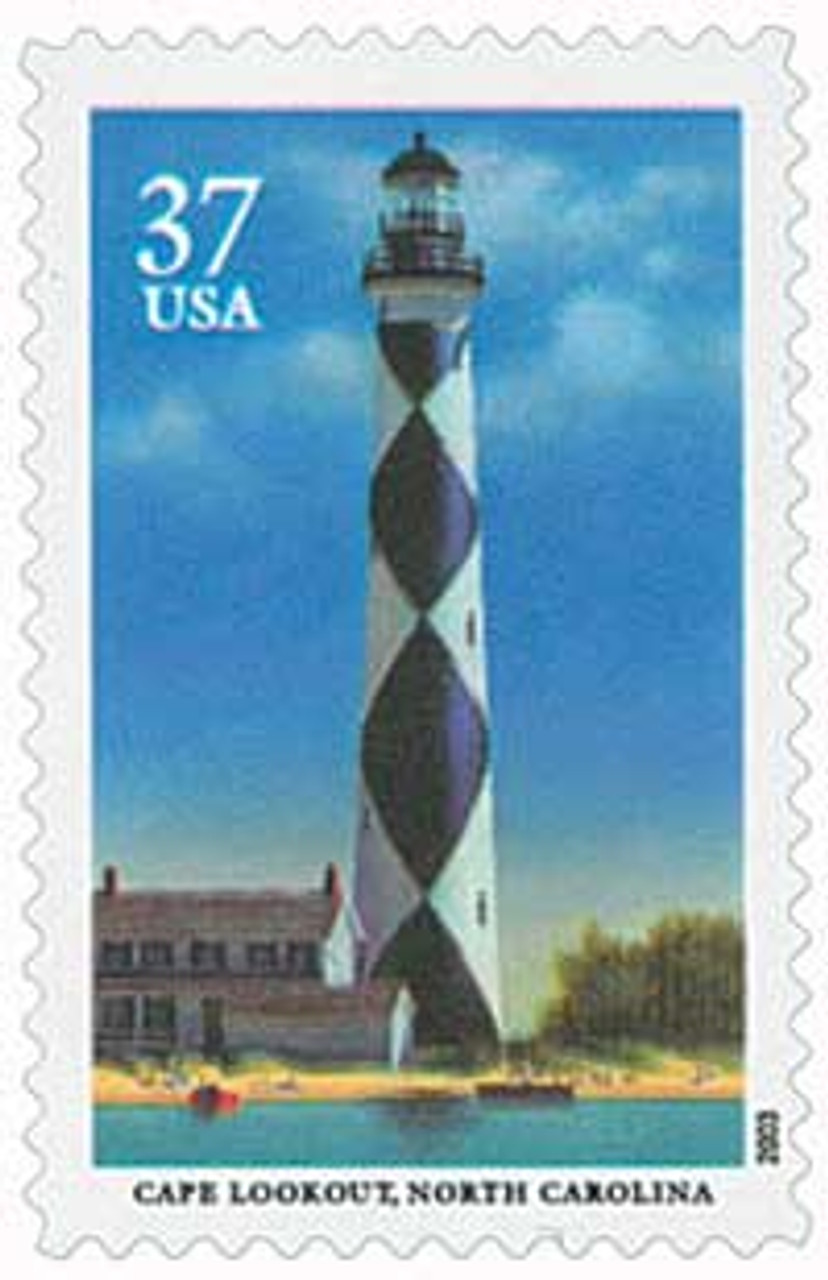
U.S. #3788
37¢ Cape Lookout, NC
Southeastern Lighthouses
Issue Date: June 13, 2003
City: Tybee Island, GA
Quantity: 125,000,000
Printed By: American Packaging Corporation for Sennett Security Products
Printing Method: Photogravure
Perforations: Serpentine Die Cut 10.75 x 10.25
Color: Multicolored
In 2003, the romance of lighthouses was reflected in a strip of five commemorative stamps picturing historic beacons from America’s southeast (U.S. #3787-91). This stamp features Cape Lookout.
The waters off Cape Lookout, North Carolina, earned a fearsome reputation among early navigators, appearing on a 1590 map under the Latin name Promontorium tremendum, meaning horrible headland. Local landowners deeded four acres to the federal government in 1805 for a lighthouse, and the first tower, a ninety six foot structure of brick and wood, entered service around 1812. By the 1850s that original lighthouse had fallen into disrepair and proved too short to adequately warn ships away from the treacherous shoals extending miles offshore, prompting the newly created Light House Board to authorize a taller replacement.
Congress approved $45,000 for construction in 1857, and the new lighthouse, rising 163 feet, was completed and lit for the first time on November 1, 1859. Fitted with a powerful first order Fresnel lens, the tower could be seen from as far as nineteen miles at sea and became the tallest lighthouse south of New Jersey until the Cape Hatteras Lighthouse surpassed it in 1870. During the Civil War, Confederate raiders damaged the tower's lower levels and staircase in an 1864 explosion, though the light continued its service to mariners navigating the dangerous waters of the Outer Banks.
In 1873, the Light House Board assigned Cape Lookout its now famous black and white diamond pattern, one of several distinct paint schemes created to help sailors distinguish between the similar tall brick towers along the North Carolina coast. The diamonds were designed with a directional purpose, with black diamonds pointing north and south while white diamonds pointed east and west. The pattern proved so recognizable that the small community that grew up around the lighthouse later took the name Diamond City, and the tower remains an active aid to navigation today, having been automated by the Coast Guard in 1950.
U.S. #3788
37¢ Cape Lookout, NC
Southeastern Lighthouses
Issue Date: June 13, 2003
City: Tybee Island, GA
Quantity: 125,000,000
Printed By: American Packaging Corporation for Sennett Security Products
Printing Method: Photogravure
Perforations: Serpentine Die Cut 10.75 x 10.25
Color: Multicolored
In 2003, the romance of lighthouses was reflected in a strip of five commemorative stamps picturing historic beacons from America’s southeast (U.S. #3787-91). This stamp features Cape Lookout.
The waters off Cape Lookout, North Carolina, earned a fearsome reputation among early navigators, appearing on a 1590 map under the Latin name Promontorium tremendum, meaning horrible headland. Local landowners deeded four acres to the federal government in 1805 for a lighthouse, and the first tower, a ninety six foot structure of brick and wood, entered service around 1812. By the 1850s that original lighthouse had fallen into disrepair and proved too short to adequately warn ships away from the treacherous shoals extending miles offshore, prompting the newly created Light House Board to authorize a taller replacement.
Congress approved $45,000 for construction in 1857, and the new lighthouse, rising 163 feet, was completed and lit for the first time on November 1, 1859. Fitted with a powerful first order Fresnel lens, the tower could be seen from as far as nineteen miles at sea and became the tallest lighthouse south of New Jersey until the Cape Hatteras Lighthouse surpassed it in 1870. During the Civil War, Confederate raiders damaged the tower's lower levels and staircase in an 1864 explosion, though the light continued its service to mariners navigating the dangerous waters of the Outer Banks.
In 1873, the Light House Board assigned Cape Lookout its now famous black and white diamond pattern, one of several distinct paint schemes created to help sailors distinguish between the similar tall brick towers along the North Carolina coast. The diamonds were designed with a directional purpose, with black diamonds pointing north and south while white diamonds pointed east and west. The pattern proved so recognizable that the small community that grew up around the lighthouse later took the name Diamond City, and the tower remains an active aid to navigation today, having been automated by the Coast Guard in 1950.


