


Zoom the image with the mouse
#57
1896 Newfoundland
$80.00
Share:
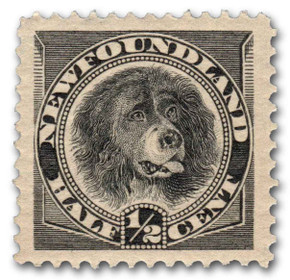
Scott #57 is a half-cent red orange stamp issued by Newfoundland in 1896, featuring a portrait of a Newfoundland dog — one of the most recognizable and beloved dog breeds in the world, named for the very island that issued this stamp. The design fills the circular frame with a detailed engraved portrait of the dog's head, with "Newfoundland" running around the top of the circle and "Half Cent" with the fraction "½" at the bottom. The half-cent denomination was used primarily on printed matter and newspapers, where postal rates were lower than for standard letters.
The Newfoundland dog breed has a long history on the island, though the exact origins of the breed are debated among historians. By the 18th and 19th centuries, Newfoundland dogs were well established as working animals on the island, valued by fishermen for their strength, swimming ability, and calm temperament. They were used to haul fishing nets, carry loads, and rescue people from the icy North Atlantic waters. The breed became popular in Britain and Europe during the 19th century, partly through its portrayal in art and literature — most famously in J.M. Barrie's Peter Pan, where the Darling family's dog Nana is a Newfoundland.
The decision to put the Newfoundland dog on a postage stamp was a natural one for a colony that had come to see the breed as part of its own identity. The 1896 issue was the first time the dog appeared on a Newfoundland stamp, and it proved popular enough that the Newfoundland dog design was used again on later issues.
Scott #57 is a half-cent red orange stamp issued by Newfoundland in 1896, featuring a portrait of a Newfoundland dog — one of the most recognizable and beloved dog breeds in the world, named for the very island that issued this stamp. The design fills the circular frame with a detailed engraved portrait of the dog's head, with "Newfoundland" running around the top of the circle and "Half Cent" with the fraction "½" at the bottom. The half-cent denomination was used primarily on printed matter and newspapers, where postal rates were lower than for standard letters.
The Newfoundland dog breed has a long history on the island, though the exact origins of the breed are debated among historians. By the 18th and 19th centuries, Newfoundland dogs were well established as working animals on the island, valued by fishermen for their strength, swimming ability, and calm temperament. They were used to haul fishing nets, carry loads, and rescue people from the icy North Atlantic waters. The breed became popular in Britain and Europe during the 19th century, partly through its portrayal in art and literature — most famously in J.M. Barrie's Peter Pan, where the Darling family's dog Nana is a Newfoundland.
The decision to put the Newfoundland dog on a postage stamp was a natural one for a colony that had come to see the breed as part of its own identity. The 1896 issue was the first time the dog appeared on a Newfoundland stamp, and it proved popular enough that the Newfoundland dog design was used again on later issues.
Related Items


Most Orders Ship
within 1 Business Day
90 Day Return Policy
Satisfaction Guaranteed
Earn Reward Points
for FREE Stamps & More