
Zoom the image with the mouse
#EP44
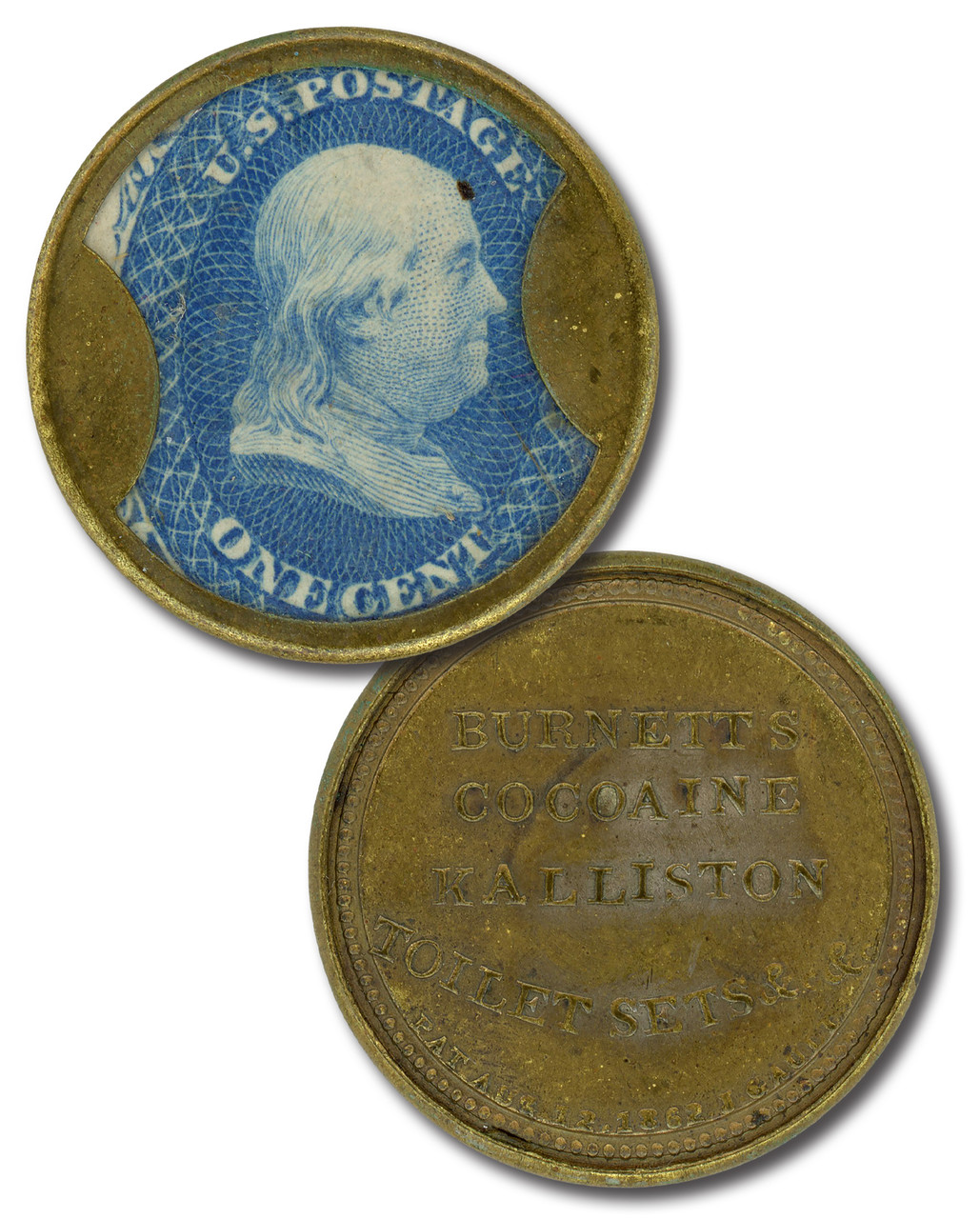
1862 1c Franklin, Burnett's Cocoaine Kalliston, Encased Postage
$2,250.00
Share:
By the summer of 1862, something alarming was happening in shops, markets, and counting houses across America — coins had all but vanished from everyday life.
It wasn't a mystery what was happening. The Civil War had shaken confidence in the future so thoroughly that ordinary people were doing what frightened people always do: they were holding on to anything that felt solid. Gold and silver disappeared into mattresses, tin boxes, and coat pockets. Even copper pennies were worth hoarding. And without small change, commerce started to seize up. Shopkeepers couldn't make change. Customers couldn't pay exact amounts. A simple transaction — a loaf of bread, a newspaper, a stamp — became a minor ordeal.
The U.S. government tried to bridge the gap by declaring that postage stamps could be used as currency. It was a practical idea that ran headlong into a practical problem: loose stamps are flimsy things. They stick together, they tear, they disintegrate in a coat pocket after a few days of handling. Spending them was harder than it sounded.
A Boston businessman named John Gault saw the problem and patented a solution. He designed a small brass frame — about the size of a large button — that held a postage stamp behind a protective window of mica. The denomination was visible through the front. The back was a flat brass disc, and Gault had the insight to sell that space to advertisers: druggists, dry goods merchants, patent medicine makers, sewing machine companies. Businesses from across the country paid to put their names on something that was passing through American hands dozens of times a day.
Encased postage was in active use for only about a year before the Treasury introduced fractional paper currency and made them obsolete. That short window — combined with the fragility of the mica and the stamps inside — is a big part of why survivors in decent condition are so hard to come by today.
What you're looking at, when you hold one of these, is a small brass artifact that was handled by real people in one of the most uncertain years in American history. It was spent at a counter somewhere, pocketed and passed on, doing the quiet work of keeping daily life moving while the country tore itself apart around it.
Burnett's Cocoaine was a coconut oil-based hair tonic created by Boston pharmacist Joseph Burnett in the mid-19th century. Despite its provocative name, the product had nothing to do with cocaine — it was derived from coconut oil, though the name was likely chosen to capitalize on public fascination with coca-based products. Burnett launched his career working for a Boston dealer of drugs and toilet articles before opening his own apothecary in 1847 and later partnering with William G. Edmunds to form Joseph Burnett & Co. The firm's most lucrative preparation remained Burnett's Cocoaine, promoted at just 50 cents a bottle as the best and cheapest hair dressing in the world. In 1902 and 1903 it was sometimes advertised as "Burnett's Cocaine" rather than "Cocoaine," possibly to emulate the economic success of coca-based beverages such as Vin Mariani and Coca-Cola.
Kalliston was a companion skin cream sold alongside Cocoaine under the Joseph Burnett & Co. brand. The two products are perhaps best known to collectors today through their appearance on Civil War-era encased postage stamps, like this one.
By the summer of 1862, something alarming was happening in shops, markets, and counting houses across America — coins had all but vanished from everyday life.
It wasn't a mystery what was happening. The Civil War had shaken confidence in the future so thoroughly that ordinary people were doing what frightened people always do: they were holding on to anything that felt solid. Gold and silver disappeared into mattresses, tin boxes, and coat pockets. Even copper pennies were worth hoarding. And without small change, commerce started to seize up. Shopkeepers couldn't make change. Customers couldn't pay exact amounts. A simple transaction — a loaf of bread, a newspaper, a stamp — became a minor ordeal.
The U.S. government tried to bridge the gap by declaring that postage stamps could be used as currency. It was a practical idea that ran headlong into a practical problem: loose stamps are flimsy things. They stick together, they tear, they disintegrate in a coat pocket after a few days of handling. Spending them was harder than it sounded.
A Boston businessman named John Gault saw the problem and patented a solution. He designed a small brass frame — about the size of a large button — that held a postage stamp behind a protective window of mica. The denomination was visible through the front. The back was a flat brass disc, and Gault had the insight to sell that space to advertisers: druggists, dry goods merchants, patent medicine makers, sewing machine companies. Businesses from across the country paid to put their names on something that was passing through American hands dozens of times a day.
Encased postage was in active use for only about a year before the Treasury introduced fractional paper currency and made them obsolete. That short window — combined with the fragility of the mica and the stamps inside — is a big part of why survivors in decent condition are so hard to come by today.
What you're looking at, when you hold one of these, is a small brass artifact that was handled by real people in one of the most uncertain years in American history. It was spent at a counter somewhere, pocketed and passed on, doing the quiet work of keeping daily life moving while the country tore itself apart around it.
Burnett's Cocoaine was a coconut oil-based hair tonic created by Boston pharmacist Joseph Burnett in the mid-19th century. Despite its provocative name, the product had nothing to do with cocaine — it was derived from coconut oil, though the name was likely chosen to capitalize on public fascination with coca-based products. Burnett launched his career working for a Boston dealer of drugs and toilet articles before opening his own apothecary in 1847 and later partnering with William G. Edmunds to form Joseph Burnett & Co. The firm's most lucrative preparation remained Burnett's Cocoaine, promoted at just 50 cents a bottle as the best and cheapest hair dressing in the world. In 1902 and 1903 it was sometimes advertised as "Burnett's Cocaine" rather than "Cocoaine," possibly to emulate the economic success of coca-based beverages such as Vin Mariani and Coca-Cola.
Kalliston was a companion skin cream sold alongside Cocoaine under the Joseph Burnett & Co. brand. The two products are perhaps best known to collectors today through their appearance on Civil War-era encased postage stamps, like this one.
Related Items



Most Orders Ship
within 1 Business Day
90 Day Return Policy
Satisfaction Guaranteed
Earn Reward Points
for FREE Stamps & More