


Zoom the image with the mouse
#RB23
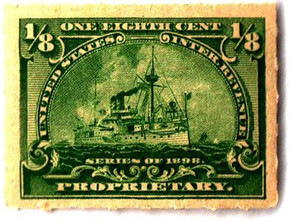
1898 5/8c Battleship, Proprietary Revenue Stamp, Deep Ultramarine, Rouletted 5.5
$0.75
Share:
Beginning in 1895, Cuba fought a war of independence from Spain, and tensions in the region escalated sharply when the United States sent the battleship USS Maine to Havana Harbor in January 1898 to protect American citizens and interests. On February 15, 1898, just three weeks after its arrival, the Maine exploded, killing 266 crew members. The rallying cry "Remember the Maine" helped push the United States into war with Spain that April, a conflict that lasted less than four months but marked the end of the Spanish Empire and the emergence of the United States as a major world power.
To help fund the war effort, Congress passed the War Revenue Act of 1898, reviving the practice of documentary and proprietary stamp taxes the government had first used during the Civil War decades earlier. This five eighths cent stamp was part of a new series of proprietary revenue stamps, required on so-called proprietary articles, branded consumer goods of the era such as patent medicines sold under a trademarked name. The 1898 law set a graduated tax scale based on a product's retail price, charging five eighths of a cent on items selling between fifteen and twenty five cents, with an additional five eighths cent owed for every further twenty five cents in price, resulting in the unusual fractional denominations that make this series distinctive among American revenue stamps.
The stamp's design features a United States battleship, a fitting and patriotic image given the naval tragedy that had helped spark the war just months before the stamp's release. Many surviving examples carry distinctive printed cancellations applied directly by the pharmaceutical companies and manufacturers that used them, with collectors having documented cancels from more than a hundred different businesses of the era.
Beginning in 1895, Cuba fought a war of independence from Spain, and tensions in the region escalated sharply when the United States sent the battleship USS Maine to Havana Harbor in January 1898 to protect American citizens and interests. On February 15, 1898, just three weeks after its arrival, the Maine exploded, killing 266 crew members. The rallying cry "Remember the Maine" helped push the United States into war with Spain that April, a conflict that lasted less than four months but marked the end of the Spanish Empire and the emergence of the United States as a major world power.
To help fund the war effort, Congress passed the War Revenue Act of 1898, reviving the practice of documentary and proprietary stamp taxes the government had first used during the Civil War decades earlier. This five eighths cent stamp was part of a new series of proprietary revenue stamps, required on so-called proprietary articles, branded consumer goods of the era such as patent medicines sold under a trademarked name. The 1898 law set a graduated tax scale based on a product's retail price, charging five eighths of a cent on items selling between fifteen and twenty five cents, with an additional five eighths cent owed for every further twenty five cents in price, resulting in the unusual fractional denominations that make this series distinctive among American revenue stamps.
The stamp's design features a United States battleship, a fitting and patriotic image given the naval tragedy that had helped spark the war just months before the stamp's release. Many surviving examples carry distinctive printed cancellations applied directly by the pharmaceutical companies and manufacturers that used them, with collectors having documented cancels from more than a hundred different businesses of the era.
Related Items




Most Orders Ship
within 1 Business Day
90 Day Return Policy
Satisfaction Guaranteed
Earn Reward Points
for FREE Stamps & More