This 5-cent private die playing card revenue stamp was issued by Victor E. Mauger & Petrie, the New York firm that Victor Eugene Mauger operated with his partner John Petrie. Mauger was born in England and arrived in New York in 1855, initially building a business importing metal goods and stationery. By 1867 he was importing playing cards from Charles Goodall & Son of London, one of England's leading manufacturers, and selling them into the American market. When high import duties made that arrangement uneconomical, Mauger pivoted and began manufacturing his own cards in 1873, quickly establishing himself as a serious competitor in the New York trade.
Mauger's 1876 Centennial Exposition deck, produced to commemorate both the Philadelphia world's fair and the 100th anniversary of the Declaration of Independence, is considered by playing card historians to be the first deck ever created to commemorate a world's fair. It featured four-color pips and indices in all four corners, a design innovation Mauger called Quadruplicates, and the Ace of Spades bore the Latin motto Nunquam Retrorsum, meaning Never Retreat. The firm Victor E. Mauger & Petrie reflected his partnership years, during which the company expanded into an extraordinary range of products alongside playing cards, including imported wines, patent medicines, and an infant food product called Victor Baby Food.
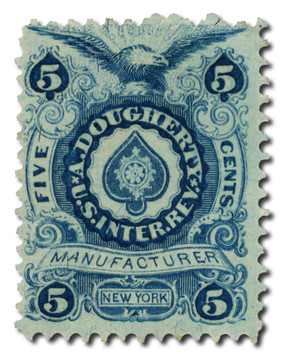
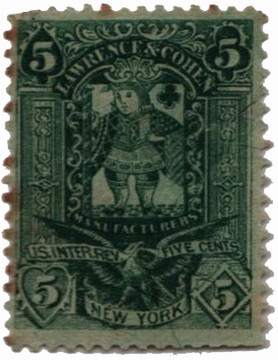
The stamp design for this issue is among the most elaborate in the playing card revenue series. Actual playing cards fan out across the face of the stamp, with a king of clubs visible at upper right, and the firm's intertwined monogram appears on a spade at the center. The design functions almost as a miniature advertisement for the product it taxed, placing the playing cards themselves front and center. Mauger sold the playing card business in 1878, the same period in which this double line watermark variety was issued, making this stamp one of the last artifacts of his time as an independent manufacturer.
This 5-cent private die playing card revenue stamp was issued by Victor E. Mauger & Petrie, the New York firm that Victor Eugene Mauger operated with his partner John Petrie. Mauger was born in England and arrived in New York in 1855, initially building a business importing metal goods and stationery. By 1867 he was importing playing cards from Charles Goodall & Son of London, one of England's leading manufacturers, and selling them into the American market. When high import duties made that arrangement uneconomical, Mauger pivoted and began manufacturing his own cards in 1873, quickly establishing himself as a serious competitor in the New York trade.
Mauger's 1876 Centennial Exposition deck, produced to commemorate both the Philadelphia world's fair and the 100th anniversary of the Declaration of Independence, is considered by playing card historians to be the first deck ever created to commemorate a world's fair. It featured four-color pips and indices in all four corners, a design innovation Mauger called Quadruplicates, and the Ace of Spades bore the Latin motto Nunquam Retrorsum, meaning Never Retreat. The firm Victor E. Mauger & Petrie reflected his partnership years, during which the company expanded into an extraordinary range of products alongside playing cards, including imported wines, patent medicines, and an infant food product called Victor Baby Food.
The stamp design for this issue is among the most elaborate in the playing card revenue series. Actual playing cards fan out across the face of the stamp, with a king of clubs visible at upper right, and the firm's intertwined monogram appears on a spade at the center. The design functions almost as a miniature advertisement for the product it taxed, placing the playing cards themselves front and center. Mauger sold the playing card business in 1878, the same period in which this double line watermark variety was issued, making this stamp one of the last artifacts of his time as an independent manufacturer.